In anticipation of our upcoming visit to Colombo, Sri Lanka, we did a little background research. What an interesting history to explore in this port city and island country.

Evening View of Beira Lake and Colombo, Sri Lanka. Photo by Arvindkumarn.
Here are 20 Fun Facts About Colombo, Sri Lanka
1. Colombo is the largest city of the island country of Sri Lanka in the northern Indian Ocean off the southern Coast of India. Sri Lanka was formerly known as Ceylon until 1972.
2. Since ancient times, Sri Lanka was known for its cinnamon. The country still produces 80 to 90 percent of the world supply of C.verum cinnamon.

Cinnamomum Verum and Ciccamomum Aromaticum sticks side by side. The cinnamon of Sri Lanka is on the left. Photo by Antti Vähä-Sipilä
3. With its cinnamon supply and a large, deep natural harbor strategically positioned along East-West trade routes, Colombo was known to and valued by Indian, Greeks, Persians, Romans, Arabs, and Chinese traders more than 2,000 years ago.
4. Muslim Moor traders began to settle in Colombo in the 8th century AD, drawn because the port facilitated their trading business between the local Sinhalese kingdoms and the outside world. Today, their descendants make up the local Sri Lankan Moor community.
5. Portuguese explorers first arrived in Sri Lanka in 1505, striking a treaty with the King that allowed them to trade the islands’ crop of cinnamon, which lay along the coastal areas of the island, including in Colombo.
6. The Portuguese were given full authority over the coastline in exchange for promising to protect it against invaders. The Portuguese soon established a trading post in Colombo, built a fort in 1517 and expelled the Muslim inhabitants.
7. By 1593, the Portuguese established complete control over the coastal area, with Colombo as their capital. Today, this part of Colombo is still known as Fort and houses the presidential palace and the majority of Colombo’s top hotels.
8. In 1638 the Dutch signed a treaty with King Rajasinha II of Kandy giving the king assistance in his war against the Portuguese in exchange for a monopoly of the island’s major trade goods.
9. The Portuguese resisted the Dutch but were gradually defeated in their strongholds. After an epic siege in 1656, the Dutch captured Colombo.

Copper engraving, ‘De Stadt Colombe’ (The Town of Colombo), from Dutch book c. 1775, after original engraving by Johannes Kip of c. 1680
10. Initially, the Dutch gave the captured area back to the Sinhalese kings, but later reneged and took control over the island’s richest cinnamon lands including Colombo. Colombo was named the capital of Dutch Ceylon under the control of the Dutch East India Company.
11. In 1796, the British captured Colombo, keeping it as a British military outpost until 1815 when Colombo was named the capital of the newly-created British Ceylon crown colony.
12. The British began constructing houses and other civilian structures around the fort, creating the basis the current-day city of Colombo.
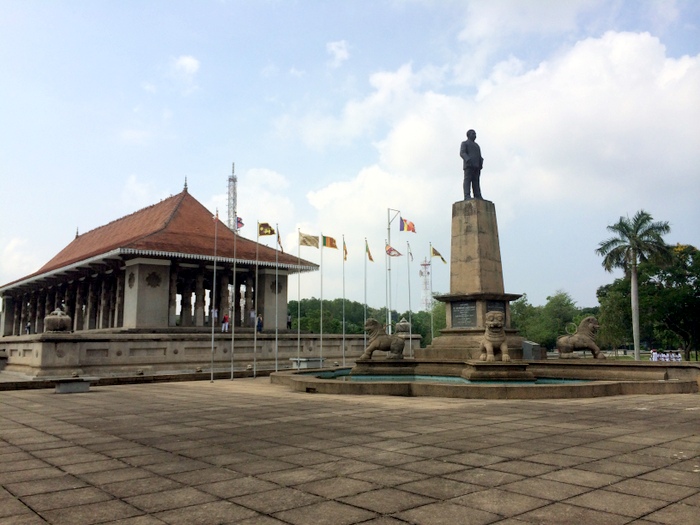
13. Ceylon gained independence from Britain in 1948, ushering in a new culture along with changes in laws, customs, clothing styles, religions and family names.
14. The 160-acre Lake Beira is in the center Colombo. During the Portuguese, Dutch and British colonial eras, Lake Beira was used to transport goods within the city and surrounding towns through many intricate canals.

The Galle Face Green promenade runs between the Indian Ocean and the financial and business districts of Colombo, Sri Lanka. Photo by Mayakaru.
15. When Englishman Sir Henry Ward created the Galle Face Green promenade in 1859, it was also used for horse racing and as a golf course. Today’s smaller Galle Face Green is attached to Sri Lanka’s first five-star hotel – the Ceylon Inter-Continental — and as well as the countries’ oldest hotel — the Galle Face Hotel known as Asia’s Emerald on the Green since 1864.
16. The two World Trade Center towers – completed in 1997 – are most recognized landmarks of the city.
17. St. Paul’s Church Milagiriya, one of the oldest churches in Sri Lanka, first built by the Portuguese and re-built by the British in 1848.
18. Cricket is most popular sport in Sri Lanka and is played in parks, playgrounds, beaches and the streets of Colombo. The country won the 1996 Cricket World Cup and placed second in 2007 and 2011.

The Nelum Pokuna Mahinda Rajapaksa Theater in Colombo. Photo by Dhammikah.
19. Opened in December, 2011, the Nelum Pokuna Mahinda Rajapaksa Theater was designed to reflect a Lotus Pond in Polonnaruwa, the royal ancient city of in central Sri Lanka.


20. Sri Lanka’s Ceylon tea is world famous, but in the 1860s Sri Lanka was the world’s biggest coffee producer. Only after a deadly disease stuck the coffee plantations did the British colonists convert them to tea.
During our visit, we hope to check out some of the spots profiled in this New York Times 36 Hours in Colombo, Sri Lanka piece.
Learn more about Sri Lanka with these resources:


Have you visited Colombo, Sri Lanka? What “˜fun fact’ can you add to this list?
Interact with us on Twitter, Facebook, Pinterest or Instagram.
If you enjoy history and interesting facts about far-flung destinations, check out these other Fun Facts posts: