
Juneau, Alaska’s capital city is located on the Gastineau Channel in the southeast part of the state between the Gulf of Alaska and British Columbia.
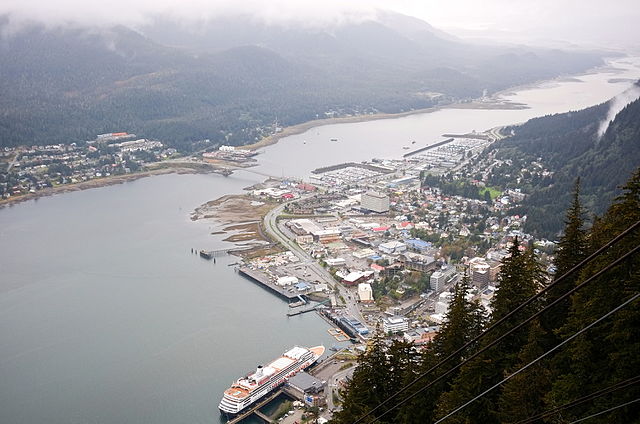
The heart of Juneau, a city of 32,406 residents, lies between the ocean and ice-covered mountains. Downtown Juneau sits at sea level below mountain peaks reaching up to 4,000 feet. These mountains are topped by the Juneau Icefield, a 1,500-mile ice mass that feeds more than 30 glaciers including the 13-mile long Mendenhall Glacier that ends in Mendenhall Lake just outside of Juneau.
20 Interesting Facts about Juneau, Alaska
1. The Auke and Tuku tribes of native Tlingit Indians fished along the Gastineau Channel near Juneau for thousands of years before Europeans explored Alaska.
2. In 1880, local Tlingit Chief Kowee led prospectors Joe Juneau and Richard Harris to Silver Bow Basin, where they discovered gold nuggets “as large as beans” at the mouth on a stream they called Gold Creek. This find was the first major Alaskan gold discovery.
3. On October 18, 1880, Juneau and Harris marked a 160-acre town site where soon a mining camp appeared. Acting as recorder, Mr. Harris named the new mining district Harrisburgh after his own name.
4. Upon learning of the gold discovery, the U.S. Navy sent a detachment under the command of Lt. Com. Charles Rockwell to keep order 30 miners arrived by Christmas of 1880. At one of the first town meetings in February 1881, the residents decided there were too many other American cities called Harrisburgh, and changed the town name to Rockwell in honor of the Navy commander.
5. In late 1881, the miners met again and renamed the town Juneau, after Joe Juneau, who was rumored to have bought more drinks for those voting on the city name.
6. Across Gastineau Channel in the community of Douglas (now a part of Juneau) the Treadwell and Ready Bullion mines operated from 1882 to 1917, producing $66 million in gold in its 35 years of operation.
7. In 1916, the Alaska-Juneau gold mine was built on the mainland and became the largest operation of its kind in the world. The Alaska-Juneau (A-J) mine produced more than $80 million in gold before it was closed in 1944 during World War II.
8. In 1906, the capital of the District of Alaska was moved to Juneau from Sitka. The move of the capital city followed the gold-rush fueled growth of Juneau combined with the decline in whaling and fur trade that had given Sitka its earlier economic prominence.

9. In 1911, the United States Congress authorized funds for an Alaska Territory capitol building; World War I, however, delayed construction until September 8, 1929. The Art Deco building was dedicated on February 14, 1931, and became the state capital in 1958 when Alaska gained statehood.
10. A 14,400 sq. Alaska Governor’s Mansion was completed in Juneau in 1912. The governor resides on the second floor of the 6-bedroom, 10-bathroom and 8-fireplace mansion when he or she is in Juneau for official business.
11. Juneau is the only U.S. state capital to border another country (Juneau shares its eastern border with the Canadian province of British Columbia.)
12. While Juneau is located on the Alaska mainland, there are no roads that connect the city to the rest of Alaska or North America due to the rugged terrain that surrounds it. All goods arrive and depart by plane or boat. Cars arrive to Juneau via the Alaska Marine Highway Ferry System — the floating roadway for Southeast Alaska.
13. Tourism is a large part of Juneau’s current economy in addition to government and fishing. Nearly a million visitors experience Juneau each summer via a cruise ship.
14. Tourists visiting Juneau via a ship is not, however, a recent development. Wealthy travelers first sailed north to sight-see Juneau via monthly voyages on the Ancon and the Idaho by the Pacific Coast Steamship Co. of San Francisco as early as 1881.
15. The Taku River, just south of Juneau, was named after the cold t’aakh wind, which occasionally blows down from the mountains. Juneau residents occasionally experience the Taku winds—which can gust up to 100 miles per hour—between October and March.
16. The State Office Building is affectionately called the “S.O.B.” by locals. Visitors should check out the restored pipe organ, totem pole and eight-floor observation deck with great views of Juneau and Gastineau Channel.

17. The Mount Roberts Tramway whisks visitors up nearly 2,000 feet from Juneau’s waterfront to the mountaintop in just six minutes, providing both a stunning view and access to hiking trails.
18. Juneau has more than 130 miles of hiking trails.
19. About 20,000 bald eagles reside in Juneau.
20. The Aurora Borealis (also known as the Northern Lights) can be seen occasionally on clear evenings between late August and April, usually above Mt. Juneau.


Do you want to learn more about Juneau?
Juneau


Do You Know Juneau? A Kid’s Guide To Juneau, Alaska
Are you visiting Juneau via a cruise ship? This is a good guide for all of your Alaska ports:
National Geographic Traveler: Coastal Alaska: Ports of Call and Beyond
Check out these “Fun Facts” posts on Alaska destinations:
- 17 Fun Facts About Kodiak, Alaska
- 12 Fun Facts About Dutch Harbor, Alaska
- Visiting Alaska? 22 Fun Facts You Might Want to Know
- 21 Fun Facts About Ketchikan, Alaska
- 28 Fun Facts About Anchorage, Alaska
Other posts on cruising Alaska:
- Experiencing the Rainforest Canopy & Zipline in Ketchikan, Alaska
- 10 Tips on What to Pack
- Packing Advice for a 2-Week Land+Cruise Tour to Alaska
- Glacier Bay, National Park and Preserve, Southeast Alaska
- Spectacular Do-It-Yourself Port Day in Haines, Alaska
Follow us on Twitter or interact with us on Facebook
Or, check out our boards on Pinterest and/or our photos on Instagram.