While we’ve visited Phoenix, Arizona many times, we’ve never done background research on the city that we find makes a visit more interesting.
Prior to a visit this weekend, we gathered some interesting tidbits about Arizona’s largest city.
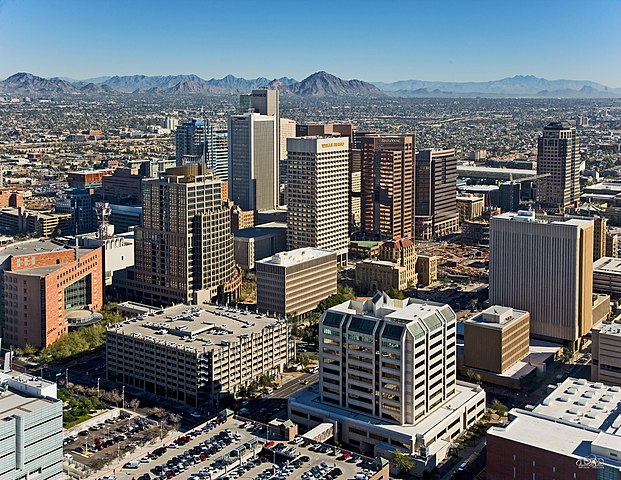
Downtown Phoenix, Arizona with view of Camelback Mountain in the background. Photo by DPPed.
42 Fun Facts about Phoenix, Arizona
1. The land that would become the city of Phoenix was first inhabited by the Hohokam people around 700 AD. The Hohokam created 135 miles irrigation canals allowing the cultivation of crops in the desert climate.
2. The Hohokam later abandoned the area; their departure thought to be caused by floods and drought between 1300 -1450 AD.

Jack Swilling
3. In 1867 a man named Jack Swilling was traveling through the Salt River Valley and saw a potential for farming. He formed a small community near the confluence of the Salt and Gila Rivers.

“Lord” Phillip Darrel Duppa
4. Seeing the remains of the Hohokam’s prehistoric irrigation canals, one of the settlers in Swilling’s party — Englishman “Lord” Phillip Darrell Duppa — suggested the name “Phoenix”, as it described a city born from the ruins of a former civilization.
5. When Phoenix became an incorporated city on February 25, 1881, it was home to approximately 2,500 people.
6. By 2017, Phoenix has grown to become the fifth-largest city in the United States with a population of 1,626,078 people.
7. The Phoenix metropolitan area, also known as the Valley of the Sun, is home to approximately 4.73 million people as of 2017.

Aerial lithograph of Phoenix from 1885
8. Phoenix became the capital of Arizona Territory in 1889.
9. On February 14, 1912 Phoenix became a U.S. state capitol when Arizona was admitted to the Union as the 48th state.
10. Today, Phoenix is the only capital city in the United States with a population of more than 1 million residents.
11. The sun shines on Phoenix during 85 percent of its daylight hours, more often than any other major metropolitan area in the U.S.
12. Phoenix has an average annual rainfall of 8.04 inches.
13. Despite its hot desert climate, the irrigation canal system in Phoenix allowed farming to thrive.
14. Litchfield Park, in Phoenix’s west Valley, was originally founded in 1916 as a cotton farm for the Goodyear Tire & Rubber Company of Akron, Ohio. The company used long-staple Egyptian cotton to strengthen its tires, but needed a domestic source when German U-boats cut off supply ships during WW I. The town is named for Paul Litchfield, the Goodyear Tire executive who established the Arizona cotton farm community.


15. The “Five C’s — cotton, cattle, citrus, climate, and copper –were the primary drivers of Phoenix’s economy until after World War II, when air conditioning became more prevalent and technology companies relocated to the area to take advantage of the strong supply of post-war military talent.
16. The Arizona Biltmore hotel –first opened to guests in 1929 – was designed by architect Albert Chase McArthur –a former student of Frank Lloyd Wright. Wright served as consulting architect for relating to the “Textile Block” construction the hotel, and the Frank Lloyd Wright “style” shows throughout the resort’s design.
17. In 1930, Chicago chewing gum magnate William Wrigley, Jr. became the sole owner of the Arizona Biltmore. Wrigley built the resort’s first swimming pool.


The historic Catalina Pool at the Arizona Biltmore Hotel. Photo by Marine 69-71.
18. The Biltmore’s historic “Catalina Pool” is allegedly both Marilyn Monroe’s favorite pool, and the location where composer Irving Berlin penned the holiday melody, White Christmas.


20. Greater Phoenix sits within the Sonoran Desert –one of the few native habits for the saguaro cactus – a type of cactus can grow more than 40 feet tall and live more than 150 years.

Saguaro Cactus
21. The saguaro can take 50 to 100 years to grow its “arms.”
22. Harming a saguaro cactus is illegal in Arizona. Cutting down a saguaro without a permit — even on your own property — is considered a class four felony with a possible three-year, nine-month jail sentence.
23. Phoenix landmark Camelback Mountain –which rises to 2,704 feet above sea — level resembles the hump and head of a kneeling camel. Most of Camelback Mountain falls within Phoenix city limits.
24. Phoenix is hot. The temperature in Phoenix reaches or exceeds 100°F an average of 110 days during the year, including most days from late May through early September.
25. Phoenix averages only five days per year where the temperature drops below freezing.
26. The hottest temperature ever recorded in Phoenix was 122 degrees Fahrenheit at Sky Harbor International Airport on June 26, 1990.


28. Actress Jennie Garth of Beverly Hills, 90210


29. Scenes from the 2017 movie Transformers: The Last Knight

30. Only about three percent of Phoenix homes have basements. The reason: parts of the Phoenix Valley have soil called Caliche that is so hard you can actually see sparks fly off your shovel if you try to dig into it.
31. More than 40 million passengers fly through Phoenix Sky Harbor International Airport each year, making it one of the 10 busiest airports in the United States.

The BMO Tower in Phoenix was constructed in 1991 for the Dial Corporation. It was designed to resemble a bar of Dial soap.
32. The BMO Tower — a high-rise on Central Avenue in Midtown Phoenix –was originally built in 1991 for the Dial Corporation. The building’s shape was designed to resemble bar of Dial soap.
33. Central Ave. in Midtown Phoenix is also home to the “Punch Card Building” that is part of the Phoenix Financial Center complex built in 1963.

The “Punch Card Building” in Midtown, Phoenix. Photo by Ixnayonthetimmay.
The high-rise building gets its nicknamed due the building’s southern façade resemblance to a computer punch card.


35. The Silver Pony–a cash-only dive bar in Phoenix — offers a hitching post where you can tie up your horse (that you rode in on) while you drink and enjoy the music. It is located just 6 miles south of downtown at 620 W. Dobbins Rd.
36. Opened in 1962, the 125-acre Phoenix Zoo is the largest privately owned, non-profit zoo in the United States with more than 1,400 animals and 2.5 miles of walking trails. The zoo was founded by Robert Maytag of the Maytag appliance family.
37. Phoenix is home to the largest municipal park in North America. The South Mountain Park and Preserve covers 16,500 acres and offers 50 miles of hiking, biking and equestrian trails.
38. Phoenix is one of only a few U.S. cities with four major professional sports leagues: the Phoenix Suns (NBA), the Arizona Diamondbacks (MLB), the Arizona Cardinals (NFL) and the Arizona Coyotes (NHL).
39. Every spring the Cactus League comes to town when 15 Major League Baseball teams conduct spring training in the greater Phoenix area, drawing nearly 1.9 million fans.
40. Arizona State University (commonly known as ASU) is a public research university on four campuses across the Phoenix metropolitan area.

41. The Musical Instrument Museum showcases music of cultures from around the world, with more than 6,500 musical instruments and objects on display.
42. Although daylight savings time begins in the U.S. this Sunday, Phoenix and most of Arizona won’t “fall forward.” In 1973, Gov. Jack Williams argued against implementing daylight savings time in Arizona, saying the change would increase energy use and force children to go to school in the dark.
What fun fact about Phoenix can you add to this list?
Share your thoughts with us via Twitter, Facebook, Pinterest or Instagram.
Learn more about Phoenix, Arizona with these books:


 Phoenix, Arizona: A Photographic Portrait

 Phoenix Travel Guide 2019: Shops, Restaurants, Arts, Entertainment and Nightlife in Phoenix, Arizona (City Travel Guide 2019).