
Ceuta is a Spanish city that’s located on the north coast of Africa.
An enclave, Ceutu shares a four-mile land border with Morocco but is separated nine miles from mainland Spain by the Strait of Gibraltar.

While only 7 sq. miles in size, Ceuta’s strategic location on the narrow isthmus between the Atlantic Ocean and the Mediterranean Sea has made it a desirable location worth fighting over since the time of ancient Phoenicians.
The Carthaginians controlled Ceutu, followed by the Romans and Visigoths until the area came under Arab control. Then, in 1415, Portugal occupied the area before ceding it to Spain in 1668.
Since 1995, Ceuta is, along with Melilla, one of the two autonomous cities of Spain.
Ceuta is part of the European Union, and the Euro is its official currency.
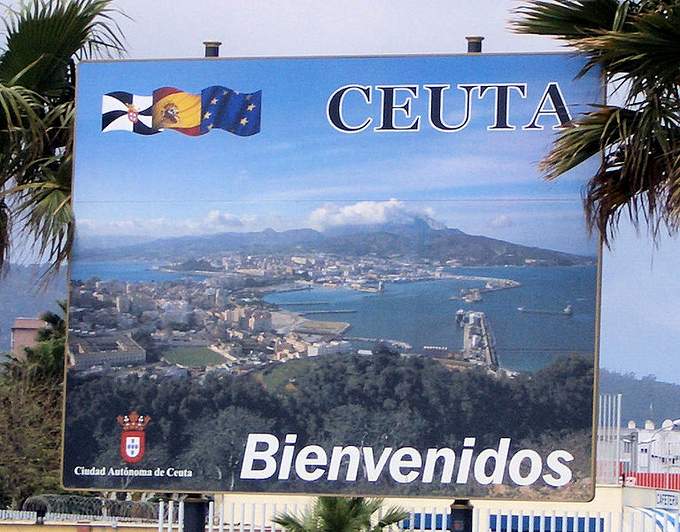
Formerly a free port, Ceuta is now part of a special low tax zone within Spain and the European Union.
The population of Ceuta — approximately 82,000 people — includes a diverse mix of religions — including Christians, Muslims, Sephardic Jews and ethnic Sindhi Hindus.
Spanish is the official language of Ceutu. Many residents also speak Darija Arabic (Moroccan Arabic). French and Berber are also spoken.

Evidence of the Phoenician era in Ceuta — dating back to the 7th Century BC — may be viewed at an archaeological site next to the Cathedral of Ceuta.

The city of Ceuta has always been a navy port with fortifications. Parts of the still-intact Royal Walls of Ceuta date to 962.

Benzú is a small settlement within the city of Ceuta, near the border with Morocco.

Benzu offers a great view of Jebel Musa — a mountain in the northernmost part of Morocco known as “The Dead Woman” because it resembles a woman on her back.
Cars and pedestrians to travel between Morocco and Ceuta via a single border road checkpoint to the south of Ceuta. A second border crossing for pedestrians only also exists between Benzú and Belyounech on Ceuta’s northern coast.
Enticed by Ceuta’s low tax status, numerous products are smuggled into Morocco through Port of Ceuta by “porters” crossing the border with personal luggage.

Besides the two checkpoints, the rest of the border between Ceuta and Morocco is closed, surrounded by 20 ft high double fences.

The current flag of Ceuta dates back to August, 1415 when the King of Portugal and his sons led a surprise attack on the city, resulting in the Conquest of Ceutu. To announce their victory, the Portuguese hoisted a flag identical to the flag of Lisbon, with the coat of arms of the Kingdom of Portugal added to the center.

On a corner of Kings Square in Ceuta there’s an extraordinary example of eclectic architecture: the Casa de los Dragones or House of the Dragons. Designed by Valencian architect José M. Cortina Pérez, the distinctive building with four bronze dragons was completed in 1905. It was commissioned by the Mayor of Ceuta — Francisco Cerni González — and his brother Ricardo.
Ceutan Lorena Miranda Dorado won a silver medal at the 2012 Summer Olympics as a member of Spain women’s water polo team.
During 2019, six cruise ships are scheduled to call at the Port of Ceuta. The ms Prinsendam is scheduled for April 15th, while the Sapphire Princess will make two calls in August.
Learn more about Ceuta with this guide:

 Ceuta Mini Guide
Have you visited Ceuta, Spain? What was the highlight of your visit?
Share your thoughts with with us via Twitter, Facebook, Pinterest or Instagram.