After spending way too many hours going down internet rabbit holes while researching Why We Had to Drive Through Iowa to Get to the Omaha, Nebraska Airport, I discovered an overabundance of intriguing tidbits about the city of Omaha, Nebraska.
99 Interesting Facts About Omaha, Nebraska
1. Located on the Missouri River on the eastern edge of the state of Nebraska, the city of Omaha has played a major role in the movement of people and goods from the east to the western part of the United States.
2. In 2020, the city of Omaha has 470,702 residents, making it the state of Nebraska’s most populated city. In addition, 1.3 million people live within a 50-mile radius of downtown Omaha, including 62,421 people living across the Missouri River in Council Bluffs, Iowa.
3. Long before the Europeans arrived, bison roamed the prairie and semi-nomadic tribes of Native Americans including the Pawnee, Otoe, Sioux, and Ioway all variously occupied the land that makes up the city of Omaha today.

4. By the early 18th century, the Omaha tribe from the lower Ohio valley arrived in the area. Translated, the word “Omaha” (actually U-Mo’n-Ho’n) means “dwellers on the bluff.”
5. In 1803, the Omaha area was part of the Louisiana Purchase — 828,000 square miles of territory that the United States bought from France. Most of this land was inhabited by Native Americans; what the United States really got from the purchase was the “preemptive” right to obtain Native American lands by treaty or by conquest.
6. In 1854, a treaty was negotiated with Logan Fontenelle and the Omaha Tribe to sell four million acres of their tribal land to the United States for less than 22 cents an acre. This allowed the settlement of Nebraska Territory and the founding of Omaha City.

7. On May 30, 1854 Nebraska Territory was organized under the Nebraska-Kansas Act, based on the condition that it remain slave-free.

8. The first session of the Nebraska Territorial Legislature convened at Omaha in 1855; acting Governor Cuming approved the bill locating the territorial seat of government at Omaha. Later, in 1867 — when Nebraska became a state — its capital was relocated to Lincoln, 53 miles south-west of Omaha.
9. In 1857, the city of Omaha was incorporated and had its first City Council meeting.
10. On July 1, 1862, President Lincoln signed the Pacific Railway Act, authorizing two companies to build a transcontinental railroad to: Central Pacific, an existing California railroad, and Union Pacific, a new railroad chartered by the Act.
11. Central Pacific would start at the Pacific Ocean and head east, and while Union Pacific would start in Omaha — at beginning of the undeveloped frontier — and head west.
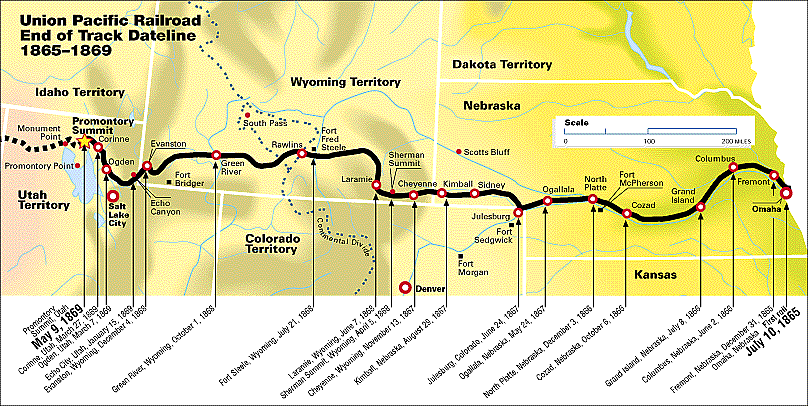
12. Union Pacific broke ground in Omaha in December, 1863. Due to many delays –the U.S. Civil War was raging–the first rails were not laid until July 1865, three months after President Lincoln’s death.
13. The Union Pacific Railroad built 1,085 miles of track westward from Omaha to Promontory Summit, Utah, where — on May 10, 1869 –it was connected to the Central Pacific Railroad.

14. The First Transcontinental Railroad provided an essential development boom for Omaha, particularly after the city’s first railroad bridge over the Missouri River to Council Bluff, Iowa opened on March 27, 1872. This bridge connected the First Transcontinental Railroad to the eastern United States, without the train’s cars having to be ferried across the Missouri River.

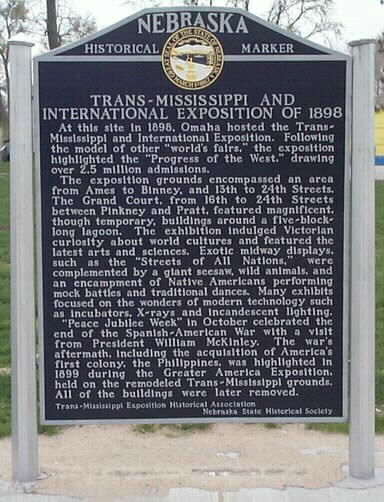
15. Another boom for Omaha occurred in 1898 when the city hosted a massive, five month-long world’s fair called the Trans-Mississippi and International Exposition.

16. Designed to showcase the development of the West from the Mississippi River to the Pacific Coast, the Trans-Mississippi Expo covered 180-acres in North Omaha. There was a 2,000 feet lagoon encircled by 21 classical buildings housing nearly 5000 exhibits from around the world.
17. More than 2.6 million people attended the Expo in Omaha, including President William McKinley and Buffalo Bill Cody with his Wild West Show.
18. The Indian Congress — held in conjunction with the Trans-Mississippi Expo in Omaha –took place August 4 to October 31, 1898. More than 500 American Indians representing 35 different tribes from across the United States attended.

19. Commissioned to photograph the 1898 Indian Congress and the Trans-Mississippi Expo, Omaha-based photographer Frank A. Rinehart became famous for his photos capturing Native American personalities, especially the portrait settings he took of leaders and members of the delegations attending the 1898 Indian Congress in Omaha. The collection of Rinehart Indian Photographs is currently preserved at Haskell Indian Nations University in Lawrence, Kansas.
20. In 1859, German immigrant Frederick Krug established Omaha’s first brewery with an output of one and a half barrels a day. By 1880 Krug Brewery was producing 25,000 barrels a year. Krug supported an amateur baseball team called Luxus –named after one of the company’s beer brands. The team made it to the Amateur Baseball World Championship in 1915.
21. Soon Omaha had more breweries. Frederick and Philip Metz founded the Metz Brothers Brewing Company in 1861. Gottlieb Storz purchased the brewery where he worked, renaming it Storz Brewery in 1884. Willow Springs Distilling Company relocated to Omaha in 1866. These were Omaha’s “Big 4” brewers — which grew dramatically as the city grew, until 1919 when Prohibition stopped production of alcoholic beverages in the U.S.
22. In 1882, Alexander Swan, a Wyoming rancher, urged Omaha business leaders to create a stockyard, pointing out that shipping his cattle the additional 500 miles to Chicago caused them to lose weight and lowered his profits.

 Alex Swan and the Swan Companies
23. Swan was convincing, and 1884 a group of investors opened the Union Stockyards on ten acres in South Omaha. Meatpackers, starting with G. H. Hammond in 1885, began building processing plants adjacent to the yards; and the Omaha stockyards grew quickly.
24. In 1886 the Livestock Exchange building opened, and more meatpacking companies set up shop, including the Fowler Brothers in 1886 and Armour-Cudahy and Swift in 1887.
25. Omaha was said to be the fastest-growing city in the United States during the 1880s, with thousands of immigrants from central and southern Europe coming to Omaha to work in the Union Stockyards and the meat packing industry in South Omaha.
26. These immigrants created Omaha’s original ethnic neighborhoods, with names such as Sheelytown, Greek Town, Little Italy, Little Bohemia and Little Poland. Meanwhile, Germans, Jewish immigrants and the first groups of African Americans developed communities on Omaha’s Near North Side.
27. By the 1920s, the “Big Four” major meatpackers – Swift, Armour, Cudahy, and Wilson — were all operating in Omaha with a near monopoly on beef production.

28. Before World War II, Omaha meatpackers had successfully resisted union efforts to organize their workers. But in 1948, Omaha workers joined in a national strike against the Big Four, leading to a twenty-year struggle in Omaha between management and labor.
29. A postwar hunger for beef drove the growth. In 1949 the average American was consuming 144 pounds of meat per year, which increased to 160 pounds by 1950.
30. In 1956, Omaha eclipsed Chicago as the largest meat producing city in the world. The stockyards ran 24 hours per day 7 days a week, sometimes processing more than 50,000 animals in a day.
31. By 1957, half of Omaha’s workforce was employed by the livestock industry – – including the stockyards, 19 different meatpacking companies, 40 commission firms, a special railroad just for livestock, and other related companies. On any given market day, more than $2.5 million dollars’ worth of livestock was handled in Omaha – roughly $18 million in today’s dollars.
32. While meatpacking was integral to Omaha’s 20th century growth and prosperity, the industry became ripe for disruption.
33. In 1961 Iowa Beef Packers (IBP), opened a single beef processing plant in Denison, Iowa, a small town near cattle producers. The idea was to open packing plants close to livestock producers, and buy directly from them, eliminating the need for a stockyard. Processing cattle closer to where they were raised shortened transportation time and reduced shrinkage. Plus, IBP could cut labor costs by hiring local non-unionized workers. This new trend was the beginning of the end for the Omaha Stockyards.
34. By 1975, Omaha’s once bustling stockyards and packing plants — that only twenty years earlier had been the largest in the world — were all but gone.
In 1973 the Union Stock Yards Company of Omaha was sold to New York investment group Canal Capital; in 1989 it was sold again to the United Marketing Services. The facilities fell into disrepair.
In 1996 the City of Omaha bought 50 acres of land for an office park, and condemned the rest of the facilities, except the Livestock Exchange Building, which was slated for renovation.
In 1999 the Union Stockyards were closed by the City of Omaha, and replaced with a business park.

Luckily, the city of Omaha persevered.
Click here to continue to Part 2 of 99 Interesting Facts to Know About Omaha, Nebraska.
Have you visited Omaha? Which of these facts surprised you?
Please share your comments or questions via Twitter, Facebook, Pinterest or Instagram.