Brest is a port city in Brittany, in the far northwestern part of France, on the western edge of continental Europe.
The ms Nieuw Statendam, one of Holland America Line’s newest ships, is scheduled for a port call in Brest on April 28, 2021, as part of the 14-Day Azores & Normandy cruise sailing from Ft. Lauderdale, Florida to Amsterdam.
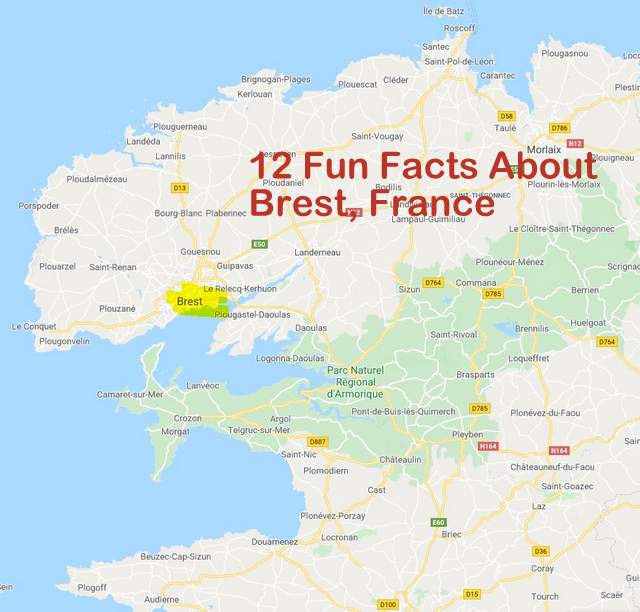
Situated to the north of a landlocked bay, the city of Brest, France is divided by the Penfeld River. The part of the town on the left bank is regarded as Brest proper, while the part on the right is known as the Recouvrance neighborhood.
With a population of 140,000 residents, the city of Brest is known for its maritime history and naval base.
12 Fun Facts About Brest, France
1. The name of the Brest is first recorded as Bresta; it may derive from “brigs“– a Celtic word for “hill.”2. Brest is a city of hills. The hillsides are so steep in some places that the second or third story of one house is level with the ground floor of the house beside it.
3. The Celts, Romans, Saxons, Franks and Normans all settled in Brest over different centuries. In 1491, Brest became a part of the French crown when Claude, the daughter of Anne of Brittany married Francis I of France.

4. The port of Brest is located on the northern edge of “rade de Brest” which is a bay of protected water covering 70 square miles. The Brest Bay is linked to the Atlantic Ocean by the Goulet de Brest, a straight that is a little more than one mile wide.
5. In 1631 Cardinal Richelieu recognized the strength of Brest’s location on the bay and constructed a wooden wharf harbor that later became a base for the French Navy. In 1752 the Académie de Marine (Naval Academy) was founded in Brest.

 WW I American Troops N304Th Field Artillery Disembarking From The USS Leviathan In Brest France May 1918
6. In 1917, during World War I, thousands of “sammies” — (a nickname referring to troops sent by Uncle Sam) — entered France through the port of Brest on their way to the front lines. In February of 1918, the U.S. Navy established a naval air station at Brest to operate seaplanes. It was closed shortly after the November 11, 1918 Armistice.

7. During World War II, the Germans — who occupied Northern France in June 1940 — built and maintained a large U-boat submarine base at Brest, using it against Allied shipping. In 1944, after the Allied invasion of Normandy, the city of Brest was heavily bombed by Allied forces during the Battle for Brest. Only a few buildings were left standing.
8. The Château de Brest — a castle on the eastern bank of the Penfeld River in the heart of the city– was one of the few structures to survive WWII bombing. Today it houses a Maritime Museum dedicated to French naval history over the centuries.

9. The Tour Tanguy — a 14th century tower across the river from the castle — is the only other significant building in Brest that survived World War II. Today this tower houses a museum with a series of diaromas showing what the city of Brest looked like before the Second World War.
10. Today Brest is best known as the home of the France’s second largest naval base — the Brest Arsenal— located on the city’s northern edge. The base houses the Brest Naval Training Center.
11. Brest is home to one of Europe’s largest aquariums — the Oceanopolis Ocean Discovery Park. Divided into three pavilions — tropical, temperate, and polar — with more than 1 million gallons of sea water and 77 aquariums, the Oceanopolis provides an introduction to 1,000 marine species from around the world.
12. Launched in 2016, Le Téléphérique is a 1,500 ft.-long urban cable car built for everyday commuting in Brest. The cable car wisks riders across the Penfeld river in 3 minutes, linking the city center of Brest to the ‘Plateau des Capucins’ area. It is open every day from 7:30 a.m. to 12:30 a.m and can carry up to 1,850 passengers per day.
Learn more about the World War II in Brest, France:

 From Beachhead to Brittany: The 29th Infantry Division at Brest, August-September 1944
Have you been to Brest, France? What fun fact can you add to this list?
One more random fact: Brest has been a sister city with Denver, Colorado since 1948.
Share your comments or questions via Twitter, Facebook, Pinterest or Instagram.