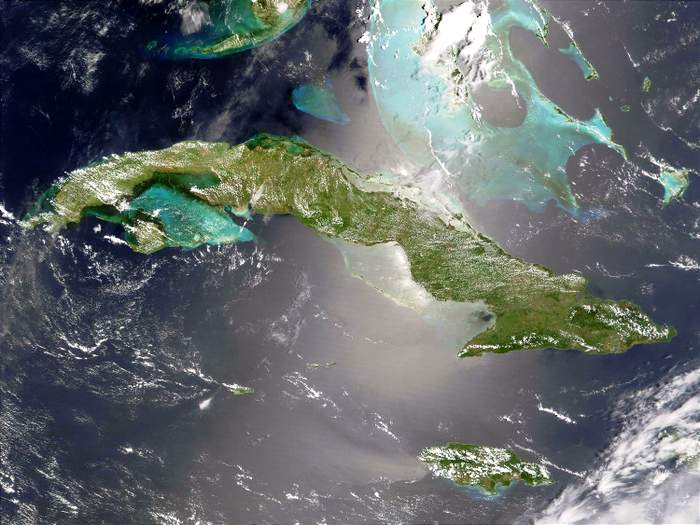
In anticipation of my first visit to Cuba via a fathom cruise, I wanted to learn a little more about the country located only 93 miles from Florida where the Caribbean Sea, the Gulf of Mexico and the Atlantic Ocean meet. My advance research yielded these interesting tidbits on Cuba.
 50 Interesting Facts about Cuba
1. The Republic of Cuba consists on the island of Cuba, Isla de la Juventud (Isle of Youth), and several minor archipelagos.
2. Cuba is often called El Caiman or El Cocodrilo (Spanish for alligator), which is what the island looks like from an aerial view.
 3. By land mass, Cuba is the largest island in the Caribbean, covering an area of 42,426 square miles.
4. With more than 11 million inhabitants, Cuba is the Caribbean’s second-most populous island, and 16th most populated island in the world.
5. Cuba’s original inhabitants were American Indians: the Ciboney (who migrated from the mainland of South America), the Taíno (who arrived from arrived from Hispaniola sometime in the 3rd century A.D.), and the Guanajatabey (who were located in western Cuba when Europeans first arrived.)
6. Christopher Columbus landed on Cuba’s northeastern coast on October 28, 1492 near what is now Bariay in the Holguin province. Columbus claimed the island for the new Kingdom of Spain.
7. The name Cuba is thought to be derived from the Taíno language, and may be translated either as ‘where fertile land is abundant’ (cubao) or ‘great place’ (coabana). Others believe that Christopher Columbus named Cuba for the town of Cuba in Portugal.
8. Diego Velázquez de Cuéllar founded the first Spanish settlement at Baracoa in 1511.
9. San Cristobal de la Habana, which later became Cuba’s capital city of Havana, was founded in 1515. Havana is Cuba’s most populated city.
10. As the island development as Spanish colony, the native population declined rapidly due to disease and harsh conditions during the next century.
11. Large numbers of African slaves were imported to work the coffee and sugar plantations, and Havana became the launching point for the annual treasure fleets bound for Spain from Mexico and Peru.
12. Cuba remained a Spanish colony until 1898, although five different U.S. presidents—Polk, Pierce, Buchanan, Grant, and McKinley—tried to buy the island of Cuba from Spain between 1845 and 1898.
13. President McKinley offered Spain $300 million to buy Cuba just before the United States invaded during the Spanish-American War of 1898,
14. Under the Treaty of Paris following Spain’s defeat in the Spanish-American War, Cuba was granted its independence from Spain, but was controlled by the United States.
15. In January 1899, the U.S. military took control of Cuba as a “protectorate,” ruling the island until 1902.
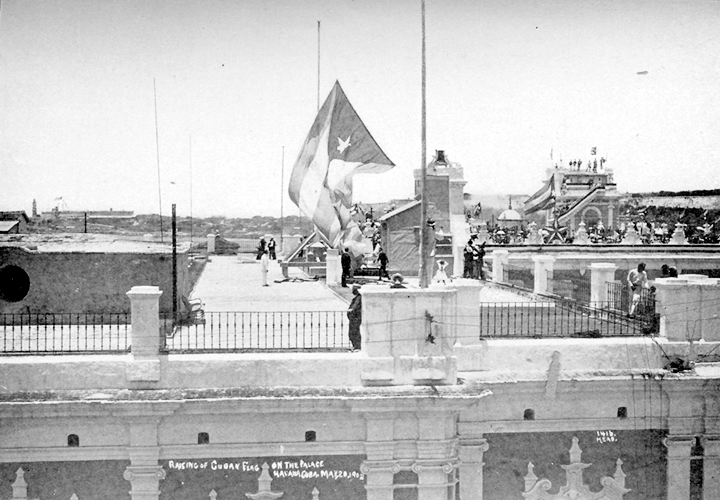
Raising the Cuban flag on the Governor General’s Palace at noon on May 20, 1902.
16. Following three-and-a-half years of U.S. military rule, Cuba gained formal independence from the U.S. on May 20, 1902, as the Republic of Cuba.
17. During the next 57 years, the United States continued a strong influence over Cuba as the country cycled through a string of governments often dominated by the military and/or corrupt politicians.
18. In 1959, Fidel Castro led a rebel army of communist revolutionaries to victory. Fidel’s authoritarian rule of Cuba would continue for almost 50 years until February 2008 when he stepped down due to health complications.
19. In March 1960, U.S. President Eisenhower approved a CIA plan to arm and train a group of Cuban refugees to overthrow the Castro regime. The Bay of Pigs Invasion took place on April 14, 1961. About 1,400 Cuban exiles disembarked at the Bay of Pigs, but failed in their attempt to overthrow Castro.
20. The Cuban Missile Crisis occurred in October 1962. By 1963, Cuba was moving towards a full-fledged Communist system modeled on the USSR.
21. In 1991, Cuba faced a severe economic downturn in the aftermath of the Soviet collapse, causing a withdrawal of Soviet subsidies worth $4-6 billion annually. This time is known in Cuba as the “Special Period”.
22. When Fidel Castro announced his resignation as President of Cuba in 2008, his younger brother, Raúl Castro, was declared the new President. In his inauguration speech, Raúl promised that some of the restrictions on freedom in Cuba would be removed.
23. As a result of efforts begun in December 2014 by President Barack Obama to re-establish diplomatic relations with the Cuban government, the United States and Cuba reopened embassies in their respective countries on 20 July 2015.
24. While the embargo between the United States and Cuba has not been yet lifted, it has been relaxed to allow import, export, and certain commerce within a limit between the two countries.
25. Meanwhile, the Republic of Cuba is one of the world’s last remaining socialist countries following the Marxist-Leninist ideology. The First Secretary of the Communist Party is concurrently the President and Premier of Cuba. Gen. Raul Castro Ruz is both chief of state and the head of Cuba’s government since February, 24, 2008.
26. The President of Cuba serves for five years and there is no limit to the number of terms of office.
27. Cuba’s national legislature, called the National Assembly of People’s Power, has 609 members that serve five-year terms. The assembly meets twice a year; between sessions legislative power is held by the 31 member Council of Ministers. Candidates for the Assembly are approved by public referendum. Cuba’s Communist Party is the only legal party, and officially sanctioned candidates run unopposed.
28. All Cuban citizens age 16 and older who have not been convicted of a criminal offense can vote. The last election was held Feb. 3, 2013 with the next one in 2018.
29. Raúl Castro, current Cuban President, has announced his resignation for 2018 at the end of his current 5-year term.
30. Cuba is divided into 15 provinces and one special municipality (Isla de la Juventud). The provinces are divided into municipalities.
31. Cuba has the highest doctor-to-population ratio in the world and has sent thousands of doctors to more than 40 countries around the world. Cuban physicians played a leading role in combating the Ebola virus epidemic in West Africa.
32. Cuba is renowned for its music. The main musical form is called son, which is a combination of upbeat rhythms with classical guitar.
33. Baseball is Cuba’s most popular sport. Boxing is also an important sport in Cuba with the country producing a number of Olympic champions.
34. Cuba has nine sites on the UNESCO World Heritage list.
35. Bacardi rum was originally manufactured in Cuba. However, the brand moved to Puerto Rico after Fidel Castro’s takeover. Havana Club is the current run of Cuba.
36. A drink of rum and coke and lime is called a “Cuba Libre” in Latin America except in Cuba. There, it’s called a “mentirita,” or “little lie.”
37. In Cuba, it is mandatory for government vehicles to pick up hitchhikers.
38. In 2000, Fidel Castro erected a statue of John Lennon of The Beatles in John Lennon Park in Havana. Castro admired Lennon and believed he was a true music revolutionary.
39. Cigars are called puros or habanos in Cuba. One company makes all the premium brands for the country.
40. Cuba has a 99.8% literacy rate, which is one of the highest in the world.
41. Major seaports in Cuba include: Antilla, Cienfuegos, Guantanamo, Havana, Matanzas, Mariel, Nuevitas Bay and Santiago de Cuba
42. The U.S. Naval Base at Guantanamo Bay is leased to the United States. The lease can be terminated only via mutual agreement or US abandonment of the facility.
43. Both men and women in Cuba are required to serve two years of compulsory military service between 17 and 28 years of age.
44. The Cuban government owns and controls all broadcast media including four national television networks and six national radio networks. Private ownership of electronic media is prohibited.
45. In April, 2011 Cuban Communist Party leaders approved a plan for wide-ranging economic changes. Since then, the government has slowly implemented economic reforms, including allowing Cubans to buy electronic appliances and cell phones, stay in hotels, and buy and sell used cars. The government has cut state sector jobs as part of the reform process, and it has opened up some retail services to “self-employment,” leading to the rise of so-called “cuentapropistas” or entrepreneurs. Approximately 476,000 Cuban workers are currently registered as self-employed.
46. Until 2011, there was an import ban on cars in Cuba. Hence, many of the cars on the road are classic cars from the 50’s.
47. As few as five percent of Cubans have open Internet access, and having an internet connection in your home in Cuba is practically non-existent. Only government officials, academics, doctors, engineers, or regime-approved journalists have Internet access at work.
48. Cuban cuisine is focused on plantains, black beans and rice (referred to as Moros y Cristianos or moros), ropa vieja (shredded beef), Cuban bread, pork with onions, and tropical fruits. Garlic, cumin, oregano, and bay leaves are the dominant spices.
49. Cuba’s terrain is mostly flat with rugged hills and mountains in the southeast part of the country.
50. Cuba has a tropical climate with moderate trade winds. November to April is considered the dry season while May to October is the rainy season.
Learn more about Cuba with these resources:


What fun fact can you add about Cuba?
Follow us on Twitter or interact with us on Facebook
Or, check out our boards on Pinterest and/or our photos on Instagram.