For an upcoming pre-cruise stay in Rome, we did some research on the Eternal City.

An aerial view of Rome, Italy. Photo by Oliver-Bonjoch.
1. Italy’s capital city, Rome is located in the central-western part of the Italian Peninsula along the shores of the Tiber River. The city is also the capital of Italy’s Lazio region.
2. Rome covers an area of nearly 500 square miles within its city limits and is home to 2.87 million residents. 4.3 million people live within the larger, suburban area called the “Metropolitan City of Rome.”
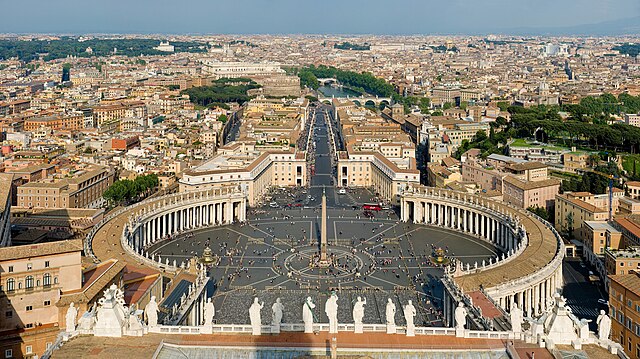
St Peter’s Square, Vatican City. Photo by DAVID ILIFF.
3. Rome is often defined as the capital of two states. The reason: the world’s smallest independent country — Vatican City — is located inside Rome’s city limits, making it a country within a city.
4. Although there is archaeological evidence of humans living in the Rome area 14,000 years ago, Roman legend dates the city’s founding to 753 BC by Romulus.

Capitoline Wolf, sculpture of the mythical she-wolf suckling the infant twins Romulus and Remus. Photo by Carole Raddato.
5. According to the Roman story, Romulus and his twin brother Remus were raised by a she-wolf after being abandoned in the Tiber river. Eventually the brothers grew up and founded a new city. During a disagreement, Remus was killed. Romulus became ruler and named the city after himself: Rome.

Roman Colosseum. Photo by Alessandroferri.
6. Many football stadiums around the world today follow the oval design of the Roman Colosseum, built of travertine, tuff, and brick-faced concrete between 72 and 80 AD. The Flavian Amphitheater — as it was originally called — could hold up to 80,000 spectators watching gladiator fights and other public events.
7. The initials “SPQR” — still seen today throughout Rome — stand for a Latin phrase: Senatus Populusque Romanus (The Senate and People of Rome) that refers to the government of the ancient Roman Republic.
8. Concrete was used extensively as a building material in Rome during the 700+ years between 300 BC to 476 AD. Since it quickly hardened into a rigid mass, concrete enabled Roman builders to create complex structures with arches, vaults and domes. The Pantheon, for example, is the world’s largest unreinforced concrete dome, and it’s still in use more than 2000 years after its construction.

Dome of the Pantheon in Rome. Photo by Jean-Christophe Benoist.
9. While concrete is often credited as to why Rome’s ancient structures still survive today, the building material disappeared with the fall of the Roman Empire. Between 500 AD and the 14th century, concrete was all but forgotten. It wasn’t until the latter part of the 14th century to the mid-18th century that the use of cement in structures and buildings gradually returned.
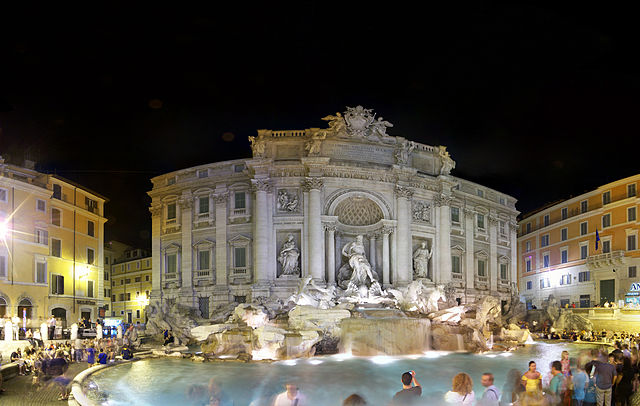
Trevi fountain at night. Photo by Wjh31
10. The Trevi Fountain — located at the junction of three roads — marks the end point of an aqueduct that supplied water to ancient Rome. Completed in 1762, the 86 ft high by 161 ft wide Baroque fountain was carved from Travertine stone, quarried about 22 miles east of Rome.
11. According to legend, visitors who use their right arm to throw a coin backwards over their left shoulder into the Trevi Fountain will return to the Rome. This was the theme of the 1954 movie Three Coins In The Fountain.


13. Visitors to Rome are clearly embrace the Trevi legend; nearly $1.5 million dollars of change was thrown into the fountain in 2016. The city removes the coins every night, averaging about 3,000 Euros. The money is donated to Caritas, a Catholic charity who uses it to provide services for needy families in Rome.
14. The famous “Scalina Spagna”, or Spanish Steps were actually built with French funds between 1721‑1725 in order to link the Bourbon Spanish embassy to the Holy See French church, Trinità dei Monti. The steps consist of 138 steps placed in a mix of curves, straight flights, vistas and terraces.
15. A Rome law allows cats to live without disruption in the place where they were born. While hundreds of wild cats climb the walls of the Colosseum and sleep among the ruins of the Forum, the real cat sanctuary is at the Largo di Torre Argentina — the historic site where Julius Caesar was stabbed by his rival Brutus in 44 B.C.

Largo di Torre Argentina in Rome. Photo by Wknight94.
When this archaeological wonder was excavated 1929as part of Mussolini’s rebuilding, Rome’s feral cats moved in, and the gattare, or cat ladies, began feeding and caring for them.
Today, volunteers at the Torre Argentina Cat Sanctuary care for approximately 130 cats, many of which are disabled or suffer from illness.
What fun fact can you add about Rome, Italy?
Interact with us via Twitter, Facebook, Pinterest or Instagram.
Planning a visit to Rome? Check out these resources:

 Rome: A History in Seven Sackings

 DK Eyewitness Travel Guide Rome: 2018