≡ Menu

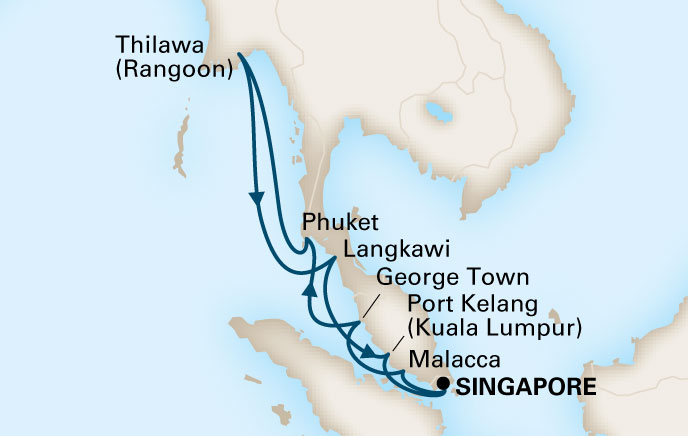
14-Day Asian Holiday cruiseAfter spending a few days in Singapore at our favorite hotel, the Conrad Centennial Singapore, today we will set sail on a 14-Day Asian Holiday cruise on Holland America’s ms Volendam.

We are excited to explore two new countries on this cruise: Malaysia and Myanmar (formerly Burma.)

We will also be sharing our updates on the Volendam cruise ship, as this is the first sailing after the ship has been in a dry-dock in Singapore.

Here is our day-by-day scheduled itinerary:

0 22 Dec 2014 Singapore 06:00 PM
1 23 Dec 2014 Malacca, Malaysia 07:00 AM 04:00 PM
2 24 Dec 2014 Penang, Malaysia 09:00 AM 06:00 PM
3 25 Dec 2014 Phuket, Thailand 08:00 AM 04:00 PM
4 26 Dec 2014 At Sea
5 27 Dec 2014 Thilawa (Rangoon), Myanmar 07:00 AM
6 28 Dec 2014 Thilawa (Rangoon), Myanmar
7 29 Dec 2014 Thilawa (Rangoon), Myanmar 07:00 PM
8 30 Dec 2014 At Sea
9 31 Dec 2014 Porto Malai, Langkawi, Malaysia Noon 07:00 PM
10 01 Jan 2015 Port Kelang (Kuala Lumpur), Malaysia 10:00 AM
11 02 Jan 2015 Port Kelang (Kuala Lumpur), Malaysia 11:00 PM
12 03 Jan 2015 Singapore 04:00 PM
13 04 Jan 2015 Singapore
14 05 Jan 2015 Singapore 06:00 AM

This little holiday bear will be joining us – look for him in future posts.
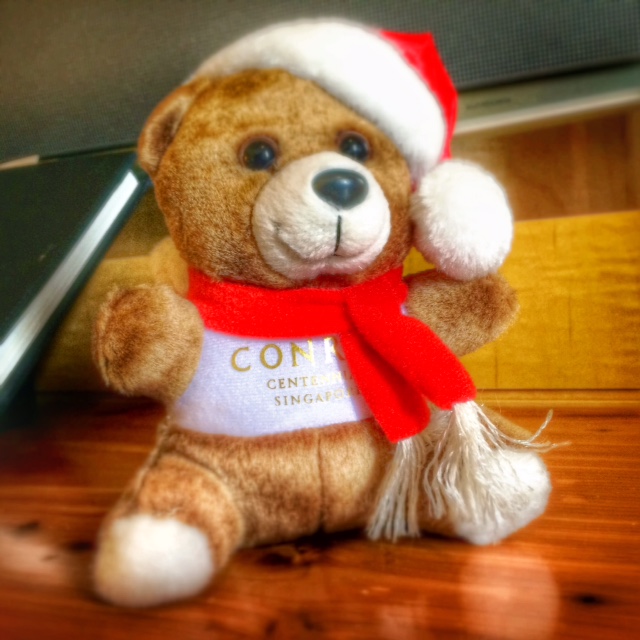
The Conrad Singapore holiday bear.

The Conrad Singapore holiday bear.

While we are long-time fans and frequent past cruisers of Holland America Line, it has been a year since our last cruise on the line.  We did cruise a few times this year on other lines including Seabourn, Royal Caribbean, and Princess, so we look forward to experiencing the latest Holland America offerings on this cruise.

We will try to share daily updates here, but know that we will likely be constrained by expensive, slow, and/or non-existent internet access.

You can also look for our updates on Cruise Critic here.

Have you cruised in Asia on Holland America Line? If so, please share your highlights and/or advice in comments below.

Here are other some other posts from our prior cruises on Holland America Line that you may want to check out: 

Follow us on Twitter or interact with us on Facebook

Or, check out our boards on Pinterest and/or our photos on Instagram.

{ 0 comments }

14 Fun Facts About Penang, Malaysia

Since we will be making our first visit to Penang, Malaysia soon, we wanted to do a little research in advance of our visit.

Penang is the second smallest state in Malaysia, and is composed of two parts  – Penang Island and Seberang Perai on the Malay Peninsula.

Here are 14 Fun Facts about Penang, Malaysia

Penang, Malaysia

An aerial view of Penang Island in Malaysia. Photo by Goh PS.

1. Residents of Penang are know as Penagites.

2. Penang was part of the Malay sultanate of Kedah until 1786, when Captain Francis Light built a fort at the site of present-day Georgetown and managed to get the island ceded to the British East India Company. Penang became the first British outpost in Southeast Asia in 1786. The island, along with Malacca and Singapore, was one of the three British Straits Settlements.

3. The name Penang comes from the Malay word Pinang, means the betel nut tree. The original name of Penang was Pulau Ka-satu or “First Island”, but on August 12, 1786 it was it renamed to Prince of Wales Island to commemorate the birthday of the Prince of Wales, who later became George IV.

4.. The capital, Georgetown, was named after King George III of Great Britain. Today, Penang has the highest population density in Malaysia and is the only state where the ethnic Chinese are the majority. Georgetown is a UNESCO World Heritage Site. George Town became the first city in the Federation of Malaya — by a royal charter granted by Her Majesty Queen Elizabeth II — on January 1, 1957.

5. Penang is the birthplace of shoe designer Jimmy Choo, the co-founder of Jimmy Choo Ltd that is known for its handmade women’s shoes. Born into a family of shoemakers, Choo’s father taught him the art of shoe-making. Jimmy made his first shoe when he was 11 years old.

Gurney Drive Food Court in Penang, Malayasia.

6. Penang is known for being the “food paradise” of Malaysia with a wealth of street food or “hawker food” that emphasizes noodles, spices, and fresh seafood. Penang’s cuisine reflects the Chinese, Nyonya, Malay and Indian ethnic mix of Malaysia, as well as influences from Thailand. Some of the best known dishes include:

  • Assam Laksa, the best known Penang dish, is a spicy noodley soup of poached mackerel in a broth with tamarind, lemongrass, chilies and shrimp paste,topped with rice vermicelli.
  • Mee Goreng consists of thin noodles fried together with garlic, onions, and meat, usually prawns or chicken,with chili, egg, cabbage and pickles. Think of it as a Malay version of Chinese chow mein.
  • Char Kway Teow is big flat rice noodles with prawns, cockles, beansprouts, Chinese chives, egg, soy sauce, chili, belacan (Malay shrimp paste), fried together inpork lard.
  • Hokkien Hae Mee, is soup-based noodle dish that combines prawns, slices of chicken, squid and fish cake, and water spinach, found in all of the hawker stands. The dish is said to originate from Fujian, China.
  • Laksa Lemak is a spicy currry-flavored noodle soup with coconut milk, shrimp or fish, chilli paste and coriander.
  • Nasi Lemak focuses on a mound of fragrant rice cooked in coconut milk, at the center of the plate the banana/pandan leaf, surrounded by small servings of Sambal, anchovies, peanuts and hard-boiled egg, a chicken leg and/or other ingredients to eat with the rice.
  • Roti canai is an adopted Malaysian flatbread, originally from India, usually served with curry sauce for breakfast or dinner.


  • Rojak is a fruit salad that in Penang is typically made with cucumber, pineapple, mango, jambu, cuttlefish, jicama, bean sprouts, puffed bean cake and fried dough fritters, tossed with a dressing made  of sugar, chili, lime juice and dark prawn paste, then topped with crushed peanuts and crunchy crackers.
  • Prawn Malai Curry is made with shrimp cooked in a rich cashew nut and coconut milk sauce.
  • Popiah are spring rolls made from little porous crepes that wrap soybean curd, eggs, vegetable stew and Chinese lettuce. They are dipped in sweet sauce, chili sauce or black sauce.
  • Char Koay Kak, also known as carrot cake or kway kak in Penang. It does not have an carrots but contains pieces “carrot cake”made of white radish and rice,stir-fried with salted turnips, bean sprouts, eggs, dark soy sauce, chili paste and lard.
  • Ice Kacang is a typical Malaysian dessert of shaved ice and red beans also known as ABC. The concoction includes a weird combination of sweet corn, grass jelly and cubes of agar, with a coconut milk topping.

7. Penang has an equatorial climate with temperatures ranging between 72°F to 86°F  and 70-90 percent humidity.

The view from the top of Penang Hill. Photo by Ac101.

8. Penang Hill offers the best view of Georgetown, and can be reached via a five minute ride on the Penang Hill Railway which was opened in 1923.  The cable train service lifts you out of the heat and humidity of the coastal plain and up to a fabulous view with cool breezes. 

9. Penang Botanic Gardens, established by Charles Curtis of Britain in 1884; it’s generally known as the Waterfall Gardens because of a little waterfall located within it. Many locals will come to the gardens to perform their daily exercises like walking, jogging, jungle trekking, aerobic dance, and to practice Tai Chi,  or Qi Gong.

10. The Kek Lok Si-Temple of Supreme Bliss, a sprawling hillside structure, is said to be the largest Buddhist temple in South-East Asia. A funicular train transports you to the summit of the hill featuring a giant statue of Kuan Yin, the Goddess of Mercy. 

11. Established in 1816, St George’s Anglican Church is the oldest Anglican Church in South East Asia and the only building from Penang that was declared one of the 50 National Treasures by the Malaysian Government.

12. Kwong Wah Yit Poh or Kwong Wah Daily — Malaysia’s oldest Chinese newspaper still in circulation, was founded by Dr. Sun Yat-sen in Penang on December 20th, 1910.

13. Penang is the first state in Malaysia to launch the “No Plastic Bag Day” campaign.

14. Established in 2012 with extensive collections, the Camera Museum is South East Asia’s first and only museum focused on — cameras.

Have you visited Penang? What fun fact can you add to this list? Please share in comments below. 

If you enjoy reading interesting facts about far-flung destinations, check out these other Fun Facts posts:

Follow us on Twitter or interact with us on Facebook

Or, check out our boards on Pinterest and/or our photos on Instagram.

{ 0 comments }

16 Fun Facts About Malacca, Malaysia

In anticipation of visiting Malacca, Malaysia during an upcoming cruise we are taking, we did a little background research.

Malacca (known as Melaka in Malay) is located in the southern part of the Malay Peninsula, next to the Straits of Malacca.

Malacca City is the capital of the Malaysian state of Malacca. Its historic center is a UNESCO World Heritage Site.

These are 16 Fun Facts About Malacca, Malaysia

1. Malacca, the third smallest state in Malaysia, is located about 150 miles north of Singapore.

2. Malacca was founded by Parameswara, the last king of Singapura who ruled from 1389 to 1398, and then fled after an invasion in 1398.  He found a good port strategically located narrowest point of the Malacca Straits, where he established Malacca in 1402.

3. The Portuguese captured Malacca is 1511 when General Alfonso de Albuquerque sailed from Goa to Malacca with a force of some 1200 men and seventeen or eighteen ships. (This was one year after the Portuguese had captured Goa.)

4. Then in 1641, with the help of the Sultan of Johore, the Dutch defeated the Portuguese, and then ruled Malacca from 1641 to 1798.

5. Under the Anglo-Dutch Treaty of 1824, the Dutch ceded Malacca to the British in in exchange for Bencoolen on Sumatra.

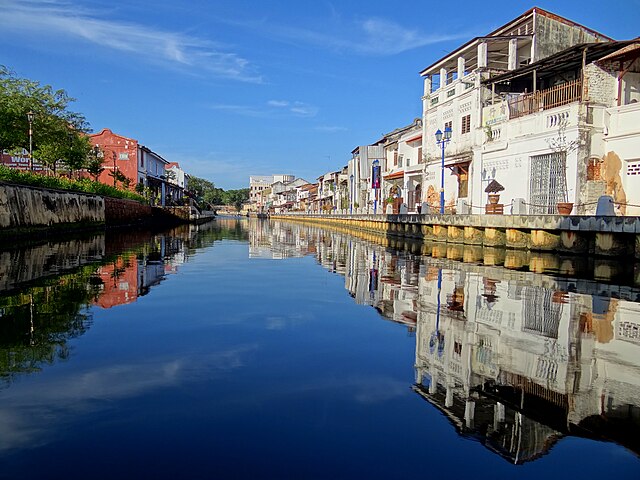
The canal-like river that flows through the historic center of Malacca City. Photo by Bjí¸rn Christian Tí¸rrissen

6. The British ruled Malacca between 1826 and 1946, first by the British East India Company and then as a Crown Colony. Along with Singapore and Penang, Malacca was part of the Straits Settlements. After the dissolution of this crown colony, Malacca and Penang became part of the Malayan Union, which later became the Federation of Malaya and eventually Malaysia.

7. The state of Malacca is 642 square miles in size, with a population of 821,110 (as of 2010) with 63 percent Malays, 25 percent Chinese, 6 percent Indians, and small communities of Kristang (people with partial Portuguese ancestry) and a small community of Eurasians with Dutch ancestry.

8. The majority religion of Malacca is Muslim (66 percent) with nearly 25 percent Buddhist, 5 percent Hindu, and 3 percent Christian.

9. The Baba Nyonya Heritage Museum and the Malacca Sultanate Palace Museum are the two best-known museums of Malacca.

A decorated bicycle rickshaw in Malacca. Photo by Nation kingdom.

10. Decorated bicycle rickshaws are popular a popular form of transportation in Malacca.

Christ Church in Malacca.

11. Constructed in 1753, the Christ Church reflects its original Dutch architecture. The building houses hand-crafted church benches, ceiling skylights, a copper replica of the Bible, and a replica of “The Last Supper”.

12. St. Peter’s Church, constructed in 1710 under Dutch rule, is the oldest Catholic church in Malaysia. Its bell was delivered from Goa in 1608.

13. Constructed by the Portuguese captain, Duarte Coelho, St. Paul’s Church was originally named “Our Lady of The Hill”, but was later turned into a burial ground by the Dutch for their noble dead, and renamed “St. Paul’s Church”. Today the church is part of the Malaccan Museums Complex. The body of St. Francis Xavier was interred here temporarily before it was taken to Goa, India.

14. Opened in 2008, the Taming Sari Tower it is a revolving structure that lets you view the sights of Malacca from a height of 260 feet in the sky.

15. The Malacca Zoo is the second largest zoo in Malaysia with 54 acres and more than 1,200 animals.

16. You can explore the traditional architecture of the different states in Malaysia at the Taman Mini Malaysia & Mini ASEAN cultural park located just outside of Malacca City. Each of the homes represents the architectural style of the 13 states in Malaysia and is furnished with various items, arts and crafts which depict the culture of each state.

Learn more about Malacca with these resources:
City Maps Malacca Malaysia

Malaysia: Kuala Lumpur & Melaka
Have you visited Malacca? What fun fact can you add?  

If you enjoy history and interesting facts about far-flung destinations, check out these other Fun Facts posts:

Follow us on Twitter or interact with us on Facebook

Or, check out our boards on Pinterest and/or our photos on Instagram.


{ 1 comment }

15 Fun Facts About Myanmar (Burma)

Since we will be visiting Myanmar for the first time in the next few weeks, we wanted to do a little background research.

Map of Myanmar by the UN Office for the Coordination of Humanitarian Affairs (OCHA).

Myanmar (pronounced MEE’-an-mar) is a country in southeast Asia that shares borders with China, India, Laos, Bangladesh and Thailand. It was formerly known as Burma.

Here are 15 Interesting Facts About Myanmar (Burma)

1. With a total area of 261,970 square miles, Myanmar is the largest country in mainland Southeast Asia, and the 40th-largest in the world. It is somewhat smaller than Texas and slightly larger than Afghanistan.

2. The population of Myanmar is 55,746,253 (July 2014.) The country’s literacy rate is 83 percent, the median age is 27.9 years and the average life expectancy is 57 years.

3. Myanmar is one of only three countries in the world that has not adopted the metric system of measurement.  The other two holdouts are Liberia and the United States. The Common local unit of weight in Myanmar is the peiktha, which equals to 3.6 pounds.

The ancient city of Bagan (formerly Pagan), located in the Mandalay Region of Myanmar, was the capital of the Kingdom of Pagan between the 9th to 13th centuries. More than 10,000 Buddhist temples, pagodas and monasteries were constructed in the Bagan plains area of Myanmar, of which more than 2,200 temples and pagodas can still be seen today. Photo by Corto Maltese.

4. Temples and pagodas found throughout Myanmar were built during the 12th and 13th centuries under the Pagan Empire as Theravada Buddhism spread throughout the country.

5. Today 89 percent of the population of Myanmar is Buddhist.

6. Both men and women in Myanmar use a yellow paste from the bark of the Thanakha tree as a cosmetic. Applied to the face, it is an effective sunscreen that also tightens the skin and prevents oiliness.

7. A typical meal in Myanmar includes steamed rice, fish, meat, vegetables and soup served at the same time.  Locals use their fingertips to mold rice into a small ball and then mix it with various dishes.

8. Major credit cards are not always accepted in Myanmar, and there are few ATMs, so visitors need to bring plenty of U.S. dollars. The higher the denomination, the better the exchange rate. The national currency of Myanmar is the kyat (pronounced “chat”). $1 U.S. dollar equals approximately 1031.60 kyat.

Rice is the major agricultural crop of Myanmar. Photo by Richard-dicky.

9. Myanmar depends on agriculture for more than half of its GDP. Rice is the major product.

10. You will see small children wear holy thread around their neck or wrist for protection from bad spirits or spells.

11. When the locals in Myanmar want to get a waiter’s attention, they make a kissing sound, usually two or three short kisses. It is the sort of sound you might make if calling a cat.

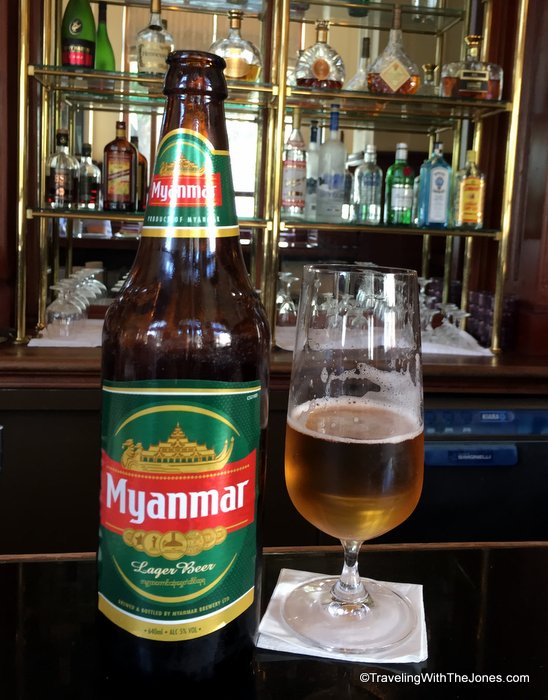
Myanmar beer at the Strand Hotel, Yangon, Myanmar12. Myanmar’s national beer is uniquely named … Myanmar Beer.

13. The traditional Burmese dress is the longyi, a wraparound skirt worn by men and women. Men tie theirs in the front and women fold the cloth over and secure it at the side.

14. Chewing betel nut is a national pastime. Small street stalls sell the palm-sized green leaves filled with betel nut, spices and sometimes a pinch of tobacco. The leaves are folded, popped in the mouth and chewed.

15. Chinlone — a combination of sport and dance team sport with no opposing team — is the traditional sport of Myanmar. The focus is on how beautifully one plays the game. Any number of players form a circle and keep the chinlone in the air as long as possible by kicking it soccer-style from player to player, using any body part except the hands.

Learn more about Myanmar (Burma) through these books:

Lonely Planet Myanmar (Burma) (Travel Guide) Letters from Burma

Have you visited Myanmar? What fun fact can you add?  

If you enjoy history and interesting facts about far-flung destinations, check out these other Fun Facts posts:

Follow us on Twitter or interact with us on Facebook

Or, check out our boards on Pinterest and/or our photos on Instagram.

{ 0 comments }