≡ Menu


Innsbruck, Austria

Heavy rain continued this morning in Innsbruck.  After a hearty Tyrolean breakfast buffet at the Hilton (great breads, jams, cheeses, meats, fruits, yogurts and muesli) we set out to explore the city despite the rain.   Our first stop was the tourist information office at the train station, where we bought 48-hour Innsbruck Cards (29 euros each) good for more attractions in the area.  


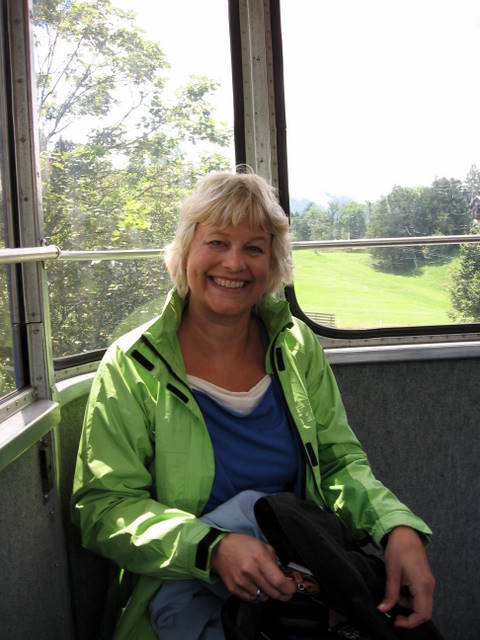
Between us we have one Patagonia rain slicker and one umbrella (bought quickly last night).  We boarded The Sightseer, a sightseeing and shuttle bus with commentary, and rode the entire route through Innsbruck.  Overview of the city complete, we are ready to explore, but it is wet and cold.  Despite three layers of t-shirts and sweaters, Janis needs a rain coat.  Luckily, we see jackets on sale at the Sporthaus Okay/InterSport store, and soon Janis is wearing a new green McKinley rainproof jacket. 

We stop for a coffee.  Now that we both have rain jackets, here comes the sun!
To take advantage of the sunshine, we boarded the J bus, and rode to the base of the Patscherkofel cable car. The Patscherkofel mountain is 2300 meters high and was the site of the 1976 winter Olympics downhill ski races and bobsled events.  Our Innsbruck card covers the lift tickets.   

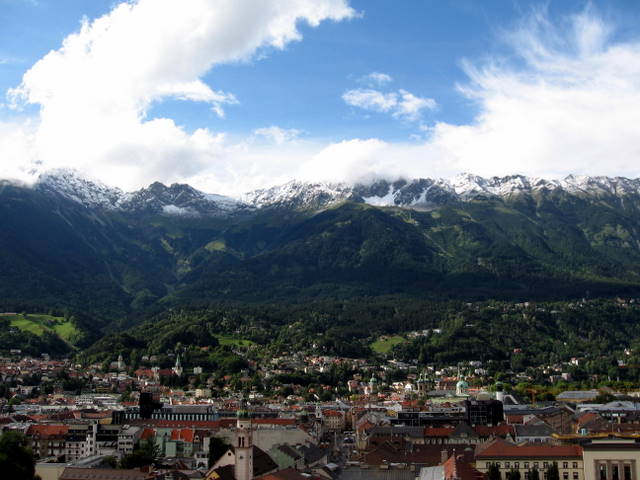
 As you head up the cable car, you see amazing views of the Innsbruck valley.  Close to the top, we heard bells ringing and then we saw cows grazing.

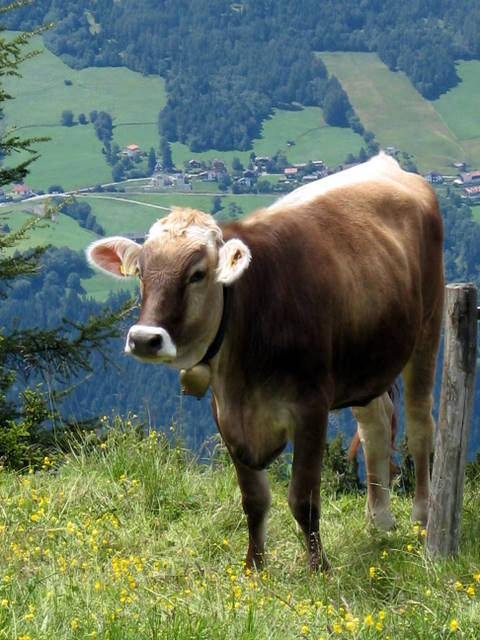
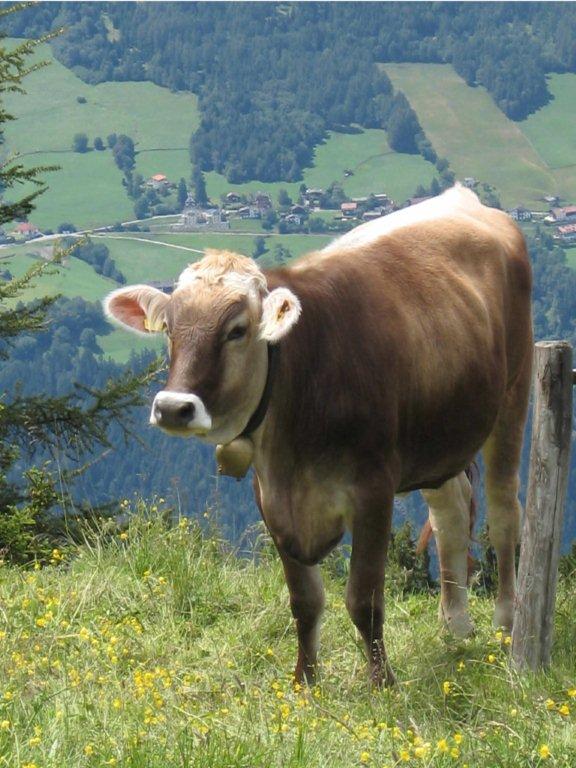
Off the cable car, there are mountain trails.   It had stormed the day before so the peaks were dusted with new snow – a post card view.   We also got close to some of the “Alpine Cows” roaming the mountain with their trademark bells.  It was picture perfect.
 
The lodge restaurant was open and had a amazing view and relatively inexpensive glasses of wine.  After our break, we started to head back to the cable car – and suddenly the sun was gone and we were in rain and thick fog (or clouds).  The cows needed their bells to find one another.


Alpine cow

{ 2 comments }

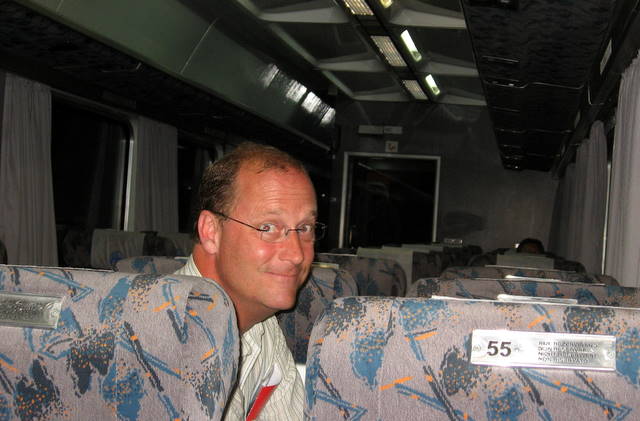
On Slovenian train from Ljubljana to Innsbruck

This morning we left Ljubljana after 8 days in Slovenia. We are now traveling on a train to Innsbruck, Austria. Austria will be the 16th country of our trip, after visiting Portugal, Spain, Morocco, Gibraltar, Italy, Malta, Croatia, Albania, Greece, Turkey, Russia, Ukraine, Romania, Bulgaria and Slovenia.

From Ljubljana, we rode the same train to Schwarzach-St. Veit, Austria, although the route # changed after the Austria border, and we made a 20 minute stop to add rail cars. In Schwarzach-St. Veit, we exited the first train and boarded Austrian train 668 to Innsbruck. The first train was late, but luckily, the connecting train was also 20 minutes late.

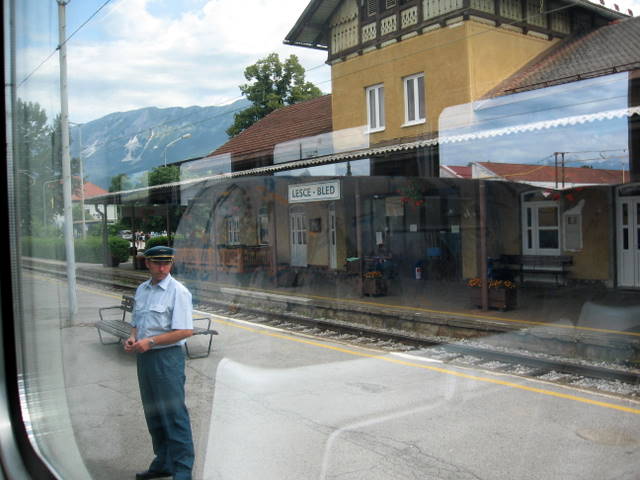
The view from our Slovenian train at Lesce-Bled station.

As we neared Schwarzach-St. Veit, we passed through beautiful mountains and green valleys. One of the stops was Bad Gadstein – an alpine and spa city we visited during our December, 1997 Salzburg, Austria trip – our first visit to Europe together. On that trip, we took the cable car to the top of the ski slope. We also passed through Zell am Zee, another Austrian ski and lake town that we enjoyed 10 years ago when everything was covered in lots of snow. Today, just as we headed our train left Zell am Zee, the sun disappeared and the rains started. We definitely are not in the Mediterranean any longer.

{ 0 comments }

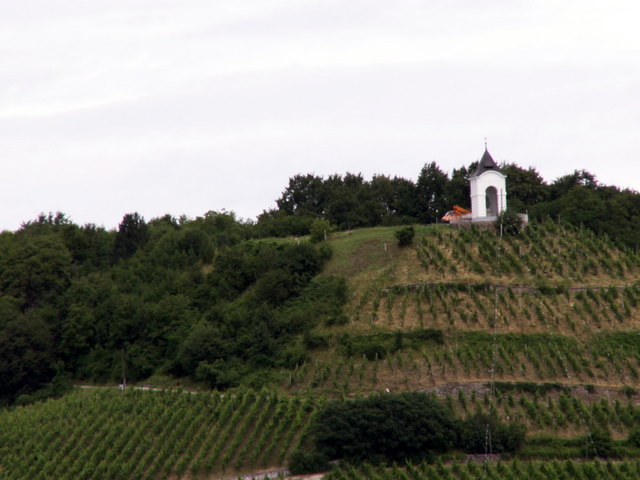
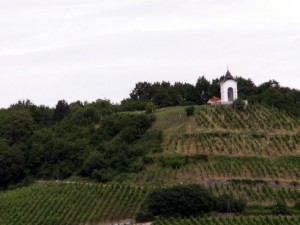
Grape vines near Maribor, Slovenia, home to the world's oldest producing vine

Mr. Jones can run.  Fast!  This was witnessed today by Mrs. Jones enroute from the hotel to the train station.  We were making a day trip to Maribor, in the northeastern part of Slovenia, south of Graz, Austria.   Mrs. Jones was a little slow and we left the hotel at 8:20 for an 8:30 train.  

No problem, the train station is only a 5 minute walk from the hotel.  Well, maybe 7 minutes if the lights are red (they were).  And then, the train to Maribor was on track #4, another 5-7 minute walk.  We walked fast.  Then Mr. Jones made a flat out sprint — he went so fast he missed track #4 and went to #5, but we did in fact make the train.  The 2-hour train ride provided a chance to catch our breath.

Maribor is the second largest city in Slovenia and it dates back to prehistoric times when the Celts, illyrians and Romans settled in the area on the banks of the Drava River. In 1254, Maribor gained town rights, developing a wine trade, town tolls and crafts.  The Hapsburgs protected and bestowed many priveleges on Maribor — they must have loved the wine.

Today, Maribor is a friendly city, surrounded by hills of grapes vines and/or mountains with a ski run. We wanted to see the oldest living grape vine in the world, which was planted by the Drava river more than 400 years ago.  We visited the Old Vine House.   Besides having the oldest vine growing on the front of the building, inside there is a muesum with some of the history, wine tasting (but you have to buy an entire bottle to taste it), and pictures of the wine queens.   We were not ready to drink a full bottle of wine so we didn’t taste.
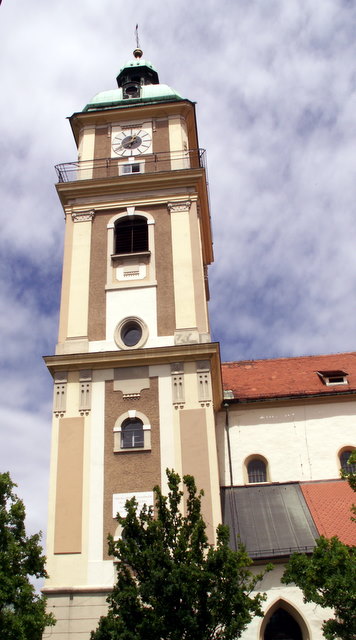
Climb Stolna Catheral Bell Tower for a view of the city and surrounding countryside

During our visit, we also climbed the bell tower of the Stolna Catheral (a fantastic view of the city and surrounding countryside is worth the climb), toured the Pokrajinski Museum, and had lunch at Patrick Murphy’s Irish Pub.

The Vinag Cellar, reported to be one of the largest cellars in Europe, was closed, as was the one wine-tasting cellar in Maribor.  Likely, this was due to the Lent Festival, which was nearing the end of its two-week run. The festival includes major music performances each night. American performers Maceo parker and Living Colour were to preform tonight.

Back in Ljubljana, we wondered around looking for a place to have a glass of wine.  Beside the Hotel Sloan, we saw a sign for Enoteca, a wine cellar.  Since it was early and we were the only guests, we had a great chat with the owner SaÅ¡o (pronounced Sa show).     SaÅ¡o offered a huge selection of Slovenian and other wines by the glass. Enoteca Wine Bar, Nazorjeva 12
{ 1 comment }

When we turned on CNN this morning, we were excited to see that Sochi, Russia was awarded the 2014 Winter Olympics. The area is a beautiful place, and the city’s finalist presentation was outstanding.

This afternoon we booked a 5.5-hour “Postojna Caves & Predjama Castle” tour (48 euros per person) from Kompas, the leading travel & tour company in Slovenia. www.kompas.si  We were expecting a bus tour and were thrilled to find out the company was using an oversized van with spacious seating for nine, including the driver/guide, a second Spanish guide and seven guests.

Carlos was our driver and English guide. He is from Portugal, and had lived a year in San Antonio, Texas in high school. He is in Ljubljana to study at the University, and stayed for the summer to guide tourists. We drove to the Karst region located between Trieste, Italy and Ljubljana.

The first stop was the Predjama Castle, built in a high cavern in the middle of a cliff. The original cave/castle dates back to the 13th century. The Predjama Castle’s most famous inhabitant was Erazem, who lived there in the 15th century. He was hiding out from Austrian emperor Frederick III who paid mercenaries to pursue him. They knew he was in the castle, but waited more than a year to starve Erazem out. This didn’t work since Erazem had a secret passage through the cave to the other side of the mountain and out to the cherry trees nearby. Finally, the mercenaries paid off a servant who pointed a light on the “outhouse” when Erazem was using it. This “spotlight” allowed the mercenaries to aim a missile on the outhouse spot, and killed Erazem in 1484. In 1570 the castle was renovated to its present form, and owned by several different royal families until WW II. We toured the castle and saw the beginning of the secret passage, which tourists can tour on a longer guided tour with light helmets and cave exploration equipment, or even in the stream via rubber raft. www.turizem-kras.si

10 kilometers from the castle is the Postojna Cave, with 20 kilometers of passages. Rail lines have been in the cave since 1872. Guests ride on the cave train about 15 minutes into the cave, then have a guided walking tour, then ride the train back out. The entire tour is about 1 and 1/12 hours; the cave is quite cool at 8 -10 degrees Celsius – brrr in our short sleeves. The cave is home to the “human fish”, a subterranean snake-like fish. This was a great day.

{ 0 comments }