≡ Menu

Oasis of the Seas in JamaicaEarlier this summer I went on my very first cruise vacation, right after I finished sixth grade.

My aunt and I sailed on Royal Caribbean’s Oasis of the Seas, one of the world’s two largest cruise ships.

My grandparents also went on the cruise.  

I had a blast.  There were lots of things to love about my first cruise. Here’s a list of my favorites:

Oasis of the Seas21 Favorite Things About Cruising on Royal Caribbean’s Oasis of the Seas

1) Getting to eat three-course meals every day.

2) Rock climbing most whenever you want.

zip lining,  Oasis of the Seas 3) Zip-lining across the 15th deck.

4) Having lots of different choices of restaurants.

Central Park, Oasis of the Seas5) Walking through Central Park.

6) Ordering more than one starter, main course or dessert.

ice show,  Oasis of the Seas 7) Watching the entertainment from a front row seat. (Make reservations ahead, and go early.)

8) Attending Hairspray, three diving shows, the ice skating show, concerts and dance shows.

9) Swimming in the “beach” swimming pool.

10) Jogging on the track.

Oasis of the Seas 11) Making my own ice cream cones.

12) Eating at the Wipeout Cafe.

13) Drinking unlimited Coke products in hundreds of different combinations from the machine.

room service, Oasis of the Seas 14) Ordering room service.

15) Using elevators to go everywhere.

16) Getting to know new people and making new friends.

shrek, Oasis of the Seas17) Getting my picture taken with Shrek.

18) Munching on delicious fruit all of the time.

19) Dressing up for formal night.

20) Eating breakfast in the Park Cafe.

boarding Oasis of the Seas 21) Spending time with Grandma, Grandpa and Aunt Janis!

Have you cruised on the Oasis of the Seas? If so, what was your favorite thing? Please share in comments below.

JustinaThis post is written by Justina, a 12-year-old from Iowa who just completed sixth grade.

Justina enjoys reading, dance, swimming and tennis, as well as hanging out with her friends.

Exuberant in every way, she embraces adventure, whether zip lining, Flow Riding or attempting a flip off of the high dive. 

To learn more about Justina’s first cruise,  check out these other posts detailing our Royal Caribbean Oasis of the Seas adventure:

Follow us on Twitter or interact with us on Facebook.

{ 0 comments }

5 Fun Facts About Huatulco, Mexico

Located in one of the most prominent sites of Mexican culture, Huatulco (pronounced wah-TOOL-co) lies along the Bays of Oaxaca, Mexico, about 310 miles south of Acapulco.

Huatulco Geography

Huatulco is located at the edge of the Sierra Madre Mountains, and spreads about 20 miles along the shoreline. As an ecologically-friendly tourist site, this city of 50,000 keeps the area well-preserved for tourists, 80 percent of which are from other parts of Mexico.

Since international airlift is limited, many of the foreign tourists that do visit arrive via a cruise ship.

Sunshine is always expected is Huatulco, and the town people are more than amiable.

Here are 5 fun facts about Huatulco, Mexico:

1. Culture in Huatulco dates back to the Mesopotamia area when the Toltecs and Quetzalcoatl tribes first occupied the land.

courtesy of mexicovacationtravels.com

Photo courtesy of mexicovacationtravels.com

2. After the Spanish Conquest, Huatulco became a port under the rule of Hérnan Cortes and was a distribution center for supplies on the Pacific coast.

curtesy of somosfans.com

Photo courtesy of somosfans.com

3. The Festival Míºsica por la Tierra features music and culture in an event designed to raise awareness about the environment.

curtesy of coug.net

Photo courtesy of coug.net

4. The bays of Huatulco are made up of a series of nine bays and numerous small coves stretching along 26 kilometers of jagged coastline, including 36 white sandy beaches.

5. Before tourism became a major force, Huatulco was known for its coffee plantations. Today there are numerous coffee plantations still in operation that give guided tours.

Have you visited Huatulco, Mexico? What “˜fun fact’ can you add? Please share in comments below.

Megan BrydeThis post is written by Megan Bryde, a forever student of the world while also finishing up her bachelors in English at Truman State University this semester.

Involved in too many activities, she sings as loud as she can, writes, cooks, bakes, and drinks a lot of coffee. Check out her blog and linkedin page to see more about what she does.

Megan is currently completing an internship with VentureTime Travel and aspires to be teaching English someday.

If you enjoy interesting facts about far-flung destinations, check out these other Fun Facts posts:

Follow us on Twitter or interact with us on Facebook.


{ 0 comments }

travel power adapterReader Kristin L. asked via a post on Facebook:

Wondering if you could comment on Power Converters and Power Adapters for Europe (Austria & Germany)?

We love questions from readers.

Kristin: here’s our take on Power Voltage Converters and Power Adapters for Europe, specifically Austria and Germany.

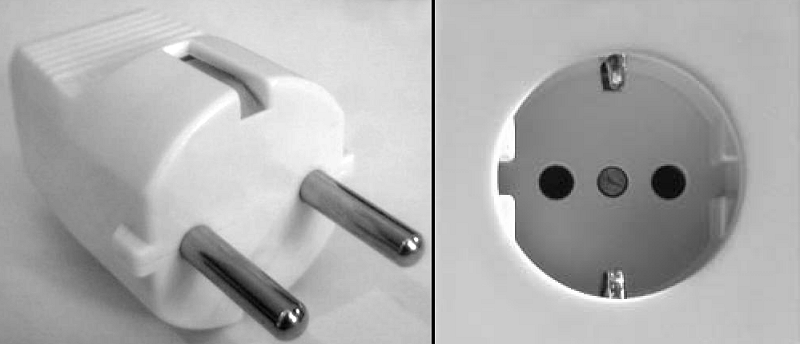
A German "Schuko" socket

A German “Schuko” socket used in Germany, Austria and a number of other European countries.

Power sockets in Germany and Austria have a round, recessed shape with two-round pole plugs. They are commonly called “Schuko” sockets, and are also used in Albania, Bosnia and Herzegovina, Bulgaria, Chile, Croatia, Denmark, Estonia, Finland, Greece, Hungary, Iceland, Indonesia, Iran, Italy, Latvia, Lithuania, Luxembourg, Republic of Macedonia, Republic of Moldova, the Netherlands, Norway, Pakistan, Portugal, Romania, Russia, Serbia, Slovenia, South Korea, Spain, Sweden, Turkey, Ukraine, and Uruguay.

When we travel to Austria and Germany, we travel with two kinds of power adapters.

German power adapter

1. A USA to Europe Power Plug Adapter (photo above) that you “add-on” to the end of your US device power cord, which adapts the plug to fit German and Austria (and many other European countries power plugs.)

Travel Universal adapter


2. Universal All-in-One World-Wide Travel Adapter with Wall Surge Protector (photo above-back, and top of post-front.) This type of travel power adapter works (in theory) in any country around the world.

Both of these types of travel power adapters are readily available and inexpensive. They work great, as long as the computer, shaver, video camera, iron, or other device  is a multi-voltage model. If the appliance is not a multi-voltage model (my Chi flat iron is not multi-voltage, for example) you will also need to buy a voltage transformer or converter, or avoid taking an electrical appliances that are not multi-voltage to Germany or Austria. 


Rockstone Power 1000 Watt 5V USB Port Heavy Duty Step Up/Down Voltage Transformer Converter

The reason that you need a voltage converter is that  the standard household electrical outlet in Austria and Germany carries a wallop of 220-240 volts, while a normal electrical appliance designed for us in the United States, Canada or Mexico has 110/120-volts.

Using an electrical appliance designed for use in the US, Canada or Mexico in a European outlet without a voltage converter will result in sparks and smoke, and often destroy your appliance as well as cause a power outage.

We generally try to avoid the need to travel with a Voltage Converter as they tend to be much heavier to carry and more expensive to purchase that voltage adapters.

If you do want to purchase a Voltage Converter for Germany and Austria, look for one specifically rated for Germany.

Note that most models of Voltage Converters with allow you to use 110V USA Laptops and Other Portable Electronics in Europe (and other 220 Volt Countries.)\

However, most of these Voltage Converters carry the following warnings:

  • Maximum capacity: 150 Watts. Good for laptops, battery chargers, iPods, shavers etc.
  • Cannot be used with any kitchen appliances, hair dryers, flat irons, etc.

As a result, I either travel with a hair-dryer and flat iron specially made for international travel with lower voltage (note: not as powerful.)

Alternatively, we now tend to stay in U.S.-based hotel chains (such as Marriott or Hilton hotels) that generally have local hair dryers, or on U.S.-headquartered cruise ships.

Or, my hair goes into a pony tail.

How do you deal with power converters and/or adapters when you travel?  We’d love to hear your solutions in comments below. 

Other travel trips you may want to check out:

Or check out 30 Travel Tips For Your Travel Toolkit.

If you have a travel question, we’d like to hear it. Please contact us here.

Or, reach out to us via Twitter or Facebook

{ 0 comments }

5 Fun Facts About Cabo San Lucas, Mexico

El Arco de Cabo San Lucas, or Lands End, marks the spot where the Pacific Ocean meets the Sea of Cortez at the southern tip of Cabo San Lucas, Mexico. Photo by Stan Shebs.

One of Mexico’s top tourist destinations and commonly referred to as “Cabo,” the city of Cabo San Lucas lies at the southern tip of the Baja California peninsula, in the Mexican state of Baja California Sur.

The city of Cabo San Lucas, together with the more historical city of San José del Cabo, make up the area known as Los Cabos.  The area along the coast between to two cities features a plethora of beach resorts and timeshares, where tourists are drawn to scuba diving, marlin fishing, coastal Mexican food and tequila.

Cabo San Lucas is also a popular cruise ship port.

Cabo San Lucas, Mexico, is a city at the southern tip of the Baja California peninsula, in the Mexican state of Baja California Sur. Cabo San Lucas together with San José del Cabo is known as Los Cabos.

Here are 5 Fun Facts about Cabo San Lucas:

1. The city is known as the “End of the Earth” as it is the last piece of land in the Baja California Peninsula.

2. Called the “Striped Marlin Capital of the World,” Cabo San Lucas hosts the world’s highest paying marlin tournament with a jackpot of more than $3 million U.S. dollars.

bisbees-black--blue-marlin-tournament-returns-to-cabo-san-lucas-mexico-main

Photo courtesy of investmentpropertiesmexico.com

3. In the winter, whales can be spotted in the area, because they like to raise their offspring in the warm waters of the Sea of Cortez.

4. Cabo offers non-stop activities for visitors, from para-sailing to riding horses through the desert, to scuba diving to “clubbing” at the numerous bars and dance clubs.

5. Look for The Gringo Gazette for news on tourist activities and the latest happenings.

800px-Gringo_Gazette

Learn more about Cabo San Lucas with these resources:
Cabo San Lucas
Baja California Sur: An Expat’s Relocation Guide for La Paz, Cabo San Lucas, San Jose del Cabo, Los Barriles, Mulege, Todos Santos, and Loreto
Lonely Planet Mexican Spanish Phrasebook & Dictionary

Have you visited Cabo San Lucas, Mexico? What “˜fun fact’ can you add? Please share in comments below.

Megan BrydeThis post is written by Megan Bryde, a forever student of the world while also finishing up her bachelors in English at Truman State University this semester.

Involved in too many activities, she sings as loud as she can, writes, cooks, bakes, and drinks a lot of coffee.

Megan is currently completing an internship with VentureTime Travel and aspires to be teaching English someday.

If you enjoy history and interesting facts about far-flung destinations, check out these other Fun Facts posts:

Follow us on Twitter or interact with us on Facebook

{ 0 comments }