≡ Menu

cruise shipsI’m a planning to  take my 12-year old niece on a cruise during her summer vacation.

Her parents agreed to the trip, but their first question was, “Does she need a passport to cruise?”

Does a 12-Year Old Need a Passport to Go on a Cruise?

The answer is “it depends on the cruise.”

The U.S. Department of State website states, “Every minor regardless of age traveling overseas must have a valid passport.”

However, according to the U.S. Customs and Border Protection website, adults and children traveling on “Closed Loop” cruises traveling to and from the same  U.S. port and cruising only within the Western Hemisphere can travel with a birth certificate and government issued ID as proof of citizenship:

“Closed Loop” Cruises: U.S. citizens who board a cruise ship at a port within the United States, travel only within the Western Hemisphere, and return to the same U.S. port on the same ship may present a government issued photo identification, along with proof of citizenship (an original or copy of his or her birth certificate, a Consular report of Birth Abroad, or a Certificate of Naturalization).

Please be aware that you may still be required to present a passport to enter the foreign countries your cruise ship is visiting. Check with your cruise line to ensure you have the appropriate documents.

In further checking with Royal Caribbean International, the cruise line that we will be sailing on, I learned this:

In the absence of a passport, a birth certificate (original, notarized copy or certified copy) plus a picture ID card issued by a federal, state or local government agency are required. A voter registration card or Social Security card is not considered to be proof of citizenship. Children under 16 years of age do not require a picture ID. 

Since our cruise is a “Closed Loop” cruise to the Caribbean sailing to and from Ft. Lauderdale, Florida, and cruising within the Western Hemisphere, my niece will only need a notarized or certified copy of her birth certificate. And, since she is under 16, she won’t need a picture ID.

If I wanted take a 12-year-old on any cruise not departing from a U.S. port, they would need a passport.

On the Oasis of the SeasAnother Key Document Is Required to Take My 12-Year Old Niece on a Cruise

While I’d found the passport answer, another question came up regarding traveling with a minor when you are not their parent or legal guardian.

If you are considering traveling with a minor under the age of 18 and you are not their parent or legal guardian, you should check with the cruise line that you plan to sail for their requirements.

In the case of Royal Caribbean International, here’s the policy from the company’s website:

Adults who are not the parent or legal guardian of a minor traveling with them must present an original notarized letter signed by the child’s parent(s), authorizing the adult to take the child on the specific cruise, supervise the child and allow emergency medical treatment to be administered.

I also learned that the letter needed to state the parents’ permission  for me to sign waivers on the child’s behalf, i.e. to participate in rock-climbing, zip-lining, the FlowRider® or other activities that require parental waivers for minors to participate.

In addition, both custodial parents or legal guardians must sign the same or separate letters.

RCI -FlowRider Now that we’ve got the requirements down, we can focus on planning all the fun we will have on the cruise.

Have you cruised with a minor under 18 when you were not the legal guardian? Any additional tips to add? Please share in comments below. 

Other cruise tips you may want to check out:

Reach out to us via Twitter or interact with us on Facebook.


{ 2 comments }

18 Tips for a First-Time Cruiser

We have a friend who is a well-traveled grad student going on her first cruise with two other friends.

Her question, “What tips do I need to know to have a great cruise?

Carnival cruise ship - tips for 1st time cruiserHere’s 18 Tips for a First-Time Cruiser:

Before You Go:

1) Find and Complete the Online Check-in For Your Cruise.  Go to the cruise line website – i.e. Carnival.com and complete the Online Check-in. Some cruise lines require that you do this 5 or more days before departure.

2) While You Are on the Cruise Line Website, Look for the “Know Before You Go” or “Frequently Asked Questions”.  This is where you will learn on the important information such as the dress code, what you can and cannot bring on the cruise, tipping policies, etc. It is a great idea to read in advance, and to contact your travel agent with any questions.

3) Review the Shore Excursions Offered by the Cruise Line. Even if you don’t plan to take any shore excursions through the cruise line, reading the descriptions is a terrific way to learn about the most interesting activities in a given port. If you do decide you want to do a specific tour, you may want to book it in advance so that you aren’t disappointed if it is sold out. 

If there are several options that interest you, you can wait until you are on the ship, and ask questions and advice from the shore excursion staff on-board. There’s generally a number that you can call in advance to ask shore excursion questions as well.  

Our rule: if it’s a once-in-a-lifetime thing that we really want to do, we book in advance. Otherwise, we book on board, or research and find our own thing to do in port.  If you do book in advance, be careful not to overbook yourself – you want it to be a relaxing vacation.

4) Print a Hard Copy of All of Your Cruise Documents and Other Confirmations.  If you purchase anything in advance or are to receive any special benefits (such as a shipboard credit or drink promo, etc.), it is a great idea to have a printed copy of the confirmation with you.  

We make a simple folder, and keep all the flight information, hotel confirmation, cruise docs, and any advance purchases in the file for easy reference. If you are driving, have the port directions and address printed out, and any confirmations of advance parking reservations. 

5) If you are sailing on Carnival, check out John Heald’s Facebook page – he’s a Carnival Cruise Director, Brand Ambassador and is funny as he shares about guests’ questions and experiences on Carnival’s ships.

6) For answers to every question you might have, log on to Cruise Critic.  Find the board for your cruise line and post questions (or read all the other questions and answers.) You may also want to join the Roll Call for your sailing if you are interested in meeting other passengers on your sailing that follow Cruise Critic.

7) Have Your Passport and Other Identification in Order.  It is best to have a valid passport with at least 6 months remaining before the expiration date. Some cruises that leave and return to U.S. ports don’t require a passport, but it’s a good idea to have one anyway. If you don’t have a passport, be sure to confirm with the cruise line that you have the proper documentation – you do not want to get left on the shore.

One more tip: scan a copy of your passport and email to yourself, and make a photo copy.  These copies will help expedite a passport replacement if it gets lost or stolen while on vacation.

8) Buy Insurance. Be sure to protect yourself when you are out of the country. Many insurance plans and Medicare do not cover you when you are outside of the U.S. It is generally preferable to buy third party insurance rather than through the cruise line.

Even if you aren’t worried about having to cancel your cruise, you can buy a low-cost plan that gives you emergency medical coverage, medical evacuation, and trip interruption coverage once you depart on your vacations.

Packing

9. After Reviewing Your Ship’s Dress Code, Plan Your Packing in Advance.  While a cruise means unpacking and repacking only once, it’s nice to take only what you need, especially if you are flying to the port. In general, pack casual clothes for the daytime – shorts, shirts, flip-flops and swimsuits for the Caribbean. You will want to take sunscreen – it’s more expensive to buy it on the ship. Take workout clothes and tennis shoes for exercising or just walking around the ship. For evenings, generally there are two formal or elegant nights on a 7-day cruise.  For these nights, women usually wear cocktail dresses or pants and a sparkly top. Men wear suits or jackets. For the other evenings, women wear sundress, pants and tops, or even jeans, although they are hot in the Caribbean. Again, check the recommendations of your cruise line.  If you plan to do certain excursions in port – say hiking through Dunn’s River Falls in Jamaica, you will want water shoes, or sandals or tennis shoes that can get wet.

10. Take a Small Travel Medical Kit. Be sure it has Advil pain reliever, antacid, Band-aids, and other every-day things you might need in it.  Get some Dramamine Tablets if anyone in your party is worried about getting sea-sick. (For the record, we never have, even in rough seas.)  Most likely, you won’t need this but if you have a headache you don’t want to search all over the ship for headache relief.

11. Take A Stash of Small Bills. Tipping on the ship is usually handled by auto-gratuities charged to your shipboard account. However, it is nice to have a stash of $1 and $5 for tipping the luggage porters at the pier, tour guides, room service deliveries, cabs, bartenders on occasion and anyone on board whom you want to show a little extra gratitude to for doing something extra for you.  There will be a safe in your cabin where you can store your money, passports and credit cards when you aren’t using them.

12. Wine or Champagne. It is essential to check with your cruise line on this – most do not allow you to carry on hard liquor or beer in any form, but some (such as Carnival) allow adults 21 and over to carry on one bottle of wine or champagne each. If you drink in in the dining room, you will be charged a corkage fee. If you want to have a champagne toast in your cabin at sail away, this is a way to do it.

13. Pack an Portable Travel Power Strip Power plugs are often very limited in cruise ship cabins. Take a small Power Strip that turns one plug-in into four. It’s easiest to find these on Amazon. They are inexpensive and help keep all your devices charged in the cabin at night.

Getting On-Board

 14.  Check Your Bags With the Porters at the Cruise Port. When you arrive at the cruise port, the first stop is to check your bags with the porters, who will get them to the cruise ship, where they will be delivered to your cabin. Be sure to use the pre-printed luggage tags (when you complete online check-in) or ask the porter for a hand-written tag.  NOTE: you won’t have access to this luggage for a few hours. Anything that you will need immediately once you get on-board such as medicine, passports/documents, cameras, computers, wine, swimming suits, change of clothes, etc. – you want to carry on these items in small bag or backpack. Once you go through check-in and board the ship, you may not be able to get into your cabin yet, so make sure this bag isn’t too big or heavy.

15. Once On-Board Either Head to Your Cabin or to the Lido. Once you get on-board, you may be able to head directly to your cabin. If you are boarding early, (before 1 pm on many ships), your stateroom may not be ready. If that’s the case, find out where lunch is being served and head there. Generally, it’s in the Lido Buffet.  Or, find an outdoor bar, and have a drink to get into the vacation mood.  There will be an announcement when staterooms are ready and then you can head to yours.

16. Explore the Ship. Embarkation day is the perfect time to explore the ship.  Usually there is signage and you are also given a deck plan in your documents when you check-in. Look for the daily program (usually in your cabin) with the blow by blow details of everything going on. Don’t feel like you have to do everything. You are on vacation after all.

17. Don’t Miss the Lifeboat Drill. Cruise lines take these drills very seriously and you should too. Attendance is mandatory and roll-call is taken.  Follow the directions, and remember, you only have to go through this one time. Once the drill is over, it’s generally close to time.

18. Unpack and Have a Terrific Cruise.  By now, your bags should be delivered to your room. Unpack and store the suitcases under the bed. If anything is amiss in your cabin, first look for your cabin steward and then contact the front desk. Don’t miss the sail away party, usually on one of the upper aft decks.  Let the fun begin and have a terrific cruise.

Are you a first-time cruiser? What other question do you have?  Or, if you are a cruise veteran, what’s your advice for a first-time cruiser? 

Reach out to us via Twitter or interact with us on Facebook.

{ 0 comments }

20 Fun Facts About Colombo, Sri Lanka

In anticipation of our upcoming visit to Colombo, Sri Lanka, we did a little background research. What an interesting history to explore in this port city and island country.

Evening View of Beira Lake and Colombo, Sri Lanka. Photo by Arvindkumarn.

Here are 20 Fun Facts About Colombo, Sri Lanka

1. Colombo is the largest city of the island country of Sri Lanka in the northern Indian Ocean off the southern Coast of India. Sri Lanka was formerly known as Ceylon until 1972.

2. Since ancient times, Sri Lanka was known for its cinnamon. The country still produces 80 to 90 percent of the world supply of C.verum cinnamon. 

Cinnamomum Verum and Ciccamomum Aromaticum sticks side by side.  The cinnamon of Sri Lanka is on the left.  Photo by Antti Vähä-Sipilä

3. With its cinnamon supply and a large, deep natural harbor strategically positioned along East-West trade routes, Colombo was known to and valued by Indian, Greeks, Persians, Romans, Arabs, and Chinese traders more than 2,000 years ago.

4. Muslim Moor traders began to settle in Colombo in the 8th century AD, drawn because the port facilitated their trading business between the local Sinhalese kingdoms and the outside world. Today, their descendants make up the local Sri Lankan Moor community.

5. Portuguese explorers first arrived in Sri Lanka in 1505, striking a treaty with the King that allowed them to trade the islands’ crop of cinnamon, which lay along the coastal areas of the island, including in Colombo.

6. The Portuguese were given full authority over the coastline in exchange for promising to protect it against invaders. The Portuguese soon established a trading post in Colombo, built a fort in 1517 and expelled the Muslim inhabitants.

7. By 1593, the Portuguese established complete control over the coastal area, with Colombo as their capital. Today, this part of Colombo is still known as Fort and houses the presidential palace and the majority of Colombo’s top hotels.

8. In 1638 the Dutch signed a treaty with King Rajasinha II of Kandy giving the king assistance in his war against the Portuguese in exchange for a monopoly of the island’s major trade goods.

9. The Portuguese resisted the Dutch but were gradually defeated in their strongholds. After an epic siege in 1656, the Dutch captured Colombo.

Copper engraving, ‘De Stadt Colombe’ (The Town of Colombo), from Dutch book c. 1775, after original engraving by Johannes Kip of c. 1680

10. Initially, the Dutch gave the captured area back to the Sinhalese kings, but later reneged and took control over the island’s richest cinnamon lands including Colombo.  Colombo was named the capital of Dutch Ceylon under the control of the Dutch East India Company.

11. In 1796, the British captured Colombo, keeping it as a British military outpost until 1815 when Colombo was named the capital of the newly-created British Ceylon crown colony.

12. The British began constructing houses and other civilian structures around the fort, creating the basis the current-day city of Colombo.

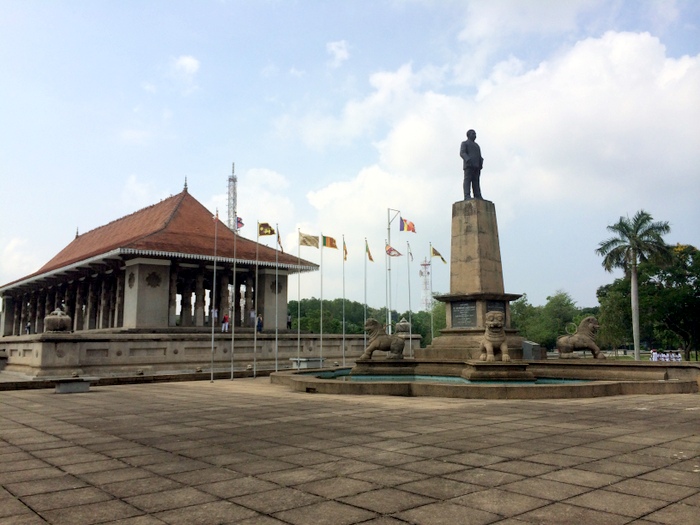
Independence Memorial Hall
Independence Memorial Hall in Columbo, Sri Lanka.

13. Ceylon gained independence from Britain in 1948, ushering in a new culture along with changes in laws, customs, clothing styles, religions and family names.

14. The 160-acre Lake Beira is in the center Colombo.  During the Portuguese, Dutch and British colonial eras, Lake Beira was used to transport goods within the city and surrounding towns through many intricate canals.

The Galle Face Green promenade runs between the Indian Ocean and the financial and business districts of Colombo, Sri Lanka. Photo by Mayakaru.

15. When Englishman Sir Henry Ward created the Galle Face Green promenade in 1859, it was also used for horse racing and as a golf course. Today’s smaller Galle Face Green is attached to Sri Lanka’s first five-star hotel – the Ceylon Inter-Continental — and as well as the countries’ oldest hotel — the Galle Face Hotel known as Asia’s Emerald on the Green since 1864.

16. The two World Trade Center towers – completed in 1997 – are most recognized landmarks of the city.

17. St. Paul’s Church Milagiriya, one of the oldest churches in Sri Lanka, first built by the Portuguese and re-built by the British in 1848.

18. Cricket is most popular sport in Sri Lanka and is played in parks, playgrounds, beaches and the streets of Colombo. The country won the 1996 Cricket World Cup and placed second in 2007 and 2011.

The Nelum Pokuna Mahinda Rajapaksa Theater in Colombo.  Photo by Dhammikah.

19. Opened in December, 2011, the Nelum Pokuna Mahinda Rajapaksa Theater was designed to reflect a Lotus Pond in Polonnaruwa, the royal ancient city of in central Sri Lanka.

Ceylon/True Cinnamon Flavored Black Tea

20. Sri Lanka’s Ceylon tea is world famous, but in the 1860s Sri Lanka was the world’s biggest coffee producer. Only after a deadly disease stuck the coffee plantations did the British colonists convert them to tea.

During our visit, we hope to check out some of the spots profiled in this New York Times 36 Hours in Colombo, Sri Lanka piece.

Learn more about Sri Lanka with these resources:

Don’t Forget Your Passport – Sri Lanka

The Sri Lanka Reader: History, Culture, Politics

Elephant Complex: Travels in Sri Lanka

Have you visited Colombo, Sri Lanka? What “˜fun fact’ can you add to this list?

Interact with us on TwitterFacebookPinterest or Instagram.

If you enjoy history and interesting facts about far-flung destinations, check out these other Fun Facts posts:

{ 3 comments }

We will be visiting Cochin, India, soon, while on a cruise ship. Since we will only have a day in the city, we wanted to learn more about the it before our visit.

A night view of Marine Drive in Cochin, India. Photo by Augustus Binu.

Here are 24 Interesting Facts about Cochin (Kochi) India:

1. Cochin is the colonial name of Kochi, India, a major port city by the Arabian Sea on the southern part of India’s west coast.

2. Since the 14th Century, Kochi has been an important spice trading center on the west coast of India, connecting the mainland to the rest of the world and known as the “Queen of the Arabian Sea.”

3. Kochi’s rise to fame began in 1340 AD, when massive flooding of the Periyar River destroyed the world-famous port at Cranganore, while also creating a natural harbor at the nearby city of Kochi.

4. With its strategic location on the international seafaring route between Europe, the Middle East, Asia and the Pacific Rim, the harbor of Kochi soon developed into a major world trading center for high-quality pepper, cardamom, cinnamon and cloves.

5. Kochi has been ruled by numerous empires. Occupied by the Portuguese Empire in 1503, Cochin was the first of the European colonies in colonial India. Chochin was the main seat of Portuguese India until 1530, when Goa was chosen instead.

6. Under the Portuguese, Cochin grew into a prosperous town and in 1530 AD built a fort at called ‘Manuel Kotta’ (Fort Emmanuel).

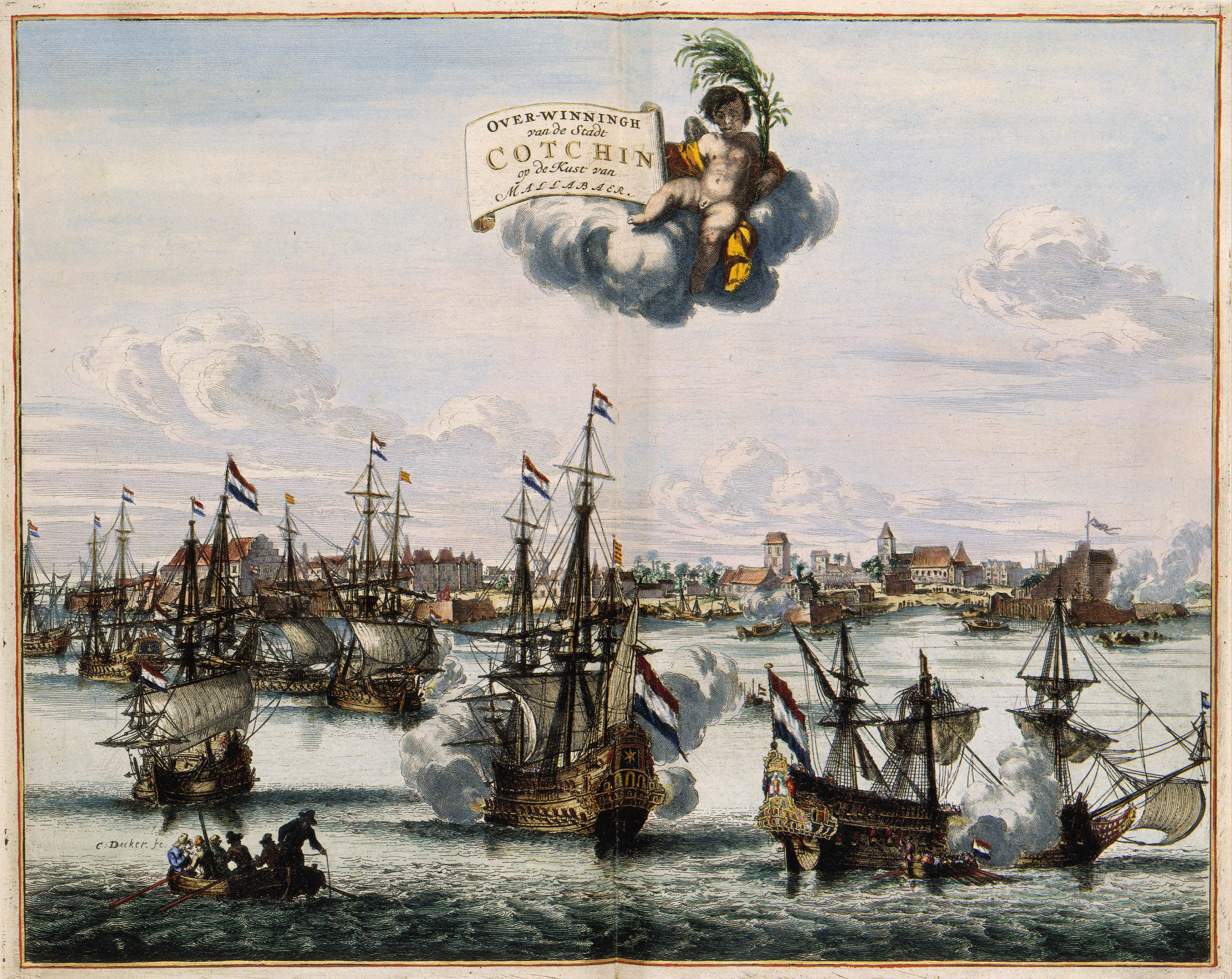
The capture of Kochi and victory of the Dutch V.O.C. over the Portuguese in 1656-A Dutch painting (c.1682)

7. The Dutch invaded Cochin in 1653 and took over rule from the Portuguese in 1663.

8. The Dutch then built Fort Williams in Cochin but were defeated by the great rulers of Mysore – Hyder Ali and Tipu Sultan.

9. When India lost to the British in 1814, Cochin became a part of the British Empire.

10. After India became independent in 1947, the state of Kerala was formed by the unification of provinces Kochi, Malabar and Travancore in 1956. Kochi was formed in 1967 by the merger of the towns – Fort Kochi, Mattanchery, Ernakulam and many nearby villages.

11. The Arabs, British, Chinese, Dutch, and Portuguese all impacted the history and development of Cochin.  The English claimed Cochin as ‘Mini England’, the Dutch called it ‘Homely Holland’ and the Portuguese referred to the port as ‘Little Lisbon’.

12. Italian traveler Nicolas Conti wrote in his travelogue:China is where you make your money, then Cochin is surely the place to spend it.

13. Today, Cochin is the headquarters of India’s Southern Naval Command, home to the Navy’s main training center, an air station, and the leading gunnery school all located on Willingdon Island.

Cochin fishermen use massive fishing nets called Cheenavala. Photo by Jorge Royan.

14. The coast between Fort Kochi and Vypeen is covered with fishermen earning their livelihood by fishing with giant nets called Cheenavala. Outside of China, these massive fishing nets are only found in Cochin, and are believed to have been introduced to the port city by Chinese traders under the court of Kublai Khan.

15.  While Malayalam is the official language of the state of Kerala, English is widely spoken.

16. Cochin residents practice a range of religions, with the population including Hindus, Christians, Muslims, Jains, Jews, and Sikhs.

The view in Cochin from the southern end of the Musical Walkway adjoining the Fishing Net Bridge.

17. Cochin averages 132 days of rain each year, especially during the June to September southwest monsoons and the northeast monsoons between October and December. The best time to visit is between October and March.

18. Tourists often enjoy boat rides through the backwaters – dotted with many small islands – that separate Ernakulam from Fort Kochi and Mattanchery.

19. Ninety percent of all of the pepper that India produces is traded through the International Pepper Exchange at Kochi.

St. Francis Church, the oldest European-built church in India. Photo by Vineethv2.

20. St. Francis Church, the oldest church built by Europeans in India, contains a clearly-marked burial spot for Portuguese trader Vasco da Gama, who died in Cochin during his third visit.  Vasco was buried in the St. Francis Church, but his remains were later taken back to Portugal.

21. The Vasco house, located on Rose Street in Fort Kochi, is one of the oldest Portuguese houses in India and features European glass pane windows and verandahs.

22. Santa Cruz Basilica, the original Catholic Church in Fort Kochi, was built by the Portuguese in 1505 and named as a cathedral in 1558. The current structure dates to 1905 and was made a basilica by Pope John Paul II in 1984.

23. The Jewish Synagogue, located near the Dutch Palace in Mattancherry, was built in 1568.  It’s decorated with magnificent Chinese tiles and Belgian chandeliers, and houses giant scrolls of the Old Testament.

24. Cochin’s best buys for shoppers include metal ware, wood carvings, and articles made of coconut shells, bamboo cane, or rattan. Shops generally open at 10 am and close around 8 pm, and are closed on Sundays.

Have you visited Cochin? What “fun fact” can you add to this list?

To learn more about Cochin, India, check out these resources:

City Maps Cochin India

Ruby of Cochin: An Indian Jewish Woman Remembers

Technology, R&D, FDI and India’s Manufacturing Export Performance: Case of Cochin Special Economic Zone

Other Fun Facts posts:

Follow us on Twitter or interact with us on Facebook

{ 10 comments }