≡ Menu

In December, we made a brief weekend trip to Denver to see long-time friends. Wanting to be downtown and close to public transportation, we chose to stay at the Renaissance Denver Downtown City Center Hotel.

lobby, Renaissance Denver Downtown City Center Hotel, ColoradoThis is the view — complete with a giant Christmas tree — that greeted us as we entered the three-story interior atrium of the Renaissance Denver Downtown City Center Hotel.

This Renaissance hotel — opened in 2014 — was formerly the Colorado National Bank building — which dates to 1915 — when its location was in Denver’s “Wall Street of the Rockies.”

The marble found throughout the Greek revival building was from the Colorado Yule Marble Company, the same marble used in the Lincoln Memorial in Washington, D.C.

Visitors to the hotel lobby can still peek into one the most secure bank vaults in existence at the time – which is today has been converted to a private dinning room.

While the building is still true to its history, the hotel rooms are packed with modern amenities.

A Look Inside Room 436
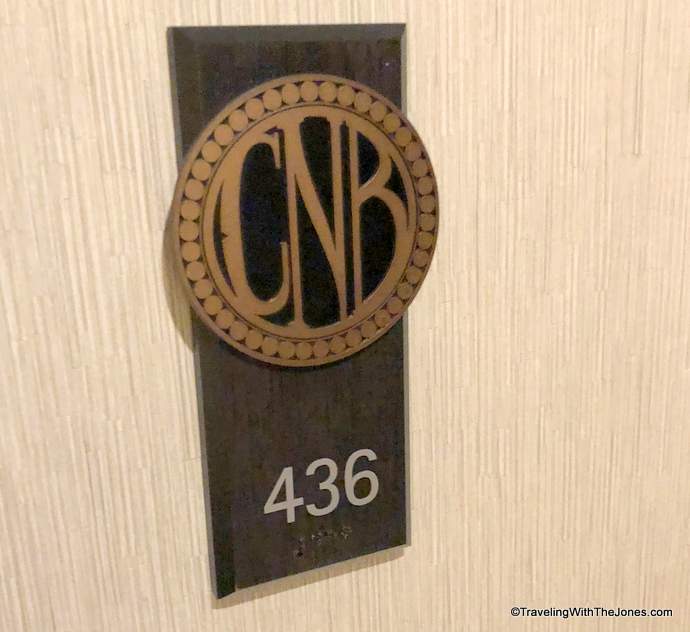
Room 436, Renaissance Denver Downtown City Center Hotel, ColoradoNote the CNB (Colorado National Bank) detail on the sign for Room #436 at the Renaissance Denver Downtown Hotel.
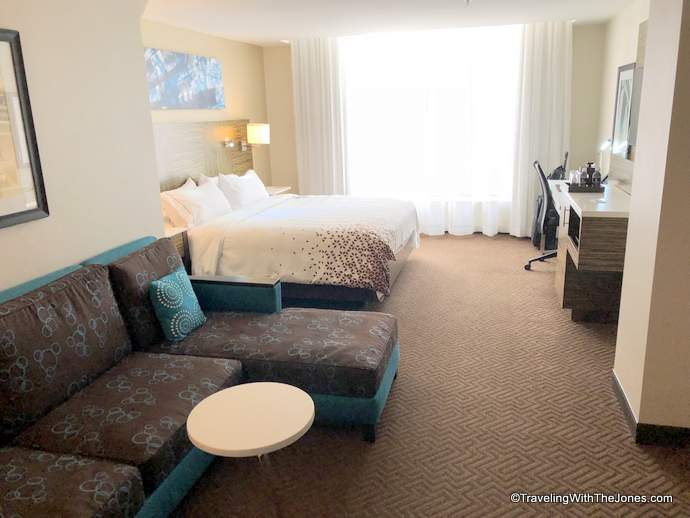
Entrance view, Room 436, Renaissance Denver Downtown City Center HotelThis is the view upon entering Room 436, a King Deluxe at the Renaissance Denver Downtown City Center Hotel.
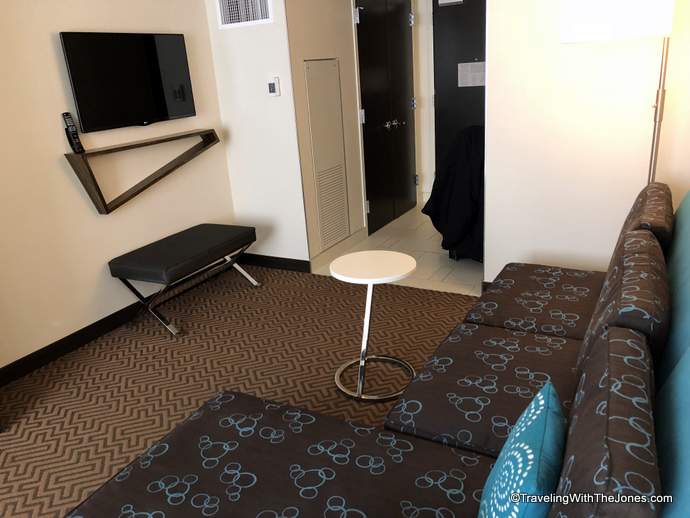
seating area, Room 436, Renaissance Denver Downtown City Center HotelThe long, somewhat narrow room has a dedicated seating area, with its own television.
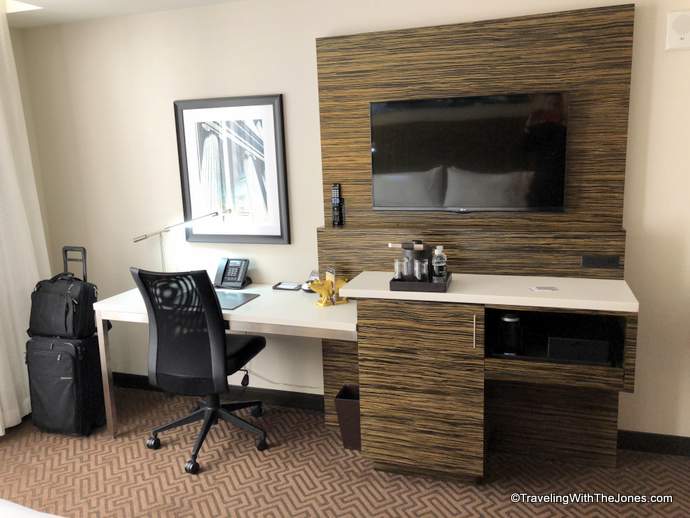
desk and 2nd TV, Room 436, Renaissance Denver Downtown City Center HotelAcross from the king bed is a comfortable desk and a second flat-screen television. The door below this TV hides a mini-fridge.
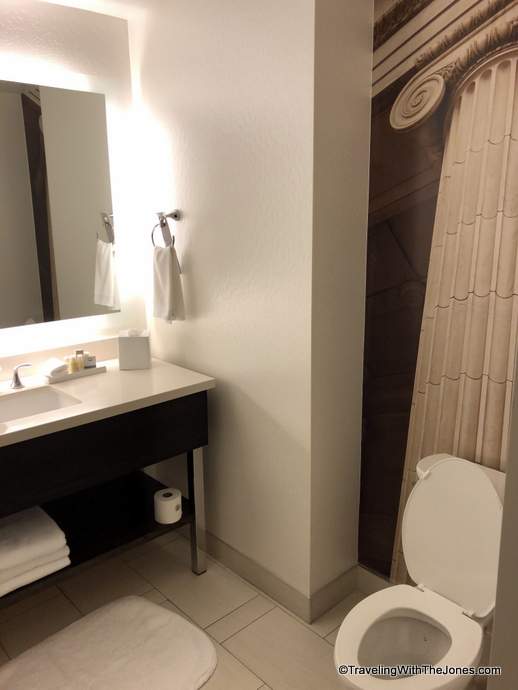
bathroom, Room 436, Renaissance Denver Downtown City Center HotelThe wall art in the bathroom of room 436 celebrates the building’s marble columns.
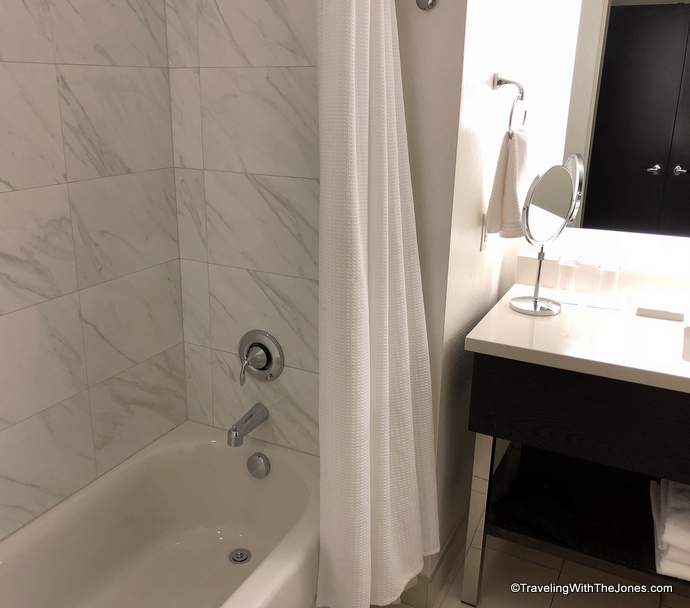
shower/tub, Room 436, Renaissance Denver Downtown City Center HotelThe walls of the shower/tub are tiled with marble, in the otherwise standard bathroom.

Our Bottom Line

We enjoyed our brief stay at the Renaissance Denver Downtown City Center Hotel.

The Pros:

  • The hotel atrium is stunning, as was especially festive for the holidays.
  • No cookie-cutter hotel, this property is unique in its reuse of a historic bank restore to its glory days.
  • The rooms have every modern convenience, from a comfortable bed, to good lighting to an effective desk for work.
  • The dedicated seating area and second television would be nice for relaxing with friends.
  • The hotel location is ideal for exploring downtown Denver on foot.

The Cons: 

  • As beautiful as it is, the three-story atrium seems impractical for a hotel. We could not enjoy a drink in the beautiful lobby at “Tellers” bar, because it closed before 10:30 pm on a Saturday evening in December. We were advised this was due to sound-proofing issues between the atrium and the guest rooms.
  • The executive lounge was in a beautiful location overlooking the lobby, but it felt like you were in a library or a museum rather than a hotel.

Have you stayed at the Renaissance Denver Downtown City Center hotel? How did the hotel rate for you?

Interact with us on TwitterFacebookPinterest or Instagram. 

Want to learn more about the history of Denver, Colorado? Check out these books:

{ 0 comments }

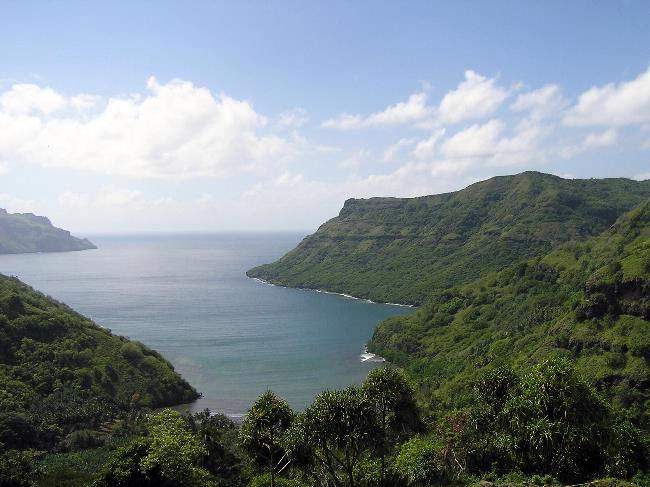
Friends on the 2018 Viking World Cruise will be visiting Taiohae on the island of Nuka Hiva — the largest of the Marquesas Islands. We were curious to learn more about the Marquesas Islands in the Pacific Ocean that make up one part of French Polynesia.

Nuka Hiva, Marquesas Islands
14 Fun Facts to Know About the Marquesas Islands

1. The Marquesas Islands are some of the world’s most remote islands. They are about 3,000 miles from the west coast of Mexico, the nearest continental land mass. The Marquesas are 850 miles northeast of Tahiti.

2. The Marquesas Islands form one of the five administrative subdivisions of French Polynesia, which is considered an overseas collectivity of France. Taiohae — a settlement on the island of Nuku Hiva — is the capital of the Marquesas Islands administrative subdivision.

The Marquesas Islands

3. There are 15 islands with a combined land area of 405 square miles that make up the Marquesas Islands group. Nuku Hiva, Ua Pou, Ua Huka, Hiva Oa, and Fatu Hiva are the major islands. All the Marquesas Islands are of volcanic origin, except for Motu One.

4. Temperatures in the Marquesas are stable year round, with average daily temperatures ranging between highs of 83°F to 87°F, with average daily lows ranging between 72°F and 76°F. Rainfall, however, is highly variable, ranging from 100+ inches on windward shores and mountains to as low as 20 inches in the “desert” region of Nuku Hiva.

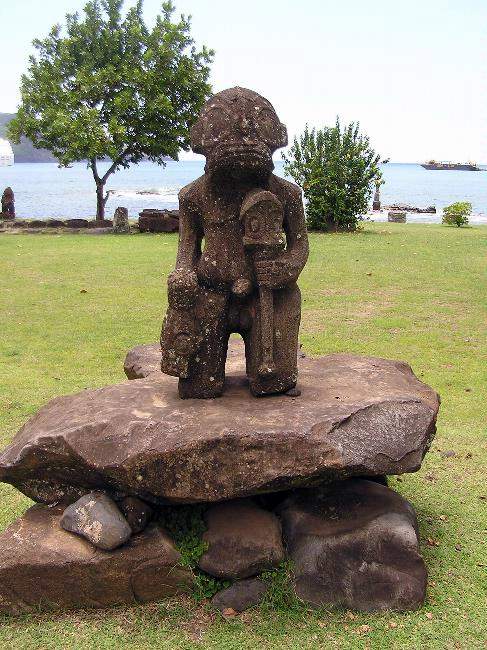
Stone tiki on Nuku Hiva Island in the Marquesas archipelago.

5. Recent research suggests that the Marquesas Islands were colonized rapidly between 1025–1120 AD by native people from West Polynesia, leading to development of a “remarkably uniform culture, human biology and language.” The islands’ rich environment supported a large population, who lived on a diet of fish and breadfruit supplemented by cultivated crops.

6. The islands were given their name by Spanish explorer Álvaro de Mendaña, who stopped at Fatu Iva on July 21, 1595. He called the islands Los Marquesas after the wife of the Viceroy of Peru.

United States Navy Commodore David Porter's fleet off Nuku Hiva in October 1813.
United States Navy Commodore David Porter’s fleet off Nuku Hiva in October 1813.

7. During the War of 1812, American Commodore David Porter claimed Nuku Hiva for the United States. On October 25, 1813 Captain Porter sailed his fleet to the island for repairs before continuing his raid against British shipping.  Captain Porter renamed Nuku Hiva “Madison’s Island” after President James Madison. On November 19th, Fort Madison –constructed on a hill next to Massachusetts Bay– was the site of an official U.S. flag raising ceremony with a declaration that the United States had officially laid claim to the island. In December 1813, Captain Porter left Nuka Hiva to continue raiding British whalers.

Captain Porter, who intended to sail back to Nuka Hiva, was captured at the Battle of Valparaíso on March 28, 1814. His claim on Nuku Hiva was never ratified by the United States Congress.

8. In 1842, France conducted a successful military operation on behalf of native chief Iotete and laid claim to the whole group of islands.  France reestablished control over the island group in 1870, and later incorporated the Marquesas into French Polynesia.

9. Of all of the Polynesia, the Marquesas suffered the greatest population decline from diseases brought in by Western explorers.  With no immunity to infectious diseases as smallpox and measles, the eighteenth-century population of more than 78,000 inhabitants declined to 20,000 by the middle of the nineteenth century, and to only 4,000 by 1900.  By 1926, the population reached an all-time low of 2,255 residents. Since then, the Marquesas population has continued to increase, reaching 9,346 inhabitants at the August, 2017 census.


10. Living in the Marquesas inspired American novelist Herman Melville’s first bookTypee: A Peep at Polynesian Life, first published in 1846. The book is a romantic account of his experiences with  of the people of Taipivai. Melville is better known for his 1851 whaling novel, Moby-Dick.

The grave of Paul Gauguin in Atuona, Marquesas Islands, is topped with a sculpture of Oviri. Photo by Christopher Brown
The grave of Paul Gauguin in Atuona, Marquesas Islands, is topped with a sculpture of Oviri. Photo by Christopher Brown.

11. Noted French artist Paul Gauguin spent the last years of his life in the Marquesas. He lived in Atuona on the island of Hiva-Oa and was buried there following his death in 1903.


12. In Aldous Huxley’s 1932 novel Brave New World, the Marquesas Islands are used as a place of exile for persons who think independently and have been identified as dangerous by the World State.


13. The Marquesas Island group is mentioned in the lyrics of the Crosby, Stills & Nash song Southern Cross: “off the wind on this heading lie the Marquesas.


14. In November 2001, the Marquesas island of Nuku Hiva was used as the filming location for the fourth season of the reality television show Survivor 4 Marquesas, airing in the United States in 2002. The Marquesas Islands, originally a backup location were for this season, were used when the original location, Jordan, was discounted as a result of the September 11 attacks and Middle East political situation.

Have you visited the Marquesas Islands in French Polynesia? What fun fact can you add?

Interact with us on TwitterFacebookPinterest or Instagram. 

{ 0 comments }

15 Fun Facts About Andorra

In anticipation of visiting Andorra – a new country to add to our list of Traveler’s Century Club destinations — I did a little background research on the 181-square-mile, land-locked country in Southwestern Europe’s Pyrenees mountains.

Andorra Fun Facts15 Interesting Facts About Andorra

1. The Principality of Andorra — as it is officially named — is the world’s 16th-smallest country by land area, and 11th-smallest country by population.

Map detailing the location of Andorra (dark green) within Europe (dark grey) by Bosonic dressing.

Map detailing the location of Andorra (dark green) within Europe (dark grey) by Bosonic dressing.

2. Andorra shares borders with Spain to its south and France to its north. The country is approximately 130 miles from Barcelona, Spain, and about 115 miles from Toulouse, France.

3. Legend says that Charlemagne (Emperor of the Romans) founded Andorra in 805 — in recognition for the help given by its inhabitants against the Saracens.

4. In 1278, the Bishop of Urgell and the Count of Foix signed the Pareatges, which established their co-sovereignty over Andorra. The Pareatges created the principality of Andorra as it is known today.

monument from 1978 commemorates the 700th anniversary of the Paréages that formed Andorra. It's located outside Casa de la Vall in the capital city of Andorra la Vella. Photo by MARIA ROSA FERRE.

This monument from 1978 commemorates the 700th anniversary of the Paréages that formed Andorra. It’s located outside Casa de la Vall in the capital city of Andorra la Vella. Photo by MARIA ROSA FERRE.

5. Andorra is the world’s only co-principality, headed by two princes. Neither of the two princes are from Andorra. One is the Bishop of Urgell, currently Joan Enric Vives Sicília, who is appointed by the Pope. The other co-prince is the President of France, currently Emmanuel Macron, who is democratically elected by the citizens of France.

6. Andorra is Europe’s sixth-smallest nation, with a population of 78,264.

7. Catalan is the official language of Andorra. Spanish, Portuguese, and French are also commonly spoken.

Grandvalira ski resort is in Andorra's Canillo and Encamp valleys. Photo by Christof Damian.

The Grandvalira ski resort is in Andorra’s Canillo and Encamp valleys. Photo by Christof Damian.

8. Located in the Eastern Pyrenees, Andorra is mountainous with 72 peaks. The Principality has two alpine and Nordic skiing areas.

9. With an elevation of 3,356 feet above sea level, Andorra la Vella — the capital city of Andorra — is Europe’s highest altitude capital city.

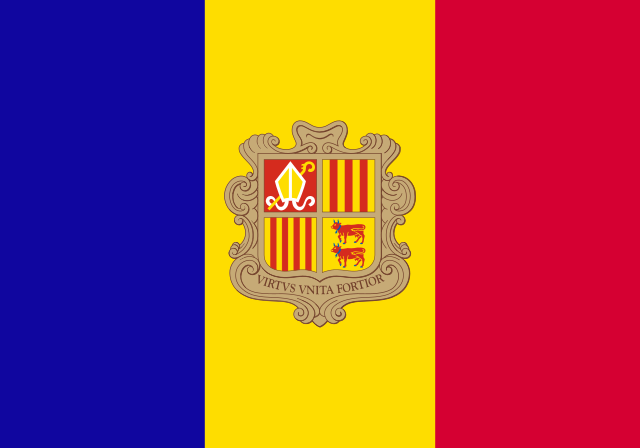
Flag of Andorra.

Flag of Andorra.

10. Tourism one of the main components of Andorra’s economy.The small country hosts 10.2 million annual visitors.

11. Many travelers to Andorra like to shop. Andorra has more than 2,000 stores and boutiques within its borders.

12. Although the euro is its official currency, Andorra is not a member of the European Union.

13. Andorra has no national bank and has never had its own currency. Before the euro, the country used the Spanish Peseta as well as the French Franc. Without a national bank, Andorra must use private banks if the country wants to incur debt.

14. In 1993, Andorra became a member of the United Nations.

15. In 2013, the people of Andorra had the highest life expectancy in the world at 81 years, according to the Global Burden of Disease Study.

Learn more about Andorra with these resources:(click on image)

Have you visited Andorra? What fun fact can you add? 

Interact with us on TwitterFacebookPinterest or Instagram. 

{ 0 comments }

While visiting Osaka, we wanted to try teppanyaki, a style of Japanese cuisine where food is cooked on an iron griddle.

The concierge at our hotel’s executive lounge recommended Rin-Tei, and made a reservation for us.

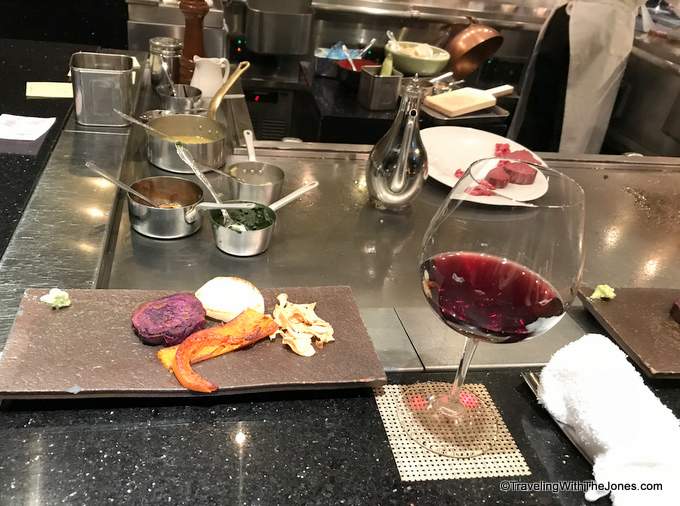
Teppanyaki at Rin-Tei in Osaka, JapanRin-Tei is located in the Hotel Trusty Osaka Abeno in the Tennoji /Abeno area. This teppanyaki restaurant was less than a 10-minute walk from our hotel (the Osaka Marriott Miyako.)

Upon our arrival, we were seated at two seats around the iron plate cooking griddle. While the set-up seemed similar to Benihana restaurants in the United States, the menu options were very different.  The chefs at Rin-Tei were very serious about cooking a five-course fine dining menu, right in front of you.

Teppanyaki chef at Rin-Tei in Osaka, JapanThe Rin-Tei seats only 17 people and for our 7:30 pm reservation on a Monday night, there were only a few other guests.

We were given a choice of five different fixed menus, each with five or more courses. I choose the Amber menu, while Mr. Jones went for the Lapis menu, since it added a foie gras dish, which he loves.  Our waiter helped us choose wines by the glass that would pair nicely with our food.
appetizer - Rin-Tei in Osaka, Japan
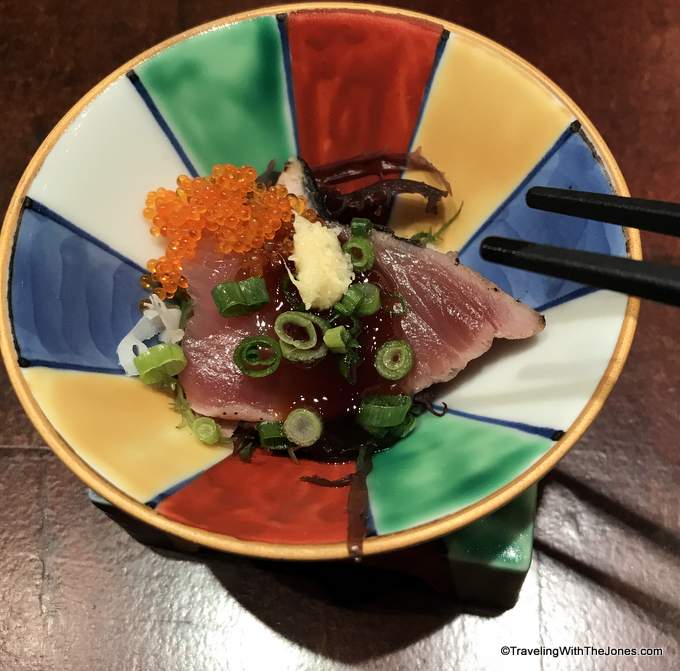
First we were served an appetizer of seared tuna. It provided an explosion of flavors, and hinted at the quality of food to come.

The next course was a soup described as a “cappuccino of cauliflower, with the flavor of espresso.”  Something might have been lost in English translation, but the soup was creamy, tasty and quickly devoured.

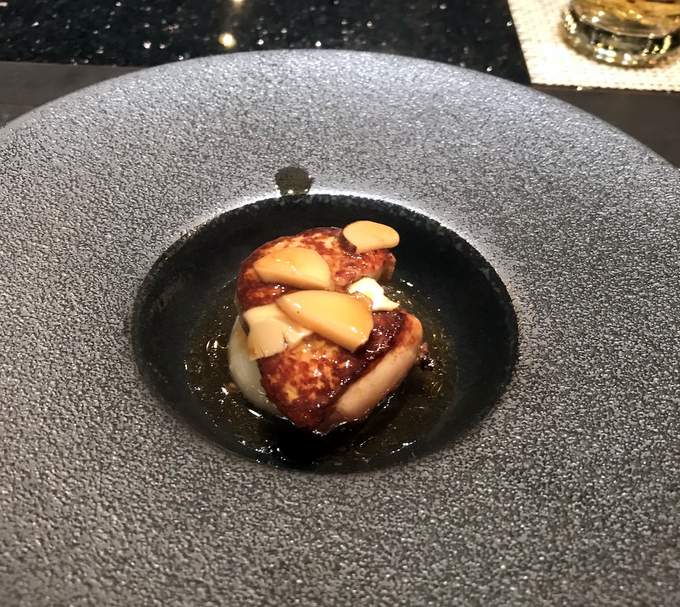
foie gras - Rin-Tei in Osaka, JapanMr. Jones enjoyed his foie gras, which had been perfectly prepared by the chef on the iron griddle in front of us. Besides eating great food, we got an up-close view of how it was prepared.

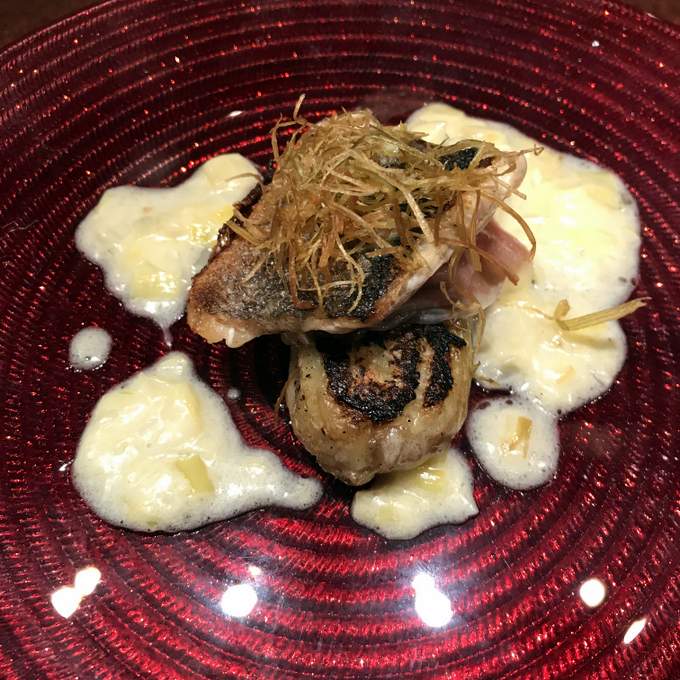
fish course - Rin-Tei in Osaka, JapanThis was my fish course from the basic Amber menu.

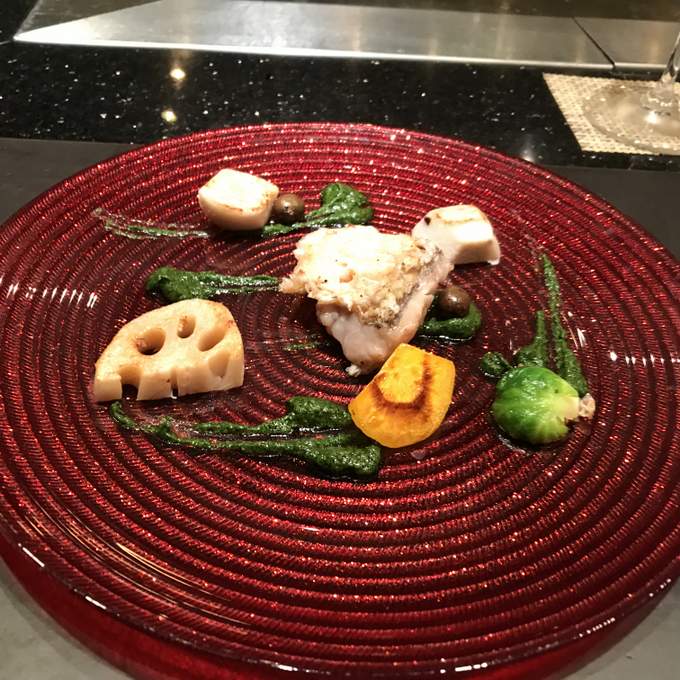
Lapis menu fish course - Rin-Tei in Osaka, JapanThis was the Lapis menu fish course. We appreciated how careful and artfully each course was plated in front of us.

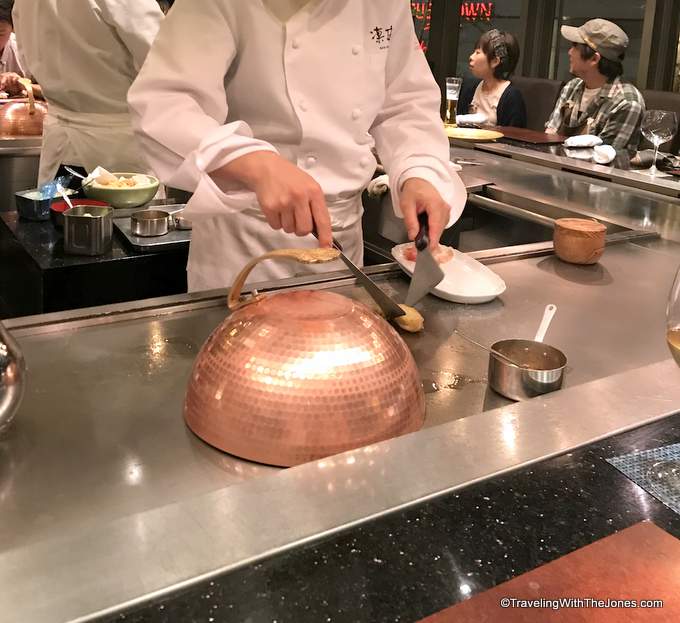
Teppanyaki preparation - Rin-Tei in Osaka, JapanWatching the teppanyaki preparation was as much fun as eating the food and drinking the wine. While the sauces were made in advance, and assistants brought the pre-cut meat and vegetables to the chefs, their sense of timing and ability to cook and plate each dish was impressive.

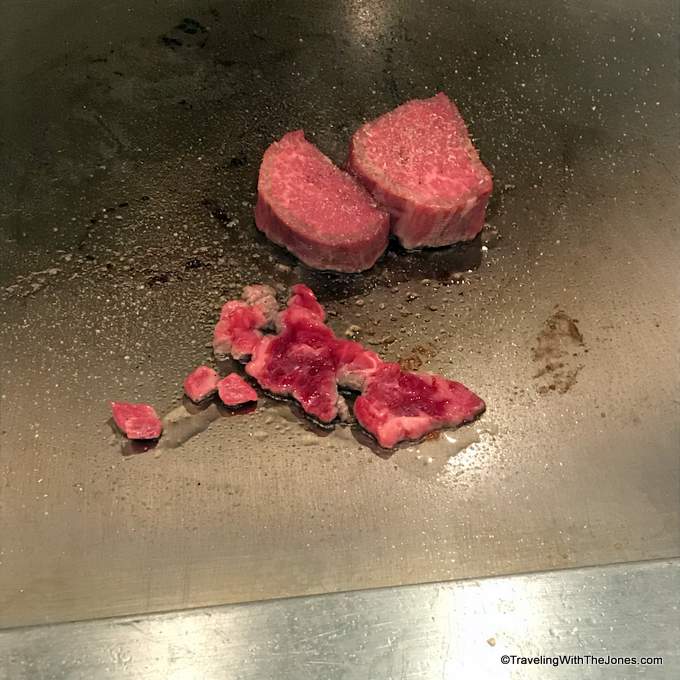
beef preparation - Rin-Tei Teppanyaki restaurant, Osaka, JapanEach diner’s beef was prepared to meet their request. The small pieces of beef were used to flavor the rice.  We could see the quality marbling in the Japanese beef.

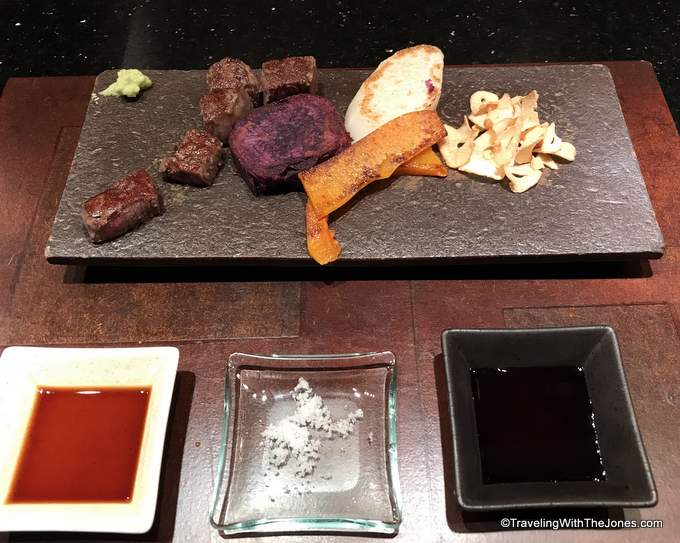
beef and vegetables - Rin-Tei Teppanyaki restaurant, Osaka, JapanThe perfectly cooked beef was served with root vegetables. Garlic chips, wasabi, sauces and seasoning were presented for each guest to use as they desired. (The beef did not, in my opinion, need any enhancements.)

After we finished enjoying all of our main courses, we were invited to move to another room (away from the teppanyaki griddle) for coffee and dessert.  
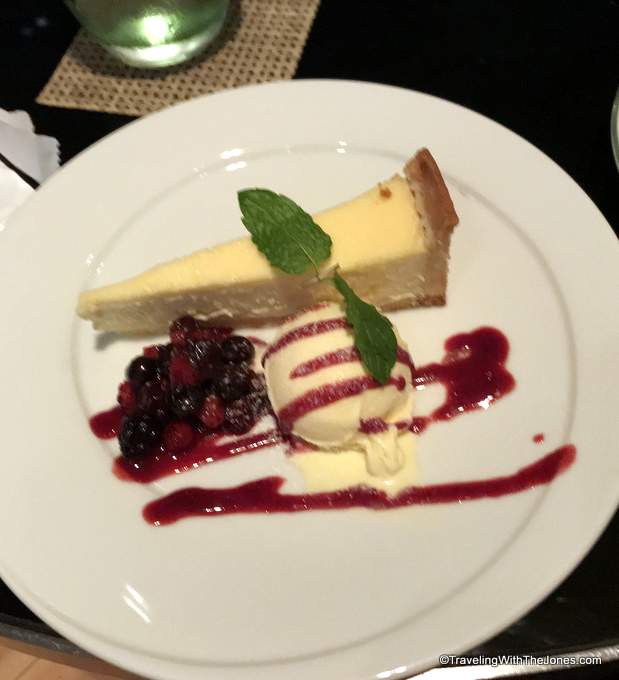
dessert - Rin-Tei Teppanyaki restaurant, Osaka, Japan
As we sipped our coffee, we decided we had to taste the dessert offering that included cheesecake, ice cream and a berry compote. It was a sweet ending to a lovely meal.

If you are in Osaka, there are literally thousands of places to eat at all price points. If teppanyaki and/or fine dining are on your wish list, we recommend Rin-Tei. Reservations are essential.  Dinner menus start at 8000 Japanese yen per person, not including wine.

Do you enjoy teppanyaki? What is your favorite? 

Learn more about Japanese food with these books:

Interact with us on TwitterFacebookPinterest or Instagram. 

{ 0 comments }