During a weekend visit to Charleston, South Carolina earlier this month, we enjoyed trying several dining and drinking establishments in this city known for its historic charm and hospitality.
View of Waterfront Park from Fleet Landing Restaurant, Charleston, South Carolina
On Sunday afternoon, we headed downtown Charleston, the oldest part of the historic city. Our first stop was to walk along the waterfront, which led us to the Fleet Landing Restaurant and Bar. The restaurant was not serving at 4 pm in the afternoon, but the indoor/outdoor bar was open.
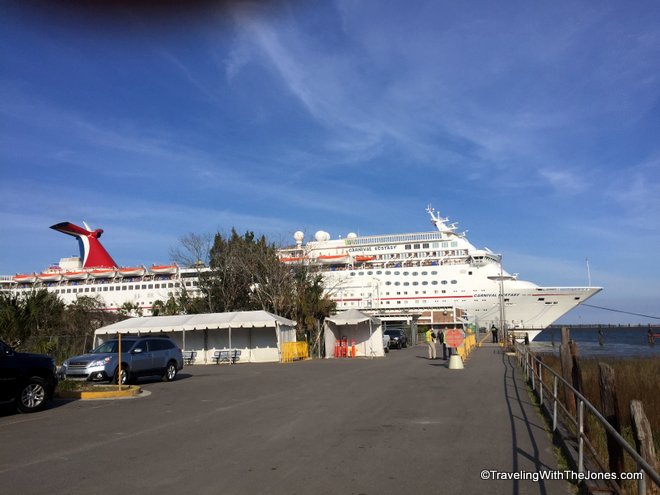
The outdoor bar at Fleet Landing is the perfect spot to watch a cruise ship departure, while enjoying a glass of wine or a local beer. As we heard the lifeboat drill, we were jealous, just for a minute, of those on board about to set sail.
We finished our drinks, and set out to explore East Bay Street, which is filled with restaurants and bars. Yelp reviews encouraged us to check out the relatively new Pawpaw restaurant, with its modern, Southern-inspired menu.
Since it was too early for us to enjoy dinner, we tried a couple of appetizers in the bar area at Pawpaw.
The “fluffy hush puppies” made with bacon and scallions (and served a trio of dipping sauces) were a big hit. We also enjoyed the unusual ahi tuna tartare bites, where the tuna mixture was served on tiny cakes said to be made of golden rice. These were a slightly spicy bite of interesting flavors – we could have eaten a dozen.
As for the cocktails, Mr. Jones’ martini-like drink was a little too herbal for his taste. While I was disappointed to find that wines by the glass were mostly limited to North Carolina “tap” or cask wines, I enjoyed a glass of sparkling rose that paired well with the appetizers. If you are willing to order a bottle, the menu does offer a more diverse selection of wines.
No longer hungry, we decided to walk round the historic section of Charleston before sunset. As we walked, we explored Church Street, poking into various alleys and side streets as we made our way from south of Broad Street to Water Street, before looping back to East Bay Street.
During our walk, we admired the architectural details of the historic houses and churches, and appreciated the signs detailing the history of some of the locations.
Post-walk, we stopped in the Gin Joint just off of East Bay Street. This bar offers a “bartenders choice” cocktail where you pick two words from a list of 16 descriptive words, and the bartender makes a drink designed to meet your taste preferences. Mr. Jones found his gin-based martini a little too “vegetal” for his tastes. “Vegetal” is one of the word choices, but was not one of his choices.
When I learned that the Gin Joint was out of my favorite Monkey 47 gin, I decided to stick with a glass of wine. I enjoyed the out-of-the ordinary Pad Thai popcorn appetizer that includes fish sauce, lime, chili and peanuts.
After more wandering around the neighborhood, we decided to make our final stop at High Cotton – a high-end bar that’s part of a fine-dining restaurant owned by the Hall Family. Since it was our final stop of the night, I decided to try a cocktail. When in Charleston, why not The Charleston Cocktail?
Although the bartender said it was not overly “sweet,” I found it too sweet (and to easy too swill like it was sweet tea) as a live music trio played in the background.
I switched to a glass of Argentinian Malbec, while Mr. Jones enjoyed a perfectly crafted martini with no hint of vegetables. We wanted a substantial appetizer, and the High Cotton meat and cheese board filled our request. It contained healthy portions of country pâté, liver mousse, salami, prosciutto, brie, smoked cheddar, and the southern staple — pimiento cheese — along with toasted bread and crackers.
Check out these Charleston food, dining and drinking reference books: The S.N.O.B. Experience: Slightly North Of Broad a cookbook by Frank Lee, Chef Emeritus, Cuisine Commando of the S.N.O.B. kitchen, another East Bay Street institution owned by the Hall Family. Charleston Receipts is the oldest Junior League cookbook still in print. First published in 1950, this cookbook contains 750 recipes, Gullah verses, and sketches by Charleston artists.
Norwegian Cruise Line recently announced a “nominal” adjustment to its daily service charges, beginning April 1, 2017. Raising its “discretionary daily service charges,” as the cruise line calls its auto gratuities, seems to be common annual occurrence, as we reported a similar increase in February, 2015 that took effect on March 1, 2015. Then there was another increase in 2016 for the cruise line.
Details of the April 1, 2017 Increase to Daily Service Charges on Norwegian Cruise Line
Here are the specifics for the new daily service charge rates.
For all ships except for the Norwegian Sky the new daily service charge rate (in US dollars) is:
• $13.99 per person per day for any category up to a Mini-Suite Stateroom. (This is increased from the current rate of $13.50, for an additional $0.49 per person per day.)
• $16.99 per person per day for any suite or Haven category. (This is increased from the current rate of $15.50, for an additional $1.49 per person per day.)
The Norwegian Sky cruise ship features an “open bar” concept for its 3 and 4 day sailings out of Miami.
For the all-inclusive product aboard Norwegian Sky (this “all-inclusive” label really means that the ship operates an open bar concept with many beverages such as soda and juice, and beer, wine and cocktails are included in the ticket price) the new daily service charge rates are increased substantially:
• $18.99 per person per day for any category up to a Mini-Suite Stateroom. (This is increased from the current rate of $13.50, for an additional $5.49 per person per day.)
• $21.99 per person per day for any suite category. (This is increased from the current rate of $15.50, for an additional $6.49 per person per day.)
There are two ways to avoid the increase if you act by March 31, 2017
1. If you plan to sail on Norwegian Cruise Line, make your booking by March 31, 2017, and then pre-pay your service charges at the current rate anytime up until one week before your cruise departure. (This is especially valuable if you are booking a sailing on the Norwegian Sky.)
WHY? For bookings made prior to April 1st, 2017, regardless of the date of your cruise prepaid service charges will be charged the CURRENT price of:
• $15.50 USD per person per day The Haven and Suites; $13.50 USD per person per day for Mini-Suites and below – FOR ALL SHIPS
2. If you are already booked for sailings on or after April 1, 2017, and you booked on or before March 31, 2017, then pre-pay your service charges at least one week prior to sailing to get the current service charge rates.
WHY? If you wait to pay service charges once on board your sailing, you will be charged the new, higher rates.
Important Notes About Service Charges on Norwegian Cruise Line
Guests sailing to Hawaii are charged an additional 4.275 percent GET Tax on their Pre Paid Service Charges.
Service charges apply to all guests 3 years or older.
You can pre-pay service charges through your travel professional, even if you already made your final payment.
If your existing cruise reservation included pre-paid service charges as a booking perk, you are not impacted for the first two guests in a cabin or suite. Third and fourth guests should be pre-paid, or else they will be charged the higher daily rate during your sailing.
Have you sailed on Norwegian Cruise Line? How was your experience?
We have four friends visiting Spain’s Canary Islands, as well as many other wonderful destinations via the 56-Day Grand Mediterranean Cruise on the ms Prinsendam. We wish we could join them as the Canaries – the seven islands off of the coast of West Africa – are still on our bucket list.
A view of Santa Cruz de la Palma, a city on the island of La Palma, one of Spain’s Canary Islands. Photo by Pwagenblast.
When we do visit, these are 7 things we’d want to see and do while on a port call to Santa Cruz de la Palma.
The most north-westerly island of the Canary Islands, La Palma is about 175,000 acres in size with a total population of about 86,000 people. Nearly 18,000 of them live in Santa Cruz de la Palma, the island’s capital city (known by locals as simply Santa Cruz.)
The city of Santa Cruz was founded by Alonso Fernández de Lugo on May 3, 1493. Originally called Villa del Apurón, the city served as a key port that connected Europe to the Americas, exporting goods from the island such as sugarcane. Pirates repeatedly sacked the city.
Museo Insular de La Palma, Santa Cruz de La Palma, Canaries
1. Learn about the town’s history at the Museo Insular de La Palma (Island Museum of La Palma) located in a 16th-century Franciscan convent. Exhibits about ethnography, natural sciences and art are displayed in rooms with elaborately carved ceilings around a courtyard of orange trees.
Ship Santa Maria in Santa Cruz de La Palma (Spain). Photo by Stephan M. Höhne.
2. It’s hard to miss the Museo Naval (Naval Museum) as it is housed in a ship. The museum building is a full-sized concrete reproduction of the Santa Maria, aboard which Christopher Columbus discovered the West Indies in 1492. This small museum details how Spanish conquistadors had taken sugar from the Canary Islands to Cuba, and how thousands of Canarians immigrated to Cuba from La Palma during the 19th century to work in the sugar industry. This ship building also plays a role in the city’s major festival every five years.
Church sanctuary that houses the Virgen de las Nieves (Snow Virgin) in Santa Cruz, La Palma, Canary Islands. Photo by Frank Vincentz.
3. Visit the church that houses the Virgin of the Snows. The island is predominately Roman Catholic and since 1676, has been known for the Fiestas Lustrales de la Bajada de la Virgen de las Nieves (the bringing down of the Virgin of the Snows.)
The Virgen de las Nieves (Virgin of Snows) Santa Cruz, La Palma,
Every five years, people come to Santa Cruz for the celebration. The image of the Virgin is taken down from her church sanctuary — the Real Insular Shrine of Our Lady of the Snows — which located in a hilly area on the outskirts of Santa Cruz — and paraded around the city of Santa Cruz during a two-week festival before she is returned. The last time this event was performed in 2015 and the next will be in 2020. The festival also features the dancing of “enanos” — costumes that people wear that give the appearance of dancing midgets.
Shopping street in Santa Cruz de La Palma, Canary Islands, Spain. Photo by Bengt Nyman.
4. Go shoe shopping among the cobbled streets.
Santa Cruz de la Palma is the birthplace of Manolo Blahnik, the world-famous shoemaker.
Although Mr. Blahnik now lives in Bath, England, surely there are shops selling his shoes in the city where he spent his childhood and still visits?
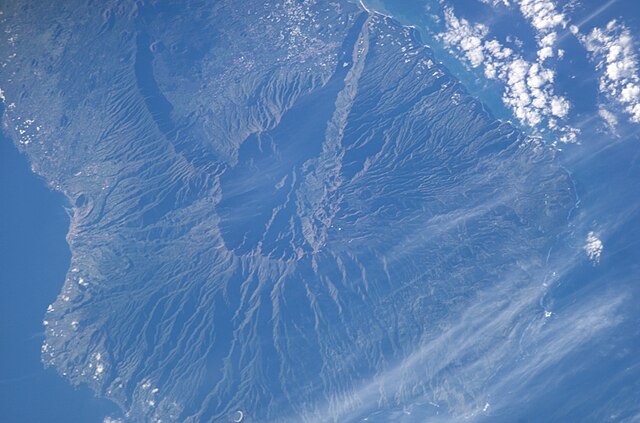
This NASA satellite photo of La Palma, one of Spain’s Canary Islands shows the Caldera de Taburiente and Cumbre Vieja, the active although dormant volcanic ridge on the island.
La Palma, like the other islands of the Canary Island archipelago, is a volcanic ocean island. The volcano rises almost 4 miles above the floor of the Atlantic Ocean.
5. Take a drive or ride around the island. La Palma has 750 miles of roads – most paved but with sharp bends and very narrow spots. You can drive completely around the island on a 112 mile-long road. There are also several public bus routes.
There is a road that runs from Los Llanos de Aridane to the capital city of the island Santa Cruz de La Palma. This road is a two-lane highway that includes a pair of two-lane tunnels that go right through the top of the mountain. When traveling from one side of the mountain, you may enter one side of the tunnel in complete clouds and come out to sun on the other side.
Roque de los Muchachos “Rock of the Boys”) is a rocky mound at the highest point on the island of La Palma in the Canary Islands, Spain. Photo by Luc Viatour / www.Lucnix.be
6. See some of the fifteen enormous telescopes were arranged along the ridge of Caldera del Taburiente National Park. There is road access from sea level to the island’s highest summit at 7,959 feet. This outcrop of rocks is called Los Muchachos “The Lads” or “Rock of Boys.”
Nordic Optical Telescope (NOT) on La Palma, Canary Islands. Photo by Michael Hanselmann @ www.MichaelHanselmann.de
As one of the world’s best places for stargazing, a number of international observatories have been built on the Roque de los Muchachos.
7. Take a hike along the water tunnels. Many people come to La Palma to hike, and there are at least 622 miles of marked paths all over the island. The most famous structures of La Palma are the minas galerias (water tunnels) which carry the water from sources in the mountains to cities, villages and banana plantations. The galerias have been cut into the rocks over centuries. It is possible to walk alongside many of the aqueducts, a popular activity for tourists.
This is what I most want to do while on La Palma, but this video shot with a GoPro Hero 4 head-mounted camera by Randy Hoffman might make me a little nervous. I’d definitely want a good local guide.
This figure-8 loop hike starts at the Barco (ship) in the centre of Santa Cruz and follows the PR LP 2.2 through residential areas to join the PR LP 2.3 (Ruta de los Molinos) into the Parque Natural Las Nieves. The trail then winds through a Laurisilva forest deep into the Barranco de la Madera through tunnels along a sheer cliff face with many “windows” to peer through. The water channel supplies rainwater from the mountains to the towns below. It was extremely hot and humid that day, and the “Calima” phenomenon (sand blown from the Sahara) was at its peak, making the air thick and more difficult to breathe as the day progressed. It was a long full-day hike … and that Dorada beer back in town tasted great afterward!
Note: There are a few exposed sections that may not be suitable for those with vertigo, and rock falls can occur at any moment. Cell coverage is sparse.
Have you visited La Palma in Spain’s Canary Islands?
Broad Street in Charleston, South Carolina. Photo by Khanrak.
1. The city of Charleston, South Carolina is located on the Atlantic Coast of the United States, roughly halfway between Washington D.C. and Miami, Florida.
2. Spread over 128 square miles, the heart of city is located on Charleston Harbor, an inlet of the Atlantic Ocean formed by the confluence of the Ashley and Cooper Rivers.
Map of Charleston, South Carolina and the surrounding area circa 1780. It has markings depicting Continental Army defenses set up in anticipation of British attack.
3. Charleston Harbor runs about 7 miles southeast to the Atlantic Ocean with a 1-mile wide entrance flanked by Sullivan’s Island to the north and Morris Island on the south.
4. Today Charleston had an estimated population of 132,600 residents, a dramatic increase from 1670 when 148 men and women that sailed into the harbor on three small ships from Bermuda. Led by William Sayle, this group established the settlement of Charles Town, named for British King Charles II. William Sayle, in his eighties, became the first Governor of South Carolina in 1670.
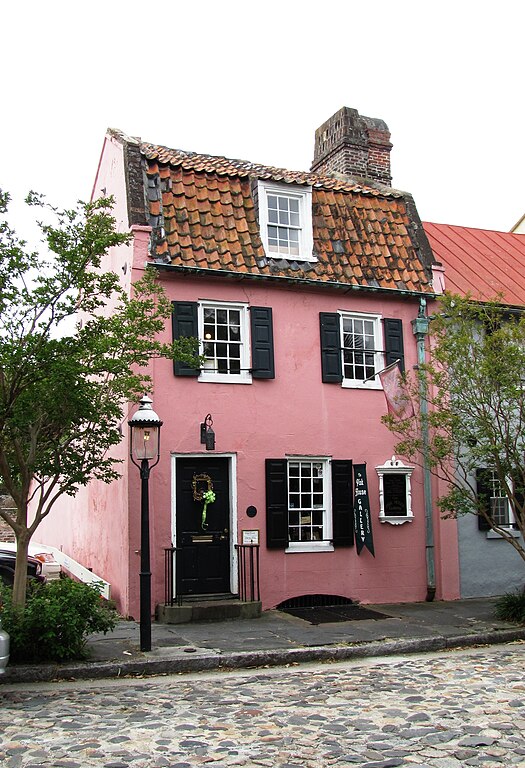
The Pink House, built of limestone from Bermuda around 1712, is considered the oldest stone house in Charleston, South Carolina today. Photo by Brian Stansberry.
5. Charles Town was the first surviving English colony in the South, and was a remarkable accomplishment given the hostile Spanish and French settlements in the region.
6. Within two years, the town was moved across the river to the peninsula known as Oyster Point, and for a while, Charles Town was also known as Oyster Town.
7. Within five years, the population of Charles Town had quadrupled. Over the years, trade in animal furs, rice, indigo, naval stores would turn the little community into a burgeoning seaport. It was also a central port for the slave trade.
8. The port and related trade brought Charles Town wealth, and the wealthy Charlestonians wanted culture. Soon they had the first theater, golf club, museum and City College in America.
9. On February 12, 1736 the original Dock Street Theatre opened with a performance of The Recruiting Officer. Built on the corner of Church Street and Dock Street (now known as Queen Street), this building was America’s first theater.
10. In 1739, Mrs. Elizabeth Timothy became Charleston’s first female newspaper editor and publisher.
11. In 1743, Charleston merchant David Deas received a shipment of 432 golf ball and ninety-six clubs from Scotland. This led to the first organized golf played in America on pastureland near the corner of Pitt and Bull Streets. Golf enthusiasts in Charleston organized the South Carolina Golf Club on September 29, 1786.
12. Dr. Alexander Garden, a Charleston physician first imported “Cape Jasmine” from South Africa around 1754. The flower was renamed Gardenia after Dr. Garden.
13. Founded in 1770 and chartered in 1785, the College of Charleston is the oldest municipal college in the United States.
14. Pineapples are a symbol of hospitality in Charleston, a tradition that goes back to Colonial days when returning sea captains would spear a pineapple outside their home. This was to let the captain’s friends know he had returned safely, and that they could come over to hear his stories from the high seas.
15. America’s first museum was founded in the city in 1773. Today the Charleston Museum’s mission is to preserve and interpret the cultural and history of Charleston and the South Carolina Low Country.
16. During the Revolutionary War, one of the most improbable victories in American military history was made near Charleston on June 28, 1776. During the Battle of Fort Sullivan, soft logs from Palmetto trees and sand smothered the effects of most of the British cannonballs, leading the America colonists to their first decisive victory during the Revolutionary War.
17. A week later the Declaration of Independence was signed, and South Carolina was on its way to becoming part of a new nation. Four Charlestonians signed the Declaration of Independence: Arthur Middleton, Thomas Heyward Jr., Edward Rutledge and Thomas Lynch Jr.
18. After the Revolutionary War it wasn’t popular to have cities named after British royalty. Charles Town was renamed Charleston in 1783.
The house at 94 Tradd St., Charleston, South Carolina was once the studio for Samuel Morse. Photo by ProfReader.
19. Samuel F.B. Morse arrived in Charleston at the age of 26 from Boston in January, 1818. A painter in search of wealthy clients to commission him to paint their portraits, Morse set up a second-floor studio in the Samuel Wainwright House at 94 Tradd Street. From this studio he painted a portrait of Mrs. Daniel DeSaussure Bacot which can be viewed today in the Metropolitan Museum of Art in New York City.
20. After his 4-year stint in Charleston, Samuel Morse went on to invent the original Morse telegraph, as well as the Morse code, the primary language of telegraph data throughout the world.
21. Charleston was a pro-slavery city. The Ordinance of Secession for South Carolina to formally secede from the United States of America was written and signed in Charleston in December 1860. This action was the beginning of the activities that led to the United States Civil War.
22. On January 9, 1861, Citadel cadets stationed on Morris Island opened fire on the USS Starof the West as it entered Charleston Harbor.
Fort Sumter in South Carolina. Photo by Jud McCranie.
23. The first full battle of the American Civil War occurred in the Charleston harbor on April 12, 1861 when shore batteries under the command of General Beauregard opened fire on the US Army-held Fort Sumter.
24. Following the seizure of Fort Sumter, Lincoln called for 75,000 volunteers and planned an invasion of the South that led to the War Between the States.
25. After the Civil War, the North donated black paint to spruce up the city. There was backlash against the “Yankee color,” so the paint was mixed with some “Confederate” yellow paint and dash of blue to become the signature “Charleston” dark green paint color.
26. On August 31, 1886, Charleston was nearly destroyed by a 7.0 magnitude earthquake that was felt from Boston to Chicago to New Orleans. The earthquake caused $6 million worth of damage, at a time when all the city’s buildings were valued around $24 million.
27. After the devastating earthquake in 1886, all newly constructed buildings in Charleston included earthquake rods. Today, the metal circles that can be seen on the outside of some historic buildings the ends of these earthquake rods.
28. Charleston established its first baseball team — the Sea Gulls — in 1886. In 2017, the Charleston RiverDogs are the local minor league baseball team, and an affiliate team of the New York Yankees. Actor Bill Murray is part-owner and “director of fun” for the RiverDogs.
29. The eye of Hurricane Hugo came ashore at Charleston Harbor in 1989, damaging three-quarters of the homes in Charleston’s historic district, and causing more than $2.8 billion in damage.
30. Named for the former U.S. Representative, the Arthur Ravenel, Jr. Bridge spans the Charleston Harbor, connecting historic Charleston and Mount Pleasant. When it was constructed in 2005, it was the longest cable-sustained bridge in United States. The bridge is 1,546 feet long and costs $700 million to build.
31. Charleston has about 230 days of sunshine each year and has an average daily temperature of 65.6 degrees Fahrenheit.
32. To keep cooler during the hot and humid summers, many homes in Charleston have verandahs that face south or west to take advantage of the prevailing winds.
33. Charleston calls itself the “Holy City” because of its numerous churches and their steeples that puncture the skyline.
The historic Emanuel African Methodist Episcopal (AME) Church in Charleston, SC. Photo by Cal Sr.
34. On June 17, 2015, 21-year-old Dylann Roof entered the historic Emanuel African Methodist Episcopal Church and sat in on part of a Bible study before shooting and killing nine people. Roof was convicted of all 33 federal hate crime charges against him stemming from the shooting, and has been sentenced to receive the death penalty.
35. While Cold Mountain, the 2003 Civil War movie featuring Nicole Kidman, Jude Law and Renee Zellweger was primarily filmed in Romania, it has some scenes shot in Charleston. One example is where the male character Inman makes conversation with the blind man.
First Lady Michelle Obama participates in an interview with Stephen Colbert during a taping of “The Colbert Report,” at the Colbert Report Studio in New York, N.Y., April 11, 2012. (Official White House Photo by Lawrence Jackson)
37. Stephen Colbert, comedian, author, and host of The Late Show with Stephen Colbert, grew up on James Island in Charleston County. He was the youngest of 11 children in a Catholic family and attended Charleston’s Episcopal Porter-Gaud School, where he participated in several school plays.
38. Boeing South Carolina in North Charleston is a final assembly and delivery point for the Boeing 787 Dreamliner to customers around the world. All final assembly of Boeing’s 787-10 planes is completed at the North Charleston facility.
39. The Port of Charleston, owned and operated by the South Carolina Ports Authority, is one of top 10 container ports in the United States. In 2015, the port handled nearly $76 billion dollars of goods.
40. Charleston’s Union Pier Cruise Ship Passenger Terminal – located at 32 Washington Street – has 80 scheduled round-trip cruise departures in 2017, in addition to 25 port calls by 15 different cruise lines. The Union Pier Terminal is the homeport for the Carnival Ecstasy cruise ship which sails 4-, 5-, 6-, and 7-day cruises to the Bahamas and the Caribbean throughout 2017 and 2018. The Carnival Sunshine cruise ship will make eight round-trip sailings from Charleston during 2017.
Learn more about Charleston, South Carolina with these resources:


 Norwegian Cruise Line recently announced a “nominal” adjustment to its daily service charges, beginning April 1, 2017. Raising its “discretionary daily service charges,” as the cruise line calls its auto gratuities, seems to be common annual occurrence, as we






 and
and  is from Charleston.
 , and host of The Late Show with Stephen Colbert, grew up on James Island in Charleston County. He was the youngest of 11 children in a Catholic family and attended Charleston’s Episcopal Porter-Gaud School, where he participated in several school plays.