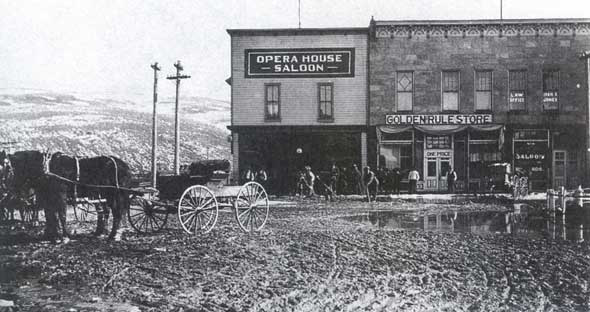
Cheyenne is the capital city of the state of Wyoming, located in the southeast corner of the state, and only 101 miles north of Denver, Colorado. As we planned a recent visit, we wanted to learn more about this city.

36 Facts to Know about Cheyenne, Wyoming
1. With 64,165 residents (in 2020) Cheyenne is the most populated city in the state of Wyoming. Only 549,914 people live in the entire state of Wyoming, making it the least populated of all 50 U.S. states.
2. The city of Cheyenne was named for the Cheyenne — indigenous people of the Great Plains — who were closely allied with the Arapaho.
3. “Cheyenne” means “people of the strange tongue” in the Arapaho language.

4. Cheyenneites have two reasons to celebrate the 4th of July: in addition to the founding of the United States in 1776, 91 years later — on July 4, 1867 –the first tents were pitched on the site now known as Cheyenne.
5. General Grenville Dodge chose the site that became Cheyenne as the point where the Union Pacific Railroad would cross Crow Creek, a tributary of the South Platte River. General Dodge was plotting the course of the Transcontinental Railroad west from Omaha toward California.
6. On November 13, 1867, the Union Pacific Railroad — started in Omaha, Nebraska, and racing west — reached Cheyenne.
7. Within five months of its founding, 4,000 people were said to be living in the city of Cheyenne. Once the railroad arrived, Cheyenne’s rapid growth earned it the “Magic City of the Plains” nickname.
8. The U.S. Census, however, counted Cheyenne’s population differently, with 1,450 people in 1870, increasing to 14,087 residents by 1900.
U.S. Decennial Census for Cheyenne, Wyoming
1870 1,450 —
1880 3,456 138.3%
1890 11,690 238.3%
1900 14,087 20.5%

9. In August of 1867, the U.S. Cavalry established Fort D. A. Russell — a military installation three miles west of Cheyenne — to protect Union Pacific Railroad workers from “hostile Indians.”
10. The fort was later renamed Francis E. Warren Air Force Base in honor of Wyoming’s first United States Senator, Francis Emroy Warren, who was awarded the Medal of Honor during the American Civil War.

11. Today Francis E. Warren Air Force Base is the oldest continuously active military installation within the U.S. Air Force. One of three strategic-missile bases in the United States, Warren AFB is home of the 90th Missile Wing, and the Twentieth Air Force, which commands all U.S. Air Force ICBMs.
12. John A. Campbell, the first governor of Wyoming Territory, took his oath of office on April 15, 1869. Two days later, the Wyoming Territory government was organized, and Cheyenne was chosen as the capital.
13. Construction of the Wyoming State Capitol building in Cheyenne started in 1869, although it took another 21 years for Wyoming to become a state.

14. Cheyenne remained the capitol city when Wyoming became the 44th U.S. state in 1890.
15. In 1881, the Wyoming Telephone Company first produced the first “yellow pages” in Cheyenne when the company ran out of white paper and had to substitute yellow paper while printing its classified section of 102 listings.

16. Dedicated on October 31, 1913, the Lincoln Highway — one of the earliest highways for automobiles to drive across the U.S. — passed through Cheyenne on its 3,389-mile coast-to-coast route from New York City’s Times Square to Lincoln Park in San Francisco.

17. The Lincoln Theatre — located in downtown Cheyenne on the Lincoln Highway (also called US 30, Licolnway, or 16th Street) was opened in March 1927. The historic theater closed in 2019 and has been converted into a live music venue.
18. Just as the railroad helped Cheyenne grow during the last quarter of the 19th century, aviation gave the city a boost after World War I. In 1920, when the U.S. Post Office announced a new airmail route from Chicago to San Francisco, Cheyenne’s civic leaders lobbied for their city to be a station on the flight route. Since the airplanes of this era could only fly during daylight and no higher 10,000 feet, Cheyenne’s location made it an ideal stopping point prior to planes crossing the Rocky Mountains.
19. On September 6, 1920, Cheyenne Airport became one of only 15 national locations to serve an airmail station when the Chicago-to-San Francisco leg of the Transcontinental Airmail Route was inaugurated. Pilot Buck Heffron flew out of Cheyenne with 400 pounds of mail destined for the West Coast. The next day, James “Jimmy” Murray landed in Cheyenne with the first load of mail from the east. Murray returned with the first east bound mail on September 13, thus helping complete the inaugural circuit of the first transcontinental air service in history.

20. In 1929, the city of Cheyenne erected a two-story, brick terminal building to accommodate the growing number of air passengers at the Cheyenne Regional Airport. Today the former terminal building is used as an office building for airport administration.
21. Also in 1929, the Boeing Air Transport Company — after changing its name to the United Aircraft and Transport Company (which eventually became United Airlines) was awarded the Chicago-to-San Francisco mail route contract. The same year, United Aircraft chose Cheyenne as the location of its main overhaul facility for maintaining and repairing planes.
22. In 1933, United consolidated all its major maintenance and overhaul facilities in Cheyenne, creating one of the world’s largest aircraft maintenance facility at the time. This move created jobs and added stature to Cheyenne’s image as an air center.
23. By 1935, the Cheyenne airport had 24 daily arrivals and departures. In 1937, United Airlines DC-3s were flying Cheyenne passengers to both coasts and south to Denver.

24. When World War II caused flying restrictions on the West Coast, United Airlines relocated its pilot training school to Cheyenne from California in 1942.
25. Also during WW II, the Cheyenne airport became a modification center for B-17s, installing new instruments and guns in the planes. The tail turret on the B-17 is known as the “Cheyenne” turret because it was invented at Cheyenne. The Cheyenne Modification Center was a huge facility that employed 1,642 workers at its peak. Half of the 1,600 employees were women.
26. After the end of WWII, United Air Lines took over the Cheyenne modification center in a lease agreement with the government; moving company’s equipment and machinery from its overhaul base at the airport to the modification center. United Airlines maintained its Douglas DC-3s planes at Cheyenne; the airline had 1,400 employees based in Cheyenne in 1946.
27. While WWII brought more aviation business to Cheyenne, it only delayed the inevitable changes brought by newer technology. The introduction of the DC-4 aircraft eliminated the 10,000-foot altitude ceiling that restricted older planes. The DC-4 could fly from Chicago to California non-stop at an altitude of 18,000 ft, eliminating the need for a stop in Cheyenne before crossing the Rocky Mountains.
28. In 1947, United moved it maintenance facilities out of Cheyenne to San Francisco, and its flight training division for pilots from Cheyenne to Denver.
29. United Airlines did not completely abandon Cheyenne in 1947. The airline did open a training school for its stewardesses in a hangar at the Cheyenne Airport. In the evening, the female trainees would relax at the Wigwam Lounge in Cheyenne’s historic Plains Hotel. Local cowboys would parade up and down the hotel’s Peacock Alley in efforts to be noticed by the women. United trained 83,000 women at the stewardess school in Cheyenne before relocating it to Chicago in 1961.
30. Today, aircraft manufacturers still test their new jetliners for high altitude flying at the Cheyenne Regional Airport, which is 6,160 feet above sea level. The latest tests in Cheyenne involved Embraer of Brazil’s E-170 and E-190 aircraft as well as Boeing’s 737-900, its 787 Dreamliner jets and the Boeing 737 Max 8.


31. In 1930, author Mary O’Hara and her second husband bought a ranch west of Cheyenne, naming it Remount Ranch. While living on the ranch, O’Hara wrote some of her best known books including My Friend Flicka (1941), Thunderhead (1943), and Green Grass of Wyoming (1946).


32. Cheyenne Frontier Days — with the world’s largest outdoor rodeo and Western celebration in the United States — dates to 1897. During its 123-year run, the event has only been canceled one time, in 2020, due to the COVID-19 pandemic.
Cheyenne Frontier Days are scheduled to return in 2021, running from July 23 through August 1.
33. Cheyenne is notable for two high profile weddings.


On November 21, 1940 literary legend Ernest Hemingway married his third wife, novelist and wartime correspondent Martha Gellhorn in Cheyenne at the Laramie County Courthouse. The couple celebrated their nuptials with a dinner at the Cheyenne Depot. The reception is depicted in the 2012 HBO movie “Hemingway and Gellhorn”


In 1980 Steve McQueen married Ali McGraw in Cheyenne’s Holliday Park. McQueen was in Cheyenne filming Tom Horn, a movie based on a true killer-for-hire story.
34. Today visitor to Cheyenne’s Holiday Park can see “Big Boy” Number 4004 — the world’s largest steam locomotive built specifically to make it over the rugged Rocky Mountains.

35. In 1968, John Turner started as a single taco stand in Cheyenne. Today Taco John’s operates and franchises nearly 400 restaurants in 23 states, making it one of the largest Mexican quick-service restaurant brands in the U.S. The company is still headquartered in Cheyenne.
36. Cheyenne is still a railroad town — on average 70 to 95 freight trains pass through the city every day. There are not any passenger trains into Cheyenne however, as Wyoming and South Dakota are the only two “lower 48” states in the U.S. without Amtrak service.
What fun fact about Cheyenne, Wyoming can you add to this list?
Share your comments or questions via Twitter, Facebook, Pinterest or Instagram.
For more fun facts posts, check out Fun Facts from Travel Destinations Around the World