≡ Menu

Explorations Cafe, Holland America LineWe received a question from Dave S. about beverage options while sailing on a Holland America Line cruise ship to Alaska this summer:

I looked at the Holland America website for info on non-alcoholic drink package and didn’t find anything. I wondered how coffees and soda drinks are charged?

Beverages included in Holland America Line Cruise Fares

Guests on Holland America Line cruises can enjoy coffee and hot tea, as well as ice tea and water free of additional charge. These options are served at all restaurants during dining hours, as well as 24 hours a day in the Lido buffet restaurant or ordering the beverages from room service. In addition, a variety of juices are served during breakfast hours, and lemonade or fruit punch during lunch and dinner hours in the Lido restaurant.

Sodas, espresso-based coffee drinks and non-alcoholic beverages such as mocktails are served for an additional charge in restaurants and bars throughout the ship, as well as in the Explorations Cafe.

Purchasing Non-Alcoholic Drink Packages on Holland America 

Holland America Line does offer five different beverage package options that include non-alcoholic drinks. These are in the form of a Beverage card which you can purchase in advance of your cruise via the Holland America website.  The five beverage card options are:

  • ITEM #1525 $50 Soda Fountain Value CardPurchase a pre-paid $25.00 fountain soda card for $25 and receive $50 toward fountain soda purchases.
  • ITEM #1526 $50 Non-alcoholic Beverage Card. This beverage card can be redeemed for a variety of beverage 50.00 selections from soda and espresso to non-alcoholic beverages.
  • ITEM #1527 $50 Beverage Card. This beverage card can be redeemed for a variety of beverage selections 50.00 from soda, espresso and non-alcoholic beverages, to wine, beer and spirits.
  • ITEM #1162 $100 Beverage Card. This beverage card can be redeemed for a variety of beverage selections 100.00 from soda, espresso and non-alcoholic beverages, to wine, beer and spirits.
  • ITEM #1163 $250 Beverage Card. This beverage card can be redeemed for a variety of beverage selections.

NOTE: only the Soda Fountain Value Card offers any discount compared to simply buying a soda or coffee or other beverage on the ship. Beverage cards, however, are nice gifts if you have friends or family members cruising. Purchasing the beverage cards in advance for your cruise helps you “pre-pay” for anticipated expenses in advance, and reduce your charges to your on board account.

mocktails, Holland America LineThese are some of the non-alcoholic beverages available on Holland America cruises.

How to Purchase A Beverage Card 

To purchase one of the beverage cards for yourself or for friends or family members who are taking a Holland America cruise, you need to visit the Holland America website.

already booked, Holland America websiteLook for the “Already Booked” link at the top right corner of the home page. (See yellow highlight in screen shot above.)

alreadybooked2, Holland America Line websiteOnce you click on “Already Booked”, look for the “Book Excursions, Flights, Indulgences, Dining & Spa” link on the left-hand side of the web page. (See the yellow highlights above.)

booking #form, Holland America websiteYou will need your booking # for the cruise. Enter it, and your last name, then click on “FIND BOOKING” to purchase a beverage card.

beverage card purchase, Holland America websiteWhen you reach the GIFTS & INDULGENCES screen, you can click on the “Beverages” link on the left side of the screen. This takes you to a long list of choices. Alternatively, you can click on the “Download our Gift Brochure” to view all of the options and prices, which also can be booked by calling Holland America Line Ship Services at 1-800-541-1576 (for guests in the U.S.)

Pink Coral Cocktail, Silk Den, Holland America Nieuw AmsterdamThe Signature Beverage Package

If you want the ability to drink most beverages offered on a Holland America cruise for one daily price, you will want to take a look at the Signature Beverage Package.  This option – which costs a total of $51.69 per person per cruise day, must be purchased for your entire cruise by all adults sharing the same stateroom.

We’ve shared our experiences with Holland America’s Signature Beverage Package several times on this blog. This beverage package includes a wide variety of wine, beer and spirits, as well as soda, espresso and non-alcoholic beverages such as mocktails. You can review those posts which include photos of drink menus by clicking on these links:

If you are not consuming any alcoholic beverages, the Signature Beverage Program will probably not be financially advantageous. Purchasing Beverage Cards, or simply charging beverages to your shipboard account as you consume them will likely be a better option.

Do you like to purchase beverage cards or beverage packages before your cruise? Please share your thoughts in the comments below. 

These posts are on drink packages offered by other cruise lines:

Follow us on Twitter or interact with us on Facebook

Or, check out our boards on Pinterest and/or our photos on Instagram.

{ 0 comments }

Exploring Makassar, Indonesia by Taxi

This post was updated on April 29, 2021. The updates ar in red text.

In 2013, while sailing on a short segment of the Holland America Grand World Voyage, I visited Makassar, the provincial capital of South Sulawesi, Indonesia.

city of Makassar, South Sulawesi, Indonesia

The port city of Makassar is also known as Ujung Pandang — which is the name of the pre-colonial fortress in the city that dates to 1545.

The original fortress was built by the Gowa Dynasty. The spice trade drew Portuguese sailors to Makassar in 1511, followed by the Dutch in the early 17th Century. When the Dutch captured the fort in 1667, which they built over the existing structure and renamed it Fort Rotterdam.

Makassar, Indonesia, is located on the southwest coast of the island of Sulawesi, facing the Makassar Strait. (Map created by Sadalmelik.)

Today, in 2021, Makassar/Ujung Pandang is Indonesia’s fifth largest metro in terms of population. The city is southern Sulawesi’s primary port, with regular domestic and international shipping connections. The port has fewer than 10 cruise ships visit each year. In 2022 and 2023, Silversea and Windstar have scheduled visits to the port of Makassar /Ujung Pandang.

Holland America's Amsterdam in Makassar (Ujung Pandang), Indonesia

I feel fortunate to have visited this Indonesian city via a Holland America cruise as it is a fasinating place that I would be unlikely to visit on my own.

Once in port, I explored independently with my friends Steve and Tom. We walked around the streets near the port area before deciding to hire a taxi to take us to a few sites that we’d learned about from Barbara, the Holland America port lecturer on the Grand World Voyage.

modes of transportation, Makassar, Indonesia

Traffic is intense in Makassar with a mix of cars and trucks, motorbikes, pete-petes (a minibus that has been modified to carry passengers), becak (pedicabs), buses and taxis.

While our taxi driver had little to understanding of English, we relied on a map to point out the sites we wanted to visit.

Al Markaz Al Mosque, Makassar (Ujung Pandang), Indonesia

Our first stop was at the Al-Markaz Al-Islami Mosque, described as one of the most opulent mosques in South Sulawesi.

with children at Al Markaz Al Mosque, Makassar (Ujung Pandang), Indonesia

Without an English-speaking guide, we found the children at the Al Markaz Al Mosque knew some English, and were very friendly.

Steve with children at Al Markaz Al Mosque, Makassar (Ujung Pandang), Indonesia

Wherever we went, the children wanted to be in our photos. Who could resist those faces?

Pantai Losari, Makassar, Indonesia

Next our taxi driver took us to Pantai Losari, the “beach” waterfront area of Makassar. It home to a floating mosque, and is a good location for taking photo memories of the city.

fishing boats, Paotere Harbor, Makassar, Indonesia

Then we headed to Paotere Harbor, a scenic anchorage location for pinisi fishing boats.

Lamba Pinisi boat, Paotere Harbor, Makassar, Indonesia

The Lamba pinisi or phinisi (picture above) is a traditional Indonesian two-masted sailing ship, still used today mostly for cargo and fishing purposes within Indonesian archipelago.

drying fish, Paotere Harbor, Makassar, Indonesia

Freshly-caught fish, drying on racks, were plentiful at the Paotere Harbor.

looking out from the Amsterdam cruise ship onto the port of Makassar, Indonesia

After a few hours of exploring, we headed back to the port and re-boarded the Amsterdam cruise ship. The view — as we began to sail away from Makassar, Indonesia — reminded me that this city is a unique combination of its spice trading history with its rapidly changing future growth and development.

Once I visit a place that I’ve never been before, I tend to pay attention when I hear about that place in the news. This BBC travel story, published on April 12, 2021 caught my attention. The BBC article focuses on the Bugis people, a powerful enthic group in Southg Sulawesi, Indonesia who sail the Prahu fishing ships into Makassar’s Paotere Harbor. Most unique, the Bugis people recognize five separate genders of people rather than just the male and female. Read the story of Asia’s isle of five separate genders.

Have you sailed on a world cruise? Do you tend to pay closer attention to news about places you’ have visited? 

You might be interested in these other out-of-the-ordinary destinations that we’ve visited via a cruise ship: 

Follow us on Twitter or interact with us on Facebook

Or, check out our boards on Pinterest and/or our photos on Instagram.

{ 0 comments }

20 Fun Facts About Juneau, Alaska

visitor welcome sign, Juneau, Alaska

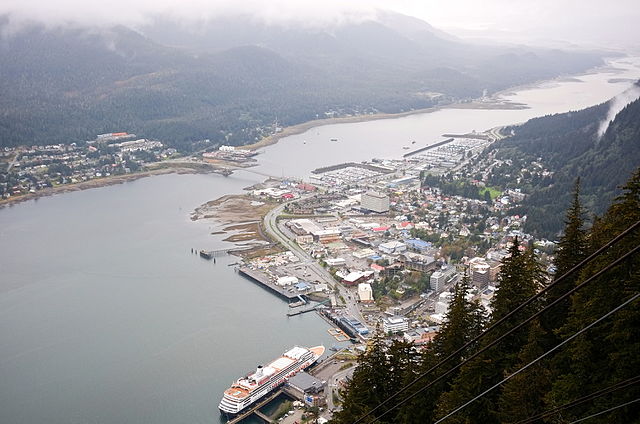
Juneau, Alaska’s capital city is located on the Gastineau Channel in the southeast part of the state between the Gulf of Alaska and British Columbia.

Aerial view of Downtown Juneau, the cruise ship port, and Douglas Island from the Mount Roberts Tramway. Photo by Mark Hogan.

The heart of Juneau, a city of 32,406 residents, lies between the ocean and ice-covered mountains. Downtown Juneau sits at sea level below mountain peaks reaching up to 4,000 feet.  These mountains are topped by the Juneau Icefield, a 1,500-mile ice mass that feeds more than 30 glaciers including the 13-mile long Mendenhall Glacier that ends in Mendenhall Lake just outside of Juneau.

20 Interesting Facts about Juneau, Alaska

1. The Auke and Tuku tribes of native Tlingit Indians fished along the Gastineau Channel near Juneau for thousands of years before Europeans explored Alaska.

2. In 1880, local Tlingit Chief Kowee led prospectors Joe Juneau and Richard Harris to Silver Bow Basin, where they discovered gold nuggets “as large as beans” at the mouth on a stream they called Gold Creek. This find was the first major Alaskan gold discovery.

3. On October 18, 1880, Juneau and Harris marked a 160-acre town site where soon a mining camp appeared. Acting as recorder, Mr. Harris named the new mining district Harrisburgh after his own name.

4. Upon learning of the gold discovery, the U.S. Navy sent a detachment under the command of Lt. Com. Charles Rockwell to keep order 30 miners arrived by Christmas of 1880. At one of the first town meetings in February 1881, the residents decided there were too many other American cities called Harrisburgh, and changed the town name to Rockwell in honor of the Navy commander.

5. In late 1881, the miners met again and renamed the town Juneau, after Joe Juneau, who was rumored to have bought more drinks for those voting on the city name.

6. Across Gastineau Channel in the community of Douglas (now a part of Juneau) the Treadwell and Ready Bullion mines operated from 1882 to 1917, producing $66 million in gold in its 35 years of operation.

7. In 1916, the Alaska-Juneau gold mine was built on the mainland and became the largest operation of its kind in the world. The Alaska-Juneau (A-J) mine produced more than $80 million in gold before it was closed in 1944 during World War II.

8. In 1906, the capital of the District of Alaska was moved to Juneau from Sitka. The move of the capital city followed the gold-rush fueled growth of Juneau combined with the decline in whaling and fur trade that had given Sitka its earlier economic prominence.

Alaska State Capital Building, Juneau. Alaska

9. In 1911, the United States Congress authorized funds for an Alaska Territory capitol building; World War I, however, delayed construction until September 8, 1929. The Art Deco building was dedicated on February 14, 1931, and became the state capital in 1958 when Alaska gained statehood.

10. A 14,400 sq. Alaska Governor’s Mansion was completed in Juneau in 1912. The governor resides on the second floor of the 6-bedroom, 10-bathroom and 8-fireplace mansion when he or she is in Juneau for official business.

11. Juneau is the only U.S. state capital to border another country (Juneau shares its eastern border with the Canadian province of British Columbia.)

12. While Juneau is located on the Alaska mainland, there are no roads that connect the city to the rest of Alaska or North America due to the rugged terrain that surrounds it. All goods arrive and depart by plane or boat. Cars arrive to Juneau via the Alaska Marine Highway Ferry System — the floating roadway for Southeast Alaska.

13. Tourism is a large part of Juneau’s current economy in addition to government and fishing. Nearly a million visitors experience Juneau each summer via a cruise ship.

14. Tourists visiting Juneau via a ship is not, however, a recent development.  Wealthy travelers first sailed north to sight-see Juneau via monthly voyages on the Ancon and the Idaho by the Pacific Coast Steamship Co. of San Francisco as early as 1881.

15. The Taku River, just south of Juneau, was named after the cold t’aakh wind, which occasionally blows down from the mountains. Juneau residents occasionally experience the Taku winds—which can gust up to 100 miles per hour—between October and March.

16. The State Office Building is affectionately called the “S.O.B.” by locals. Visitors should check out the restored pipe organ, totem pole and eight-floor observation deck with great views of Juneau and Gastineau Channel.

Mt. Roberts Tramway, Juneau. Alaska

17. The Mount Roberts Tramway whisks visitors up nearly 2,000 feet from Juneau’s waterfront to the mountaintop in just six minutes, providing both a stunning view and access to hiking trails.

18. Juneau has more than 130 miles of hiking trails.

19. About 20,000 bald eagles reside in Juneau.

20. The Aurora Borealis (also known as the Northern Lights) can be seen occasionally on clear evenings between late August and April, usually above Mt. Juneau.

Do you want to learn more about Juneau?
Juneau

Do You Know Juneau? A Kid’s Guide To Juneau, Alaska

Are you visiting Juneau via a cruise ship? This is a good guide for all of your Alaska ports:

National Geographic Traveler: Coastal Alaska: Ports of Call and Beyond

Check out these “Fun Facts” posts on Alaska destinations:

Other posts on cruising Alaska: 

Follow us on Twitter or interact with us on Facebook

Or, check out our boards on Pinterest and/or our photos on Instagram.

{ 0 comments }

Rainforest Canopy & Zipline Expedition, Ketchikan, AlaskaThe Rainforest Canopy & Zipline Expedition was of the most exciting adventures that I’ve experienced in Ketchikan, Alaska.

I booked the shore excursion via a Holland America Line 7-Day Glacier Discovery cruise sailing from Seward, Alaska to Vancouver, British Columbia.

on the 4x4 Unimog, Rainforest Canopy & Zipline Expedition – KetchikanThis zip line and canopy tour is located near the Tongass National Forest, which is a rain forest.  First you transfer from the Ketchikan cruise port about 8 miles to Herring Cove, where everyone boards an all-terrain 4×4 vehicle.

As you would expect, it rains frequently in this environment. We experienced cloudy skies but only a mild drizzle. transport up a steep rainforest hillside to the canopy chalet

The drive to reach the canopy chalet is a bumpy ride up a steep hillside through the rain forest. This forest is home to bald eagles, black bear, and a variety of other wildlife.

Chalet - Rainforest Canopy & Zipline Expedition – KetchikanFinally, the vehicle arrives at the canopy chalet that leads to the first zipping platform.

getting outfitted for the Rainforest Canopy & Zipline Expedition – KetchikanFirst though, you meet your guides and get outfitted with safety equipment in the chalet. There is also a safety training prior to zipping from the first platform.

harness, Rainforest Canopy & Zipline Expedition – KetchikanThe harness and guide lines are quite a contraption. This is a much more intense experience that other zip lines such as the Dragon’s Breath zip line on Labadee, Royal Caribbean’s Private Resort in Haiti.

the first zip, Rainforest Canopy & Zipline Expedition – Ketchikan, AlaskaThe first zip line is actually a test. You have to prove that you are strong enough to slow yourself as you “zip” into each platform.

This rainforest canopy challenge features eight ziplines and three suspension bridges strung over 6,000 feet of high tension cables.

double cables, Rainforest Canopy & Zipline Expedition – Ketchikan, AlaskaThe guides ease you into the forest canopy along cables ranging from a short 100 feet to the 750 foot pulse pounding “Ben’s Revenge”.

group harnessed to wires, Rainforest Canopy & Zipline Expedition – Ketchikan, AlaskaEach zip is over a dual-cable ziplines between lofty tree platforms. Participants are divided into small groups with two guides per group. While traversing each zipline, you are connected to the cables at four points with lanyards and trolleys.

zipping one at a time, Rainforest Canopy & Zipline Expedition – Ketchikan, Alaska
Only one person can traverses a zipline at a time.  One guide “zips” to the next platform. Then each person in your group takes their turn sailing between platforms.

zipping fast, Rainforest Canopy & Zipline Expedition – Ketchikan, Alaska

The double cables “droop” as each person speeds over them to the next platform. The more you weigh, the faster you “fly.” To participate, you must weigh between 90 and 250 pounds, and be at least 60 inches tall.

group harnessed to wires, Rainforest Canopy & Zipline Expedition – Ketchikan, AlaskaWhen all of the guests reach the next platform, the second guide follows. The guides clip your lanyards one at a time at each platform, so that no one is ever un-connected from a cable during the entire adventure.

suspension bridges, Rainforest Canopy & Zipline Expedition – Ketchikan, AlaskaIn addition to the eight ziplines, the course includes walking over three sky bridges.

suspension bridges, Rainforest Canopy & Zipline Expedition – Ketchikan, AlaskaYou are still harnessed to a cable over each skybridge, which is comforting, as the bridges do sag and sway as the group walks across them.

suspension bridge, Rainforest Canopy & Zipline Expedition – Ketchikan, AlaskaIf you are brave enough to look down 135 feet below, you can see breathtaking views of the forest and Eagle Creek below. Some guests see eagles and bears from the tree platforms. I didn’t but perhaps I was a little focused on the task at hand.

taking photos, Rainforest Canopy & Zipline Expedition – Ketchikan, AlaskaYou can only take photographs from the platforms, and any video and still cameras must be approved and attached by a guide.

zipping, Rainforest Canopy & Zipline Expedition – Ketchikan, AlaskaYou use both hands in heavy gloves to make each “zip,” so there’s no taking of iPhone selfies en-route. Closed toed shoes are required, and long pants and layered clothing are recommended.

This zipline and canopy adventure does require a high level of fitness, with full use of all limbs required. Pregnant women and guests with injuries/seizure disorders not allowed. Minors must be at least 5 feet tall, and must be accompanied by a “zipping” adult.

great views, Rainforest Canopy & Zipline Expedition – Ketchikan, AlaskaAs you get closer to the end of the route, the views from the platforms change. Here you get a stunning view of the base camp and the countryside around Ketchikan, Alaska.

viewing tower, Rainforest Canopy & Zipline Expedition – Ketchikan, AlaskaThe last zip line ends at the viewing tower, which is 55 feet above ground. You climb down these stairs and head to the base camp, where you get to take off all of your harness gear.


base camp, Rainforest Canopy & Zipline Expedition – Ketchikan, AlaskaThe base camp also has a gift shop where you can buy photos of your Rainforest Canopy & Zipline Expedition.

This shore excursion is quite expensive, costing between $179 and $200 per person. But it is a 3.5 hour-long unforgettable, if nerve-racking adventure. Participants who complete the course receive a medal.

Have you participated in the Rainforest Canopy & Zipline Tour in Ketchikan, Alaska? What did you think?

Check out these other posts on cruising Alaska: 

Check out these “Fun Facts” posts on Alaska destinations:

Follow us on Twitter or interact with us on Facebook

Or, check out our boards on Pinterest and/or our photos on Instagram.

{ 1 comment }