≡ Menu
Pizza at Bonci during Rome Food Tour

One of our favorite ways to learn about a city’s food, culture and history is through a food walking tour.

There has been explosive growth of food tours since we took our first in 2010. We like to find food tours that focus on a specific neighborhood that’s removed from the main tourist areas.

During our early-December three-day stay in Rome, we found a 4-Hour Food Tour by Night in the Rome Prati neighborhood, offered through Get Your Guide.

We met Luisa, our food tour guide, at the appointed location. She enthusiastically started our tour with introductions among our fellow food tour guests: a couple from Ireland and a family of three including a teenager from Singapore.
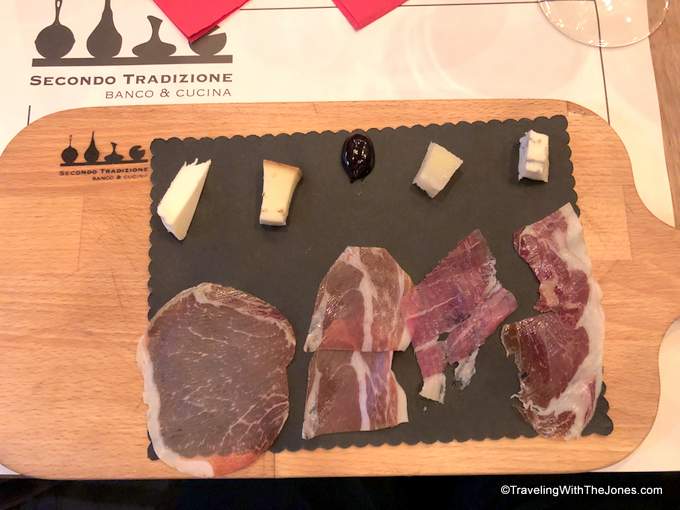
ham and cheese tasting on he Roman Food Tour

Our first stop was all about ham, and cheese, and wine. What’s not to love? We each savored four different kinds of specialty ham, including Italy’s most expensive. Can you guess which one it was in the photo above?
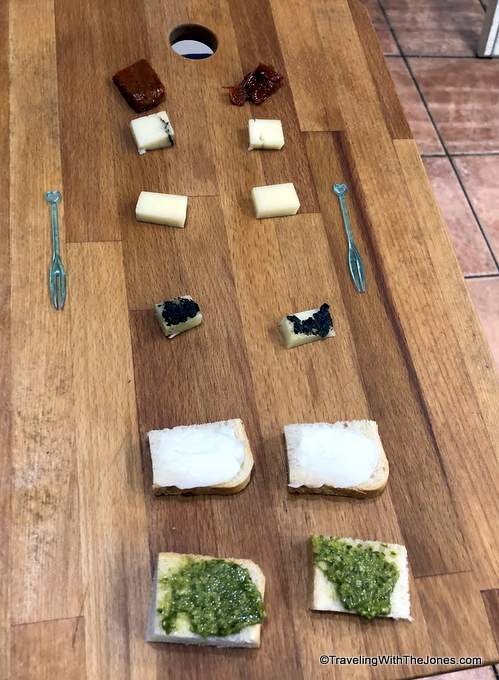
cheese tasting on he Roman Food Tour

The next stop was a small shop specializing in fine cheeses and olive oils, among other good things.
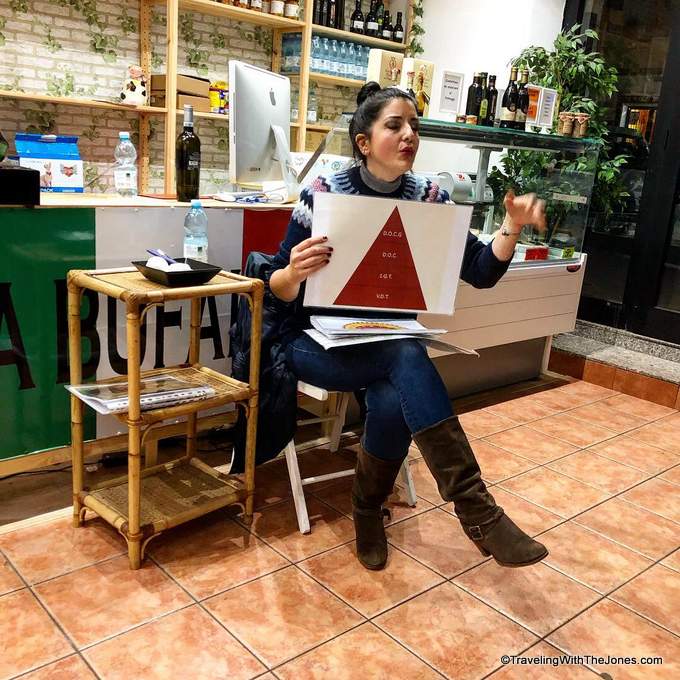
Guide Lusia explains Italian wine designations during Roman Food Tour

In addition to tasting a variety of cheeses and toppings, our guide Luisa gave us a detailed explanation of what the different designations on Italian wines indicate.

Italian wines are classified in one of four categories, ranging from
Vino Da Tavola (VdT), the most widely-produced and generally least expensive, to the most specific wines which are labeled Denominazione di Origine Controllata e Garantita (DOCG).
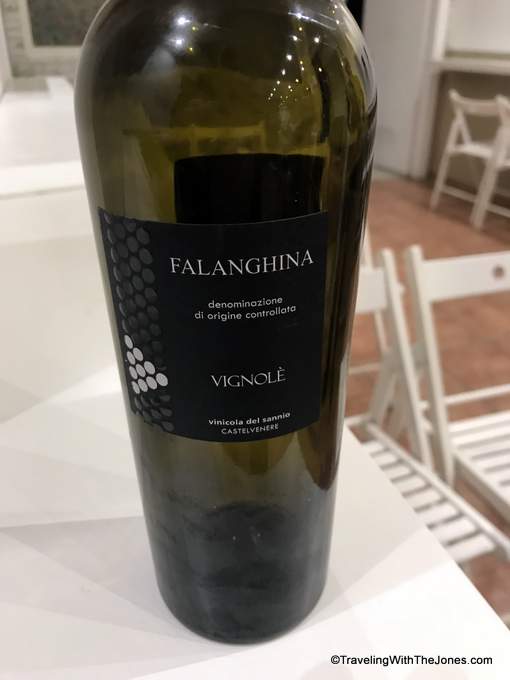
Tasting wine during the Roman Food Tour

While learning, we were tasting a glass of the Vignole wine, which is classified as a Denominazione di Origine Controllata (DOC) wine.
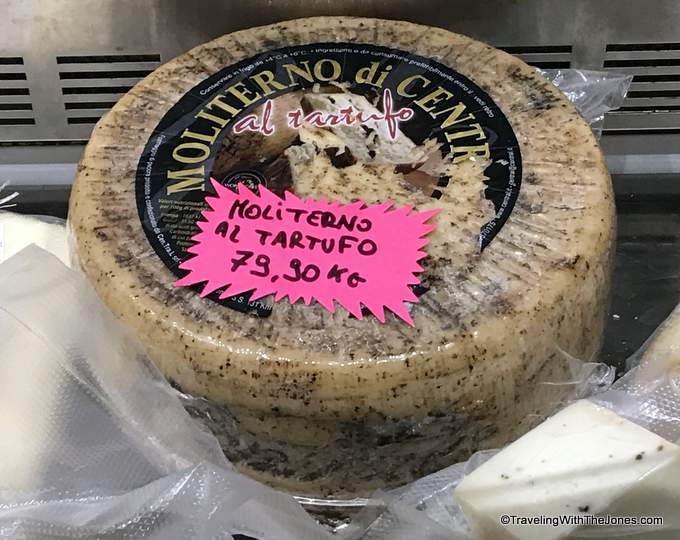
moliterno al tartufo cheese, Roman Food Tour

We sampled moliterno al tartufo, a sheep’s milk cheese injected with black truffles that is produced on the Italian island of Sardinia. It’s one of Italy’s most expensive cheeses.
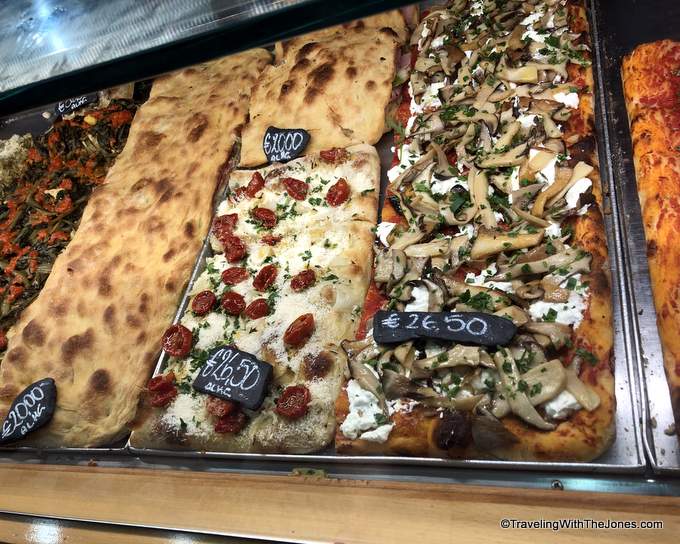
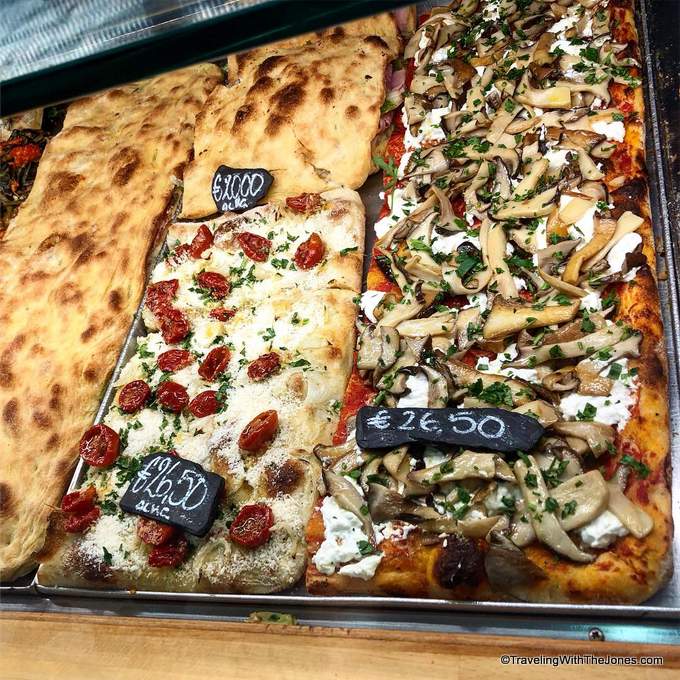
Up next on our tour was a stop at Bonci, a casual pizza stand famous for its crust and wide variety of toppings.
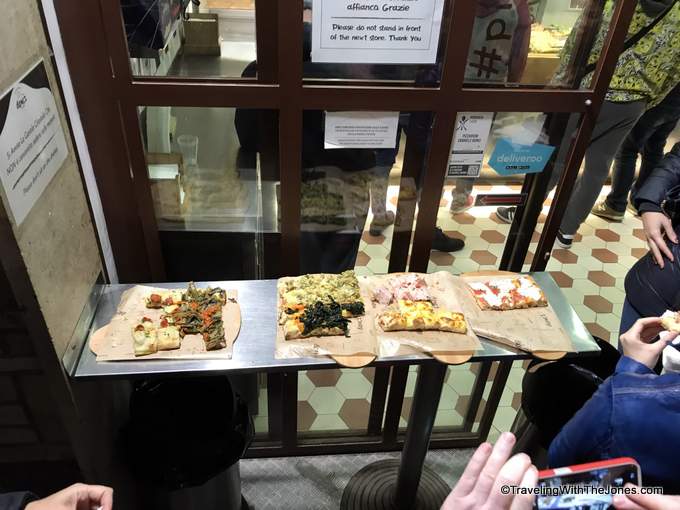
Luisa suggested each member of our group select a different topping. Then each section of pizza was cut into eight pieces, so we could try them all if we liked. (Note, one should come to this tour very hungry.)
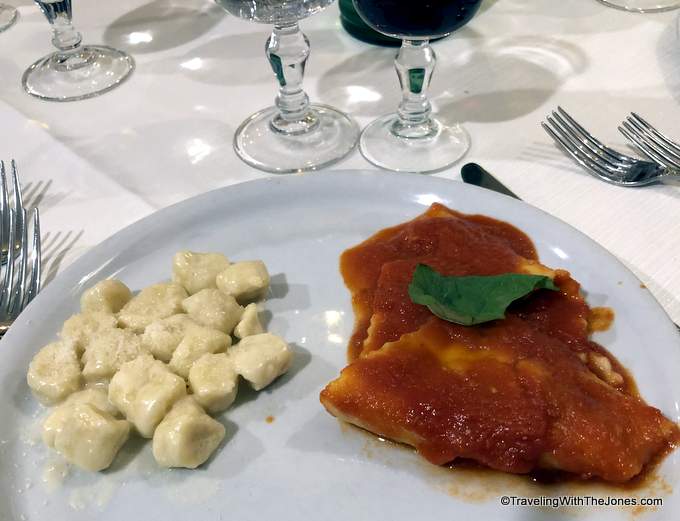
Next up was a family-run neighborhood restaurant where we enjoyed two different kinds of freshly-made pasta.
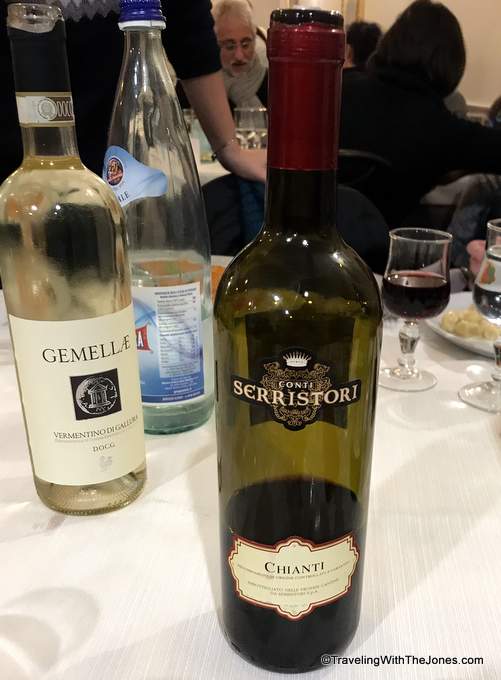
With the pastas, we tried three different Italian wines including a white, a red and a sparkling wine.
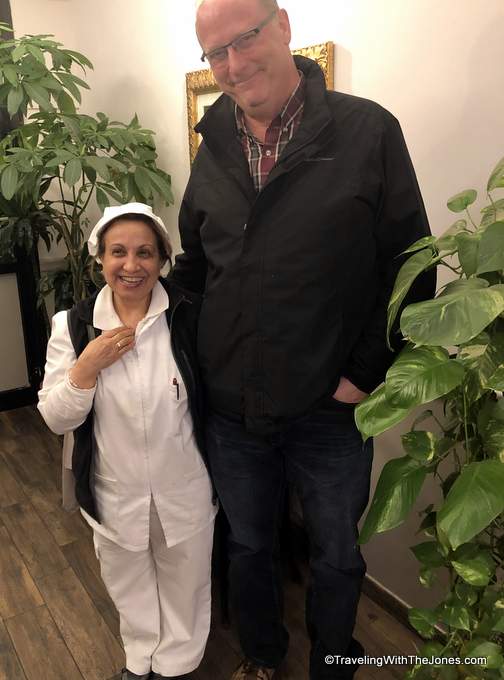
One of the owners, as well as the chief pasta maker, came out to greet our group. She wanted to take a photo with Mr. Jones (who is 6 feet, 6 inches or 2 meters tall.)
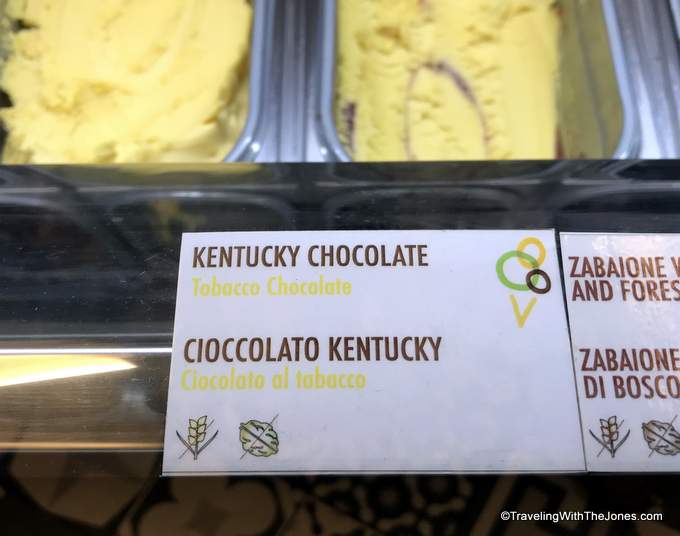
Our last stop was at a neighborhood gelateria offering a wide range of traditional and unique favors. (We skipped the “Kentucky Tobacco Chocolate” flavor, choosing instead scoops of Cioccolato, caffe and bacio (chocolate, coffee and hazelnut.)

Lusia taught our group a most helpful skill for visitors to Rome: How to spot and avoid from inferior quality gelato.

If you want to take this tour, click this link to book the 4-Hour Food Tour by Night in the Rome Prati neighborhood, offered through Get Your Guide.

Have you done a food tour in Rome? Or, in some other city around the world?

Ask us questions or share your experience with us via TwitterFacebookPinterest or Instagram

Check out these other posts on Rome:

{ 0 comments }
 Le Meridien Visconti Rome Hotel

We completed a three night stay at the Rome Visconti Le Meridien hotel during the first week of December.

The purpose of our stay was to spend a few days getting re-accquainted with Rome prior to our cruise — the 14-Day Premiere Voyage of Holland America’s newest ship, the Nieuw Statendam.

We chose the Le Meridien Visconti in part because we wanted to experience Rome’s Prati neighborhood where the hotel is located.

Check-in

We arrived from the airport an hour earlier than our requested check-in time. We checked our bags with the bell captain, and headed out for a Sunday morning walk around Rome.

After a long flight, we enjoyed the walk and first views of Rome.  After an hour we returned, and our room was ready as promised.   The front desk staff were friendly, helpful and professional throughout our stay.

Our Room — #0706 Terrace Suite

We used our Marriott Suite Night Awards to confirm an upgrade.   Five days before our arrival, we received email from the hotel confirming our upgrade to a suite.  

Upon arrival, we found the upgrade was to a top floor terrace suite, #0706.

Garden terrace on room 706,  Le Meridien Visconti Rome Hotel

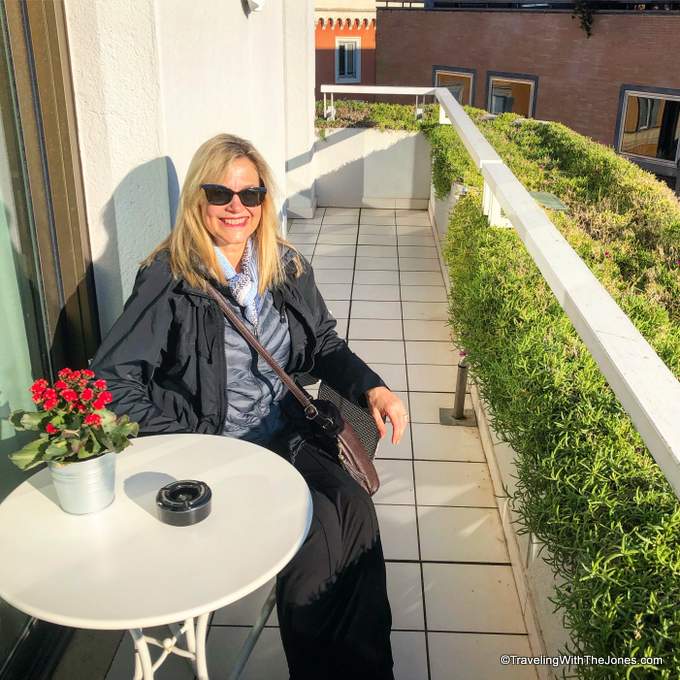
As we were lucky with sunny weather, we enjoyed and used the terrace throughout our stay.   

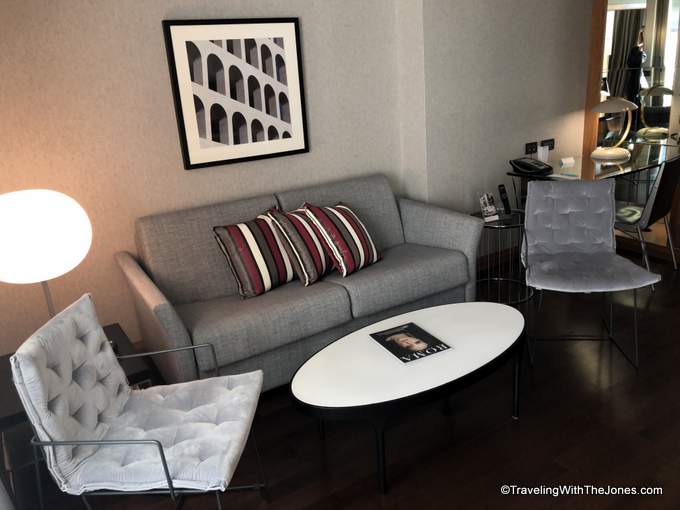
living room  #706,  Le Meridien Visconti Rome Hotel

The suite had a living room with a sliding door separating it from the bed room.

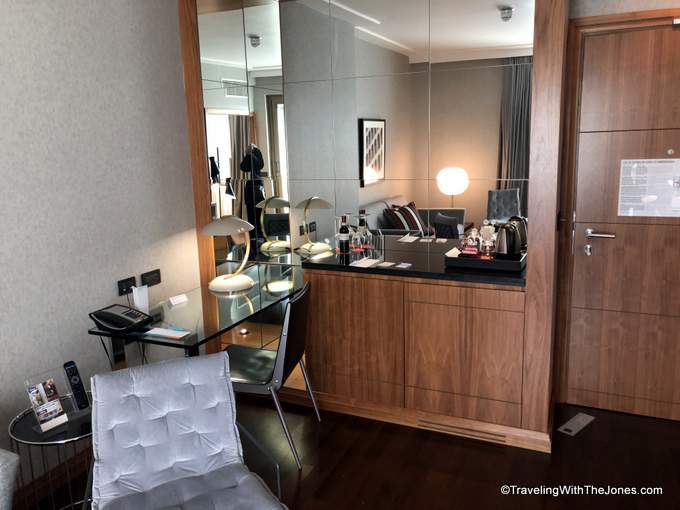
coffee/bar area in room  #706,  Le Meridien Visconti Rome Hotel

The living room also had desk and a coffee/bar area with a hidden refrigerator in room #706.

As both of us had a bit of jet lag this separate room was invaluable as it allowed one to get up and not disturb the other.

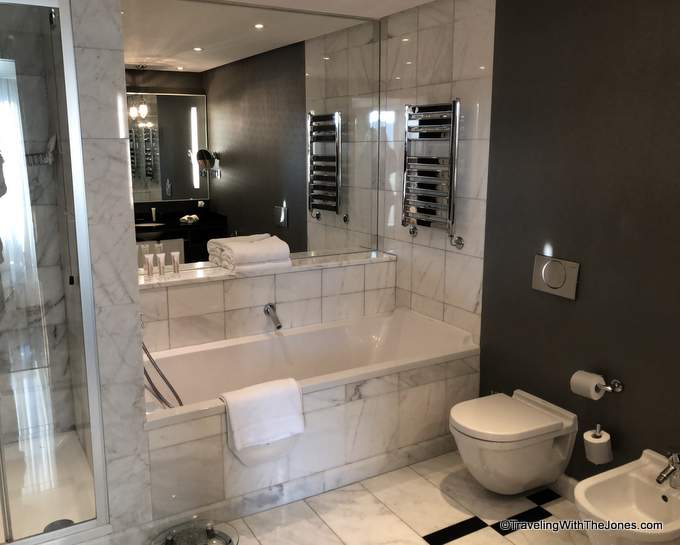
There was also a large marble-covered bathroom with a separate rain head shower and large tub.

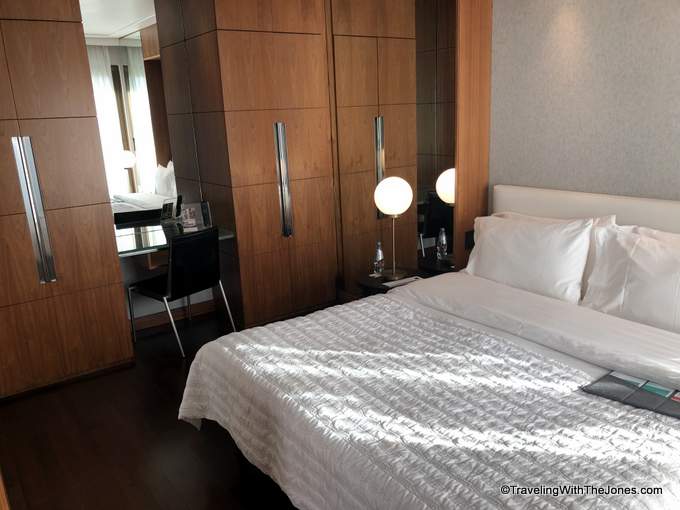
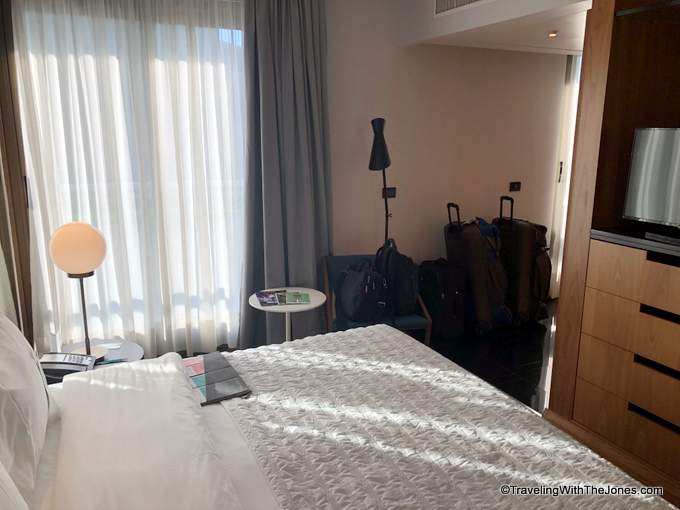
king bed, room #706,  Le Meridien Visconti Rome Hotel

The bedroom featured a king-size bed and ample storage.

bedroom #706,  Le Meridien Visconti Rome Hotel

The bedroom contained a second television, and access to the lovely terrace.

While we never saw them, the housekeeping service at the hotel was top-notch — always refreshing our room when we were out, including a nightly turn down service.

Breakfast

breakfast, Le Meridien Visconti Rome Hotel
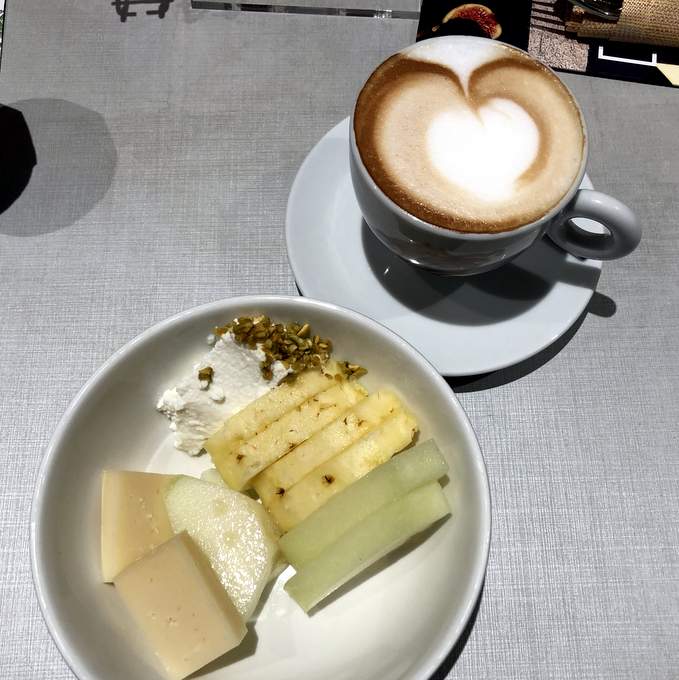
Breakfast cappuccino with fresh fruit and cheese at the Le Méridien Visconti Rome Hotel.

Some online reviewers of this hotel had commented that they disliked the layout of the breakfast area being in the basement.  We had no issue with the location as it was spacious and brightly lit. The breakfast selections were varied and tasty, and the service was good. 

Bar

We enjoyed a night cap at the bar and found the staff friendly and knowledgeable of the local wine selections.  We were also pleasantly surprised that the prices were reasonable for an upscale hotel bar.

The Neighborhood

We greatly enjoyed being in the Prati neighborhood.  We found it an easy walk to all the sights but removed from the tourist crowds.   There were plenty of local restaurants to choose from.

One of our favorite finds –right across the street from the hotel – was Kiarotti Wine, a small wine shop with hospitable staff.  Kiarotti serves wines by the glass with snacks, in addition to selling a nice selection of wines by the bottle.

Bottom Line

We had a great stay at the Le Meridien Visconti Rome Hotel and would recommend the hotel to others. When we return to Rome, this hotel would be our first choice to stay.

What’s your favorite hotel in Rome?

Share your thoughts with us via TwitterFacebookPinterest or Instagram

Check out these other posts on Rome:
{ 0 comments }

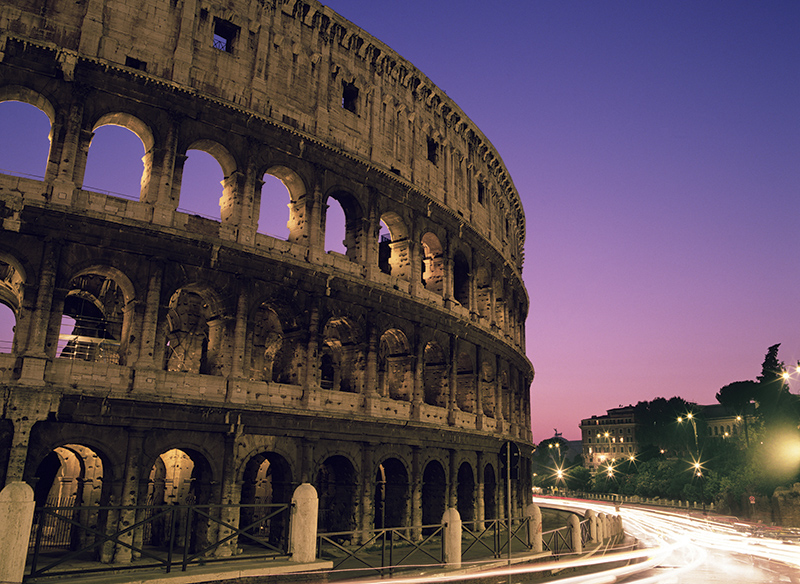
Italy, Rome, Coliseum, dusk We’re off to Rome for a few days before a cruise.

It’s not just any cruise.

14-Day Premier Cruise on Holland America Nieuw StatendamWe are excited to be sailing on the 14-Day Premiere Voyage of Holland America’s newest ship, the Nieuw Statendam.  The cruise is the very first voyage available for guests to experience the brand new ship.

We’ve never sailed on a ship’s maiden voyage before. Historically, we’ve thought it was better to wait until a new ship had at least a couple of sailings completed to work out any “bugs.”

Technically, the “Premeire” voyage is not the maiden voyage.  The Nieuw Statendam is sailing right now, from the shipyard outside of Venice to Rome, but with not with paying guests. Rather, Holland America employees are trying out the ship on a “shake-down” cruise to Rome, before the first customers board on December 5th.

We’ve enjoyed reading about all of the work that goes into launching a new ship via Captain Albert’s blog.

The itinerary from Rome to Ft. Lauderdale

The 14-day itinerary includes 10 sea days as the ship crosses the Atlantic Ocean, sailing from Europe to Ft. Lauderdale, Florida.

Date Port Arrival and Departure Times
Wednesday, December 5, 2018 Civitavecchia (Rome), Italy DEPART 5:00PM
Thursday, December 6, 2018 At Sea At Sea
Friday, December 7, 2018 Cartagena, Spain ARRIVE 8:00AM

DEPART 5:00PM

Saturday, December 8, 2018 Malaga, Spain ARRIVE 8:00AM

DEPART 6:00PM

Sunday, December 9, 2018 At Sea At Sea
Monday, December 10, 2018 Funchal (Madeira), Portugal ARRIVE 8:00AM

DEPART 5:00PM

Tuesday, December 11, 2018 At Sea At Sea
Wednesday, December 12, 2018 At Sea At Sea
Thursday, December 13, 2018 At Sea At Sea
Friday, December 14, 2018 At Sea At Sea
Saturday, December 15, 2018 At Sea At Sea
Sunday, December 16, 2018 At Sea At Sea
Monday, December 17, 2018 At Sea At Sea
Tuesday, December 18, 2018 Fort Lauderdale, Florida, US ARRIVE 11:59PM
Wednesday, December 19, 2018 Fort Lauderdale, Florida, US ARRIVE 6:00AM


We plan to post regular updates here, as internet access allows.  Check out our Instagram and Facebook pages for photo updates.

Will you be sailing with us?

Connect with us via TwitterFacebookPinterest or Instagram.

{ 0 comments }

15 Fun Facts to Know About Rome

For an upcoming pre-cruise stay in Rome, we did some research on the Eternal City.

An aerial view of Rome, Italy. Photo by Oliver-Bonjoch.

An aerial view of Rome, Italy. Photo by Oliver-Bonjoch.

1. Italy’s capital city, Rome is located in the central-western part of the Italian Peninsula along the shores of the Tiber River. The city is also the capital of Italy’s Lazio region.

2. Rome covers an area of nearly 500 square miles within its city limits and is home to 2.87 million residents. 4.3 million people live within the larger, suburban area called the “Metropolitan City of Rome.”

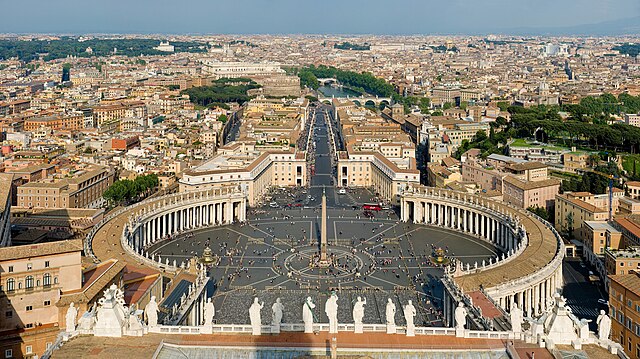
St Peter's Square, Vatican City. Photo by DAVID ILIFF.

St Peter’s Square, Vatican City. Photo by DAVID ILIFF.

3. Rome is often defined as the capital of two states. The reason: the world’s smallest independent country — Vatican City — is located inside Rome’s city limits, making it a country within a city.

4. Although there is archaeological evidence of humans living in the Rome area 14,000 years ago, Roman legend dates the city’s founding to 753 BC by Romulus.

Capitoline Wolf, sculpture of the mythical she-wolf suckling the infant twins Romulus and Remus. Photo by Carole Raddato.

Capitoline Wolf, sculpture of the mythical she-wolf suckling the infant twins Romulus and Remus. Photo by Carole Raddato.

5. According to the Roman story, Romulus and his twin brother Remus were raised by a she-wolf after being abandoned in the Tiber river. Eventually the brothers grew up and founded a new city. During a disagreement, Remus was killed. Romulus became ruler and named the city after himself: Rome.

Roman Colosseum. Photo by Alessandroferri.

Roman Colosseum. Photo by Alessandroferri.

6. Many football stadiums around the world today follow the oval design of the Roman Colosseum, built of travertine, tuff, and brick-faced concrete between 72 and 80 AD.  The Flavian Amphitheater  — as it was originally called — could hold up to 80,000 spectators watching gladiator fights and other public events.

7.  The initials “SPQR” —  still seen today throughout Rome  — stand for a Latin phrase: Senatus Populusque Romanus (The Senate and People of Rome) that refers to the government of the ancient Roman Republic.

8. Concrete was used extensively as a building material in Rome during the 700+ years between 300 BC to 476 AD.  Since it quickly hardened into a rigid mass, concrete enabled Roman builders to create complex structures with arches, vaults and domes. The Pantheon, for example, is the world’s largest unreinforced concrete dome, and it’s still in use more than 2000 years after its construction.

Dome of the Pantheon in Rome. Photo by Jean-Christophe Benoist.

Dome of the Pantheon in Rome. Photo by Jean-Christophe Benoist.

9. While concrete is often credited as to why Rome’s ancient structures still survive today, the building material disappeared with the fall of the Roman Empire. Between 500 AD and the 14th century, concrete was all but forgotten. It wasn’t until the latter part of the 14th century to the mid-18th century that the use of cement in structures and buildings gradually returned.

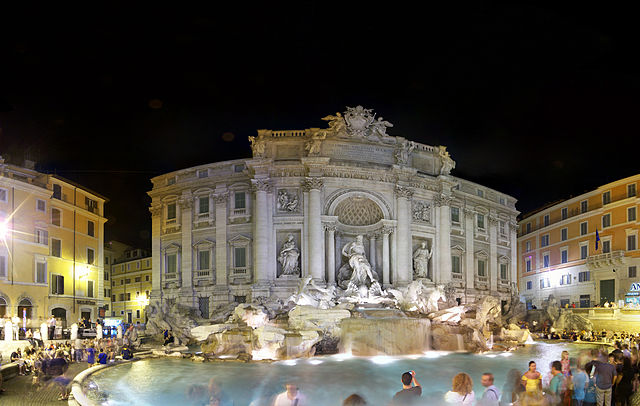
Trevi fountain at night. Photo by Wjh31

Trevi fountain at night. Photo by Wjh31

10. The Trevi Fountain — located at the junction of three roads — marks the end point of an aqueduct that supplied water to ancient Rome. Completed in 1762, the 86 ft high by 161 ft wide Baroque fountain was carved from Travertine stone, quarried about 22 miles east of Rome.


11.  According to legend, visitors who use their right arm to throw a coin backwards over their left shoulder into the Trevi Fountain will return to the Rome. This was the theme of the 1954 movie Three Coins In The Fountain.

12. Although he wasn’t credited, the Academy Award-winning song by the same name that introduced the movie was sung by Frank Sinatra.

13. Visitors to Rome are clearly embrace the Trevi legend; nearly $1.5 million dollars of change was thrown into the fountain in 2016. The city removes the  coins every night, averaging about 3,000 Euros. The money is donated to Caritas, a Catholic charity who uses it to provide services for needy families in Rome.

14. The famous “Scalina Spagna”, or Spanish Steps were actually built with French funds between 1721‑1725 in order to link the Bourbon Spanish embassy to the Holy See French church, Trinità dei Monti.  The steps consist of 138 steps placed in a mix of curves, straight flights, vistas and terraces.

15. A Rome law allows cats to live without disruption in the place where they were born. While hundreds of wild cats climb the walls of the Colosseum and sleep among the ruins of the Forum, the real cat sanctuary is at the Largo di Torre Argentina — the historic site where Julius Caesar was stabbed by his rival Brutus in 44 B.C.

Largo di Torre Argentina in Rome. Photo by Wknight94.

Largo di Torre Argentina in Rome. Photo by Wknight94.

When this archaeological wonder was excavated 1929as part of Mussolini’s rebuilding, Rome’s feral cats moved in, and the gattare, or cat ladies, began feeding and caring for them.

Today, volunteers at the Torre Argentina Cat Sanctuary care for approximately 130 cats, many of which are disabled or suffer from illness.

What fun fact can you add about Rome, Italy?

Interact with us via TwitterFacebookPinterest or Instagram.

Planning a visit to Rome? Check out these resources:

Rome: A History in Seven Sackings

DK Eyewitness Travel Guide Rome: 2018

{ 0 comments }